Provenance
Thannhauser Gallery, Berlin and Munich [based on sticker on reverse; see also Daulte 1959]; Mrs. Kate Jarrett, Forest Hills, New York, consignor of painting at the Justin K Thannhauser Gallery, New York, sometime between September 1941 and 1952 [according to stock files attached to letter from Janet Briner, Thannhauser archives]; painting sold but unknown to whom. Mr. and Mrs. J.W. Block, by January 1952 [according to handwritten note on stretcher]; Mrs. Leopold Block (died 1973), Chicago, by at least 1963 [lent to Chicago 1963; see receipt 18943, 10 Sept. 1963, for Chicago 1963 exh.]; by descent to her son and his wife, Joseph L. Block and Lucille Block, Chicago; given to the Art Institute, 1988.
Accession Number
73054
Medium
Oil on canvas
Dimensions
46.3 × 55.3 cm (18 3/16 × 21 3/4 in.)
Classification
oil on canvas
Credit Line
Gift of Lucille E. and Joseph L. Block
Background & Context
Background Story
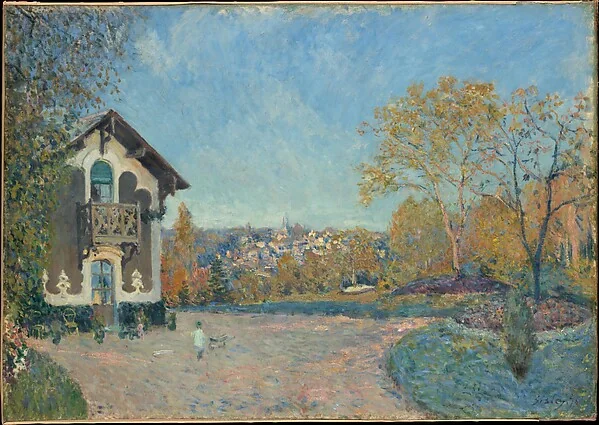
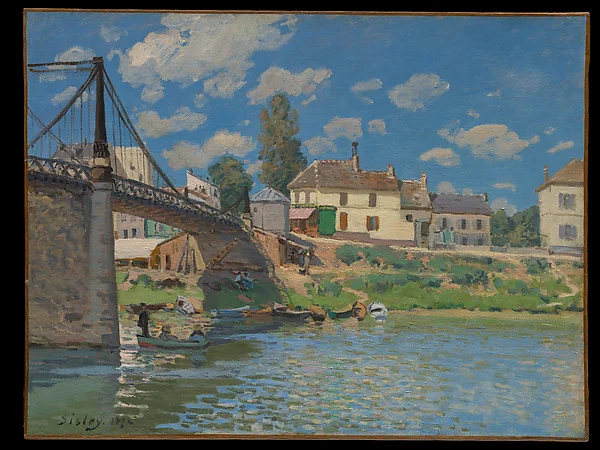
Alfred Sisley's "The Loire" (1896) is a late work from the final years of the artist's life, depicting the great river of central France with the gentle luminosity that defines his mature style. By 1896, Sisley was living in Moret-sur-Loing and had been traveling to capture the landscapes of the Loire region. This painting shows a broad expanse of river, its surface reflecting the sky, with trees and distant banks framing the composition. Sisley's handling of water was always one of his greatest strengths—he captures the reflections, the ripples, the subtle color shifts on the water's surface with extraordinary sensitivity. The palette is restrained but rich, with blues, greens, and soft earth tones held together by the unifying atmosphere that was Sisley's great gift. Unlike his earlier, more structured compositions, this late work shows a looser, more fluid touch, as if the artist had fully internalized his vision and could now paint with greater freedom. Sisley died in 1899, relatively poor and underappreciated, but his late landscapes, works of remarkable serenity, are today recognized as among the finest achievements of Impressionism.
Cultural Impact
Sisley's late river landscapes represent the culmination of his life's work, demonstrating a mastery of atmospheric effects that places him among the greatest landscape painters of the 19th century.
Why It Matters
This late Loire landscape shows Sisley at the peak of his powers, transforming a broad river into a meditation on light, reflection, and the quiet beauty of the French countryside.