Provenance
Collection Dussol; sold, Hôtel Drouot, Paris, March 17, 1884, lot 26 for 1,950 francs [according to La Chronique de la Curiosité 1884, and letter of November 13, 1987 from Stephen Hahn, in curatorial file]. Martin; his estate sale, Hôtel Drouot, Paris, April 4-7, 1892, lot 26 (ill.) for 1,800 francs [according to La Chronique de la Curiosité 1892, and letter cited above]. Théodore Duret [according to letter citied above and Fernier 1977]. E. Larcade, 1922 [lent to Paris 1922]. Collection Mlle Sée, Paris, until purchased jointly by Bernheim-Jeune, Paris and Paul Rosenberg & Co., Paris, on December 8, 1925 [Bernheim Jeune stock no. 24.513, information from letter of July 11, 2000 from Guy-Pactrice Dauberville, Bernheim-Jeune, in curatorial file]; sold by them to Alphonse Kann (died 1948), St. Germain-en-Laye and London on April 8, 1931 [according to Dauberville's letter cited above]; by descent to Michael Stewart, London; sold by him through Arthur Tooth, London, 1959 [information supplied by Madeleine Korn; see also Art News 1960 and Fernier 1977]. Alfred Daber Galerie, Paris by 1960 until at least 1975 [lent to Copenhagen 1960 and Paris 1975]. Stephen Hahn, New York by 1983; sold to the Art Institute, 1987.
Accession Number
93342
Medium
Oil on paper, mounted on canvas
Dimensions
63.5 × 77 cm (25 × 30 5/16 in.); Framed: 98.5 × 112.4 cm (38 3/4 × 44 1/4 in.)
Classification
oil on canvas
Credit Line
Gift of Joseph Winterbotham Collection
Background & Context
Background Story
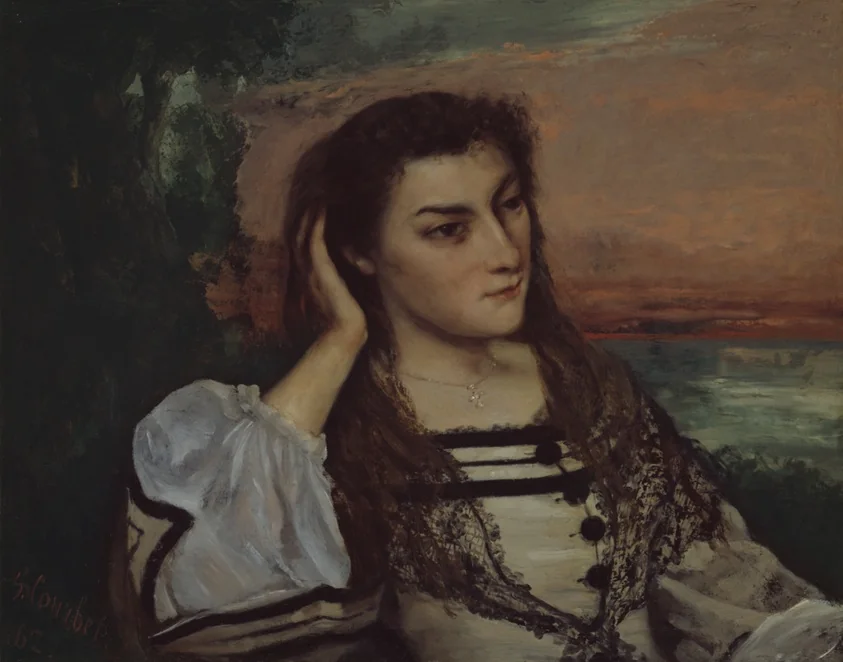
Gustave Courbet's "Rêverie (Portrait of Gabrielle Borreau)" (1862) is an oil on paper mounted on canvas, a portrait of a young woman in a state of dreamy contemplation. The title "Rêverie" (daydream) captures the mood of the painting: the sitter, Gabrielle Borreau, is lost in thought, her gaze directed inward, her expression soft and unfocused. Courbet's treatment is notable for its psychological intimacy: unlike the more formal portraits of the period, this painting captures a private moment, the sitter unaware of or indifferent to the viewer's gaze. The technique is relatively loose and fluid, the forms suggested with broad strokes of paint. The palette is warm and harmonious, with the flesh tones and the colors of the sitter's costume creating a unified, restful composition. The oil on paper mounted on canvas technique gives the painting a more spontaneous, sketch-like quality than Courbet's more finished works. This portrait reveals a more tender, intimate side of the artist known primarily for his monumental realist paintings and his powerful landscapes.
Cultural Impact
Courbet's portraits of women demonstrate the range of his artistic vision, showing that the master of realist monumentality was also capable of extraordinary intimacy and psychological sensitivity.
Why It Matters
This dreamy portrait of Gabrielle Borreau captures a moment of private reverie with remarkable tenderness, Courbet's loose handling and warm palette creating an image of quiet introspection.