Description
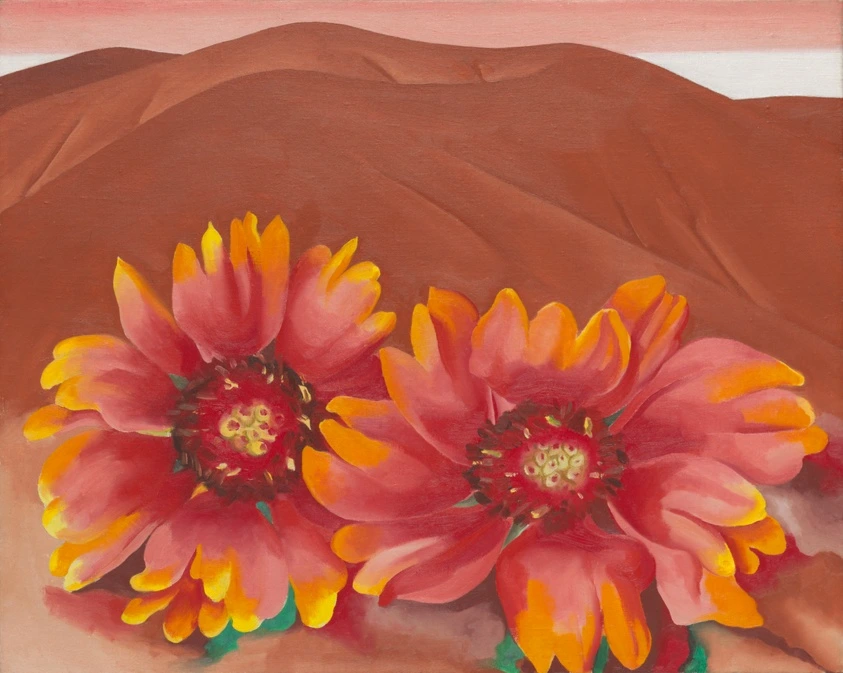
Fascinated by contrasts in scale, Georgia O’Keeffe frequently juxtaposed enlarged still-life elements with distant landscapes, as seen in Red Hills with Flowers, an image of vibrant blossoms magnified against the dry, steep hills surrounding her home in New Mexico. She admired the striking colors of the land, later equating them with artist paints: “All the earth colors of the painter’s palette are out there in the many miles of badlands. The light Naples yellow through the ochers—orange and red and purple earth—even the soft earth greens.”
Provenance
Georgia O’Keeffe (1887–1986), New York and NM, then Abiquiú, NM, from 1949; by exchange to Hortense Henry Prosser (1912–1992; born Hortense Henry; also Mrs. John Prosser), Lake Forest, IL, 1963 [Lynes 1999, vol. 1, 578, cat. 926; vol. 2, 825, cat. 1314]; through the Hortense Prosser Trust, Lake Forest, IL, 1992; bequeathed to the Art Institute of Chicago, 1992.
Accession Number
118577
Medium
Oil on canvas
Dimensions
50.8 × 63.5 cm (20 × 25 in.)
Classification
Painting
Credit Line
Bequest of Hortense Henry Prosser
Background & Context
Background Story
"Red Hills with Flowers" is one of Georgia O'Keeffe's most vibrant and characteristic paintings from her Ghost Ranch period, executed in 1937 during the years when she was establishing the visual vocabulary of the New Mexico landscape that would dominate her work for the next four decades. The composition shows the red hills of the high desert, their geological strata rendered in warm ochres, siennas, and vermilions that suggest both the mineral composition of the earth and the chromatic intensity of the desert sun. The flowers of the title appear as small, delicate accents against the massive geological forms, creating a scale relationship that emphasizes the grandeur of the landscape and the fragility of the life it supports. This contrast between monumentality and delicacy is central to O'Keeffe's mature style: she was simultaneously the painter of enormous flowers and vast landscapes, and her best works often combine these scales in ways that make the viewer reconsider their relationship to the natural world. The 1937 date places this work in the period of O'Keeffe's deepest engagement with New Mexico, after her permanent move from New York and before the international fame that would make her the most famous American woman artist of the twentieth century. The painting also reflects the influence of Precisionism, the American modernist movement that emphasized clean edges, smooth surfaces, and the geometry of industrial and natural forms. O'Keeffe's hills are precisionist in their clarity: every contour is sharp, every color area distinct, creating an image that feels both observed and designed. Art historians have connected this work to the broader tradition of American regionalism, particularly the Southwestern paintings of Marsden Hartley and the New Mexico watercolors of John Marin, noting that O'Keeffe's treatment is more monumental, more focused on the enduring forms of the landscape rather than its transient effects.
Cultural Impact
This 1937 Ghost Ranch painting combined Precisionist clarity with monumental Southwestern geology, using red-hill warmth and delicate floral scale contrast to establish O'Keeffe's four-decade New Mexico vocabulary.
Why It Matters
It matters because O'Keeffe painted red hills and made them look like they had been waiting for her—proving that even desert stone could feel personal if the color was honest enough.