Red Hills with Flowers

Description

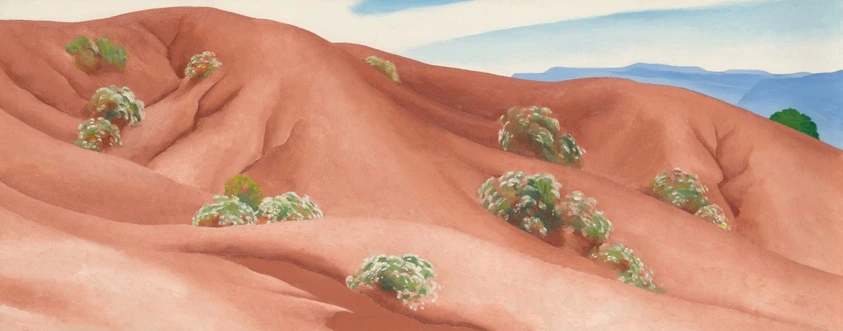
Georgia O’Keeffe frequently explored the Southwestern landscape in search of noteworthy views, and in the summer of 1940, she found an inspiring sight: “The places you can go on a horse here always astonish me . . . the most exciting was being on top of a ridge of red hills and seeing the blue flat topped mountains above them—it was very good.” She painted Red Hills with Flowers a month later, depicting bushes of small white flowers growing from the eroded gullies of the red badland, with the blue mesa barely visible to the right. O’Keeffe housed it in a thin strip frame made of a silver metal that she had partially plated with copper to complement the composition’s color scheme.

Provenance

Georgia O’Keeffe (1887–1986), New York and New Mexico, then Abiquiu, NM, from 1949; consigned to Gerald Peters Gallery, Santa Fe, 1985 [this and the following according to email from Gerald Peters Gallery, Jan. 28, 2022; copy in curatorial object file]; sold to Jack Warner (1917-2017), Tuscaloosa, AL, 1985; consigned to Gerald Peters Gallery, Santa Fe, 1996; sold to Mary P. Hines (1931–2020; born Mary Pick), Winnetka, IL, 1997; bequeathed to the Art Institute of Chicago, 2022.

Red Hills with Flowers

Georgia O'Keeffe

1940

Accession Number

263225

Medium

Oil on canvas

Dimensions

30.5 × 76.5 cm (12 × 30 1/8 in.)

Classification

Painting

Museum

The Art Institute of Chicago

Chicago, United States

Credit Line

Bequest of Mary P. Hines
Background & Context

Background Story

"Red Hills with Flowers" is a 1940 oil on canvas by Georgia O'Keeffe that captures the American modernist painter in her most luminously abstracted and intimately grand mode, the image showing red hills with wildflowers rendered with the same sweeping简化 and coloristic intensity that made her the defining painter of the American Southwest. The composition is a medium-sized canvas—30.5 × 76.5 centimeters—showing red hills with flowers with the oil on canvas creating a surface of extraordinary warmth and landscape abstraction. The horizontal format enhances the sense of panoramic expanse and geological grandeur, the painting becoming a meditation on the relationship between human vision and natural immensity. The 1940 date places this work in the period of O'Keeffe's most intensive production of Southwestern landscapes and her establishment as the leading painter of the American modernist movement. Art historians have connected this painting to the broader tradition of the American landscape, from the paintings of Church to the abstractions of the contemporary period, noting that O'Keeffe's treatment is more focused on the coloristic intensity and the sweeping simplification, the transformation of observed nature into chromatic vision, than the topographical accuracy or the sublime terror of these other traditions.

Cultural Impact

This 1940 oil canvas made red hills luminously abstracted through medium 30cm panoramic warmth and sweeping Southwestern simplification, using intensive landscape production to transform geological grandeur into chromatic vision beyond Church topographical sublime terror.

Why It Matters

It matters because O'Keeffe painted some hills and flowers and made the canvas feel like it was breathing with the quiet power of a land that doesn't need to explain itself—proving that even dirt could be beautiful if the red was honest enough.