Provenance
Daniel-Henry Kahnweiler (1884-1979), Paris, 1939. Karl Nierendorf (1889-1947), New York, about 1939. Bertrand Goldberg (died 1997), Chicago [according to the Paul Klee Foundation]. Sold by Katherine Kuh, Chicago, to the Art Institute, 1946.
Accession Number
55400
Medium
Watercolor and pen and brown ink, over graphite, on off-white wove paper, tipped on ivory wove paper
Dimensions
Max: 29.4 × 20.9 cm (11 5/8 × 8 1/4 in.)
Classification
watercolor
Credit Line
Gift of Mr. and Mrs. Walter P. Paepcke
Background & Context
Background Story
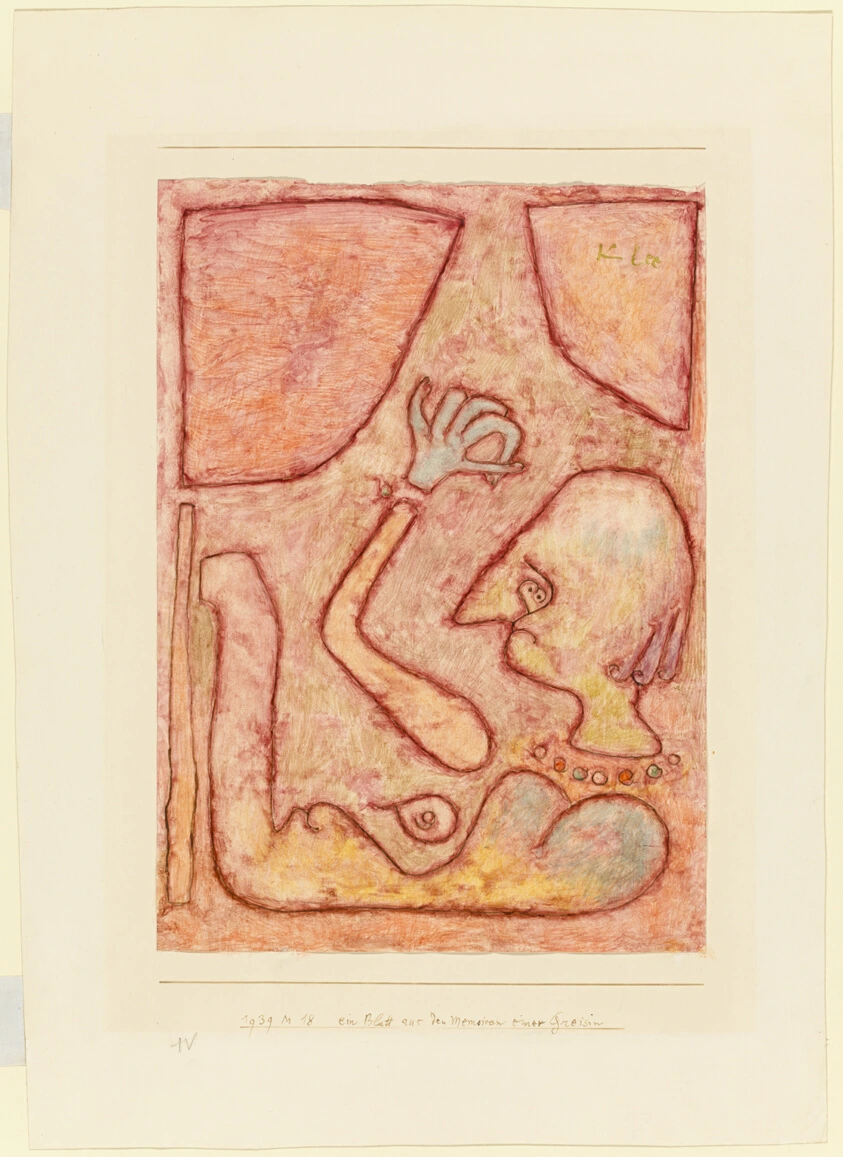
"Leaf from the Memoirs of an Old Woman" is one of Paul Klee's most poignant late watercolors, executed in 1939 during the final year of his life when he was suffering from the scleroderma that would kill him and was producing work of extraordinary delicacy and emotional depth despite his physical decline. The composition shows abstract or semi-figurative forms that suggest the memory and experience of old age without illustrating it directly, the title providing a narrative frame that the image itself refuses to fill with literal detail. The medium of watercolor and pen and brown ink over graphite on off-white wove paper tipped on ivory wove paper is extraordinarily complex, the layered supports creating a surface that feels both fragile and precious, like an ancient manuscript or a pressed flower. This material delicacy is appropriate to the subject: the "memoirs" of the title suggest a life distilled into essential moments, and the watercolor medium, with its capacity for transparency and layered accumulation, is ideally suited to this metaphor of memory as translucent overlay. The brown ink lines are fine and searching, the marks of a hand that knows it has limited time and wants to leave a trace of its passage. Art historians have connected this work to the broader tradition of the artist's late style, from Titian's dark final paintings to Monet's water lily series, noting that Klee's late watercolors share the same intensity of condensed experience. The 1939 date also places the work in the shadow of the Second World War: Klee was living in Switzerland, separated from his native Germany by the Nazi regime that had labeled him a "degenerate artist," and the image of the old woman's memories may carry the weight of exile and loss.
Cultural Impact
This 1939 late watercolor distilled old-age memory into layered translucent fragility, using complex tipped-paper support to create precious manuscript-like delicacy under the shadow of war and illness.
Why It Matters
It matters because Klee painted an old woman's memories while his own body was failing—proving that even the last leaf could be pressed between pages and kept forever.