Accession Number
82302
Medium
Watercolor and brush and black ink, over graphite, on white wove paper
Dimensions
34.2 × 45.8 cm (13 1/2 × 18 1/16 in.)
Classification
pen and ink drawings
Credit Line
Gift of James W. Alsdorf
Background & Context
Background Story
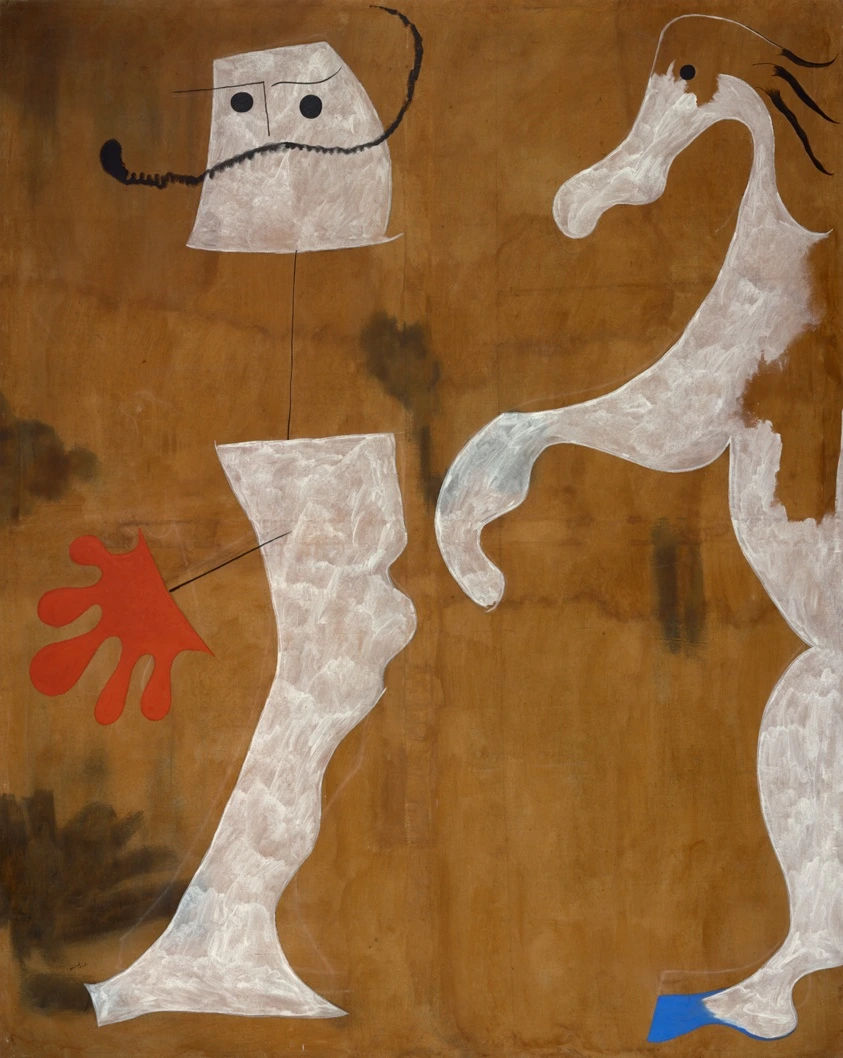
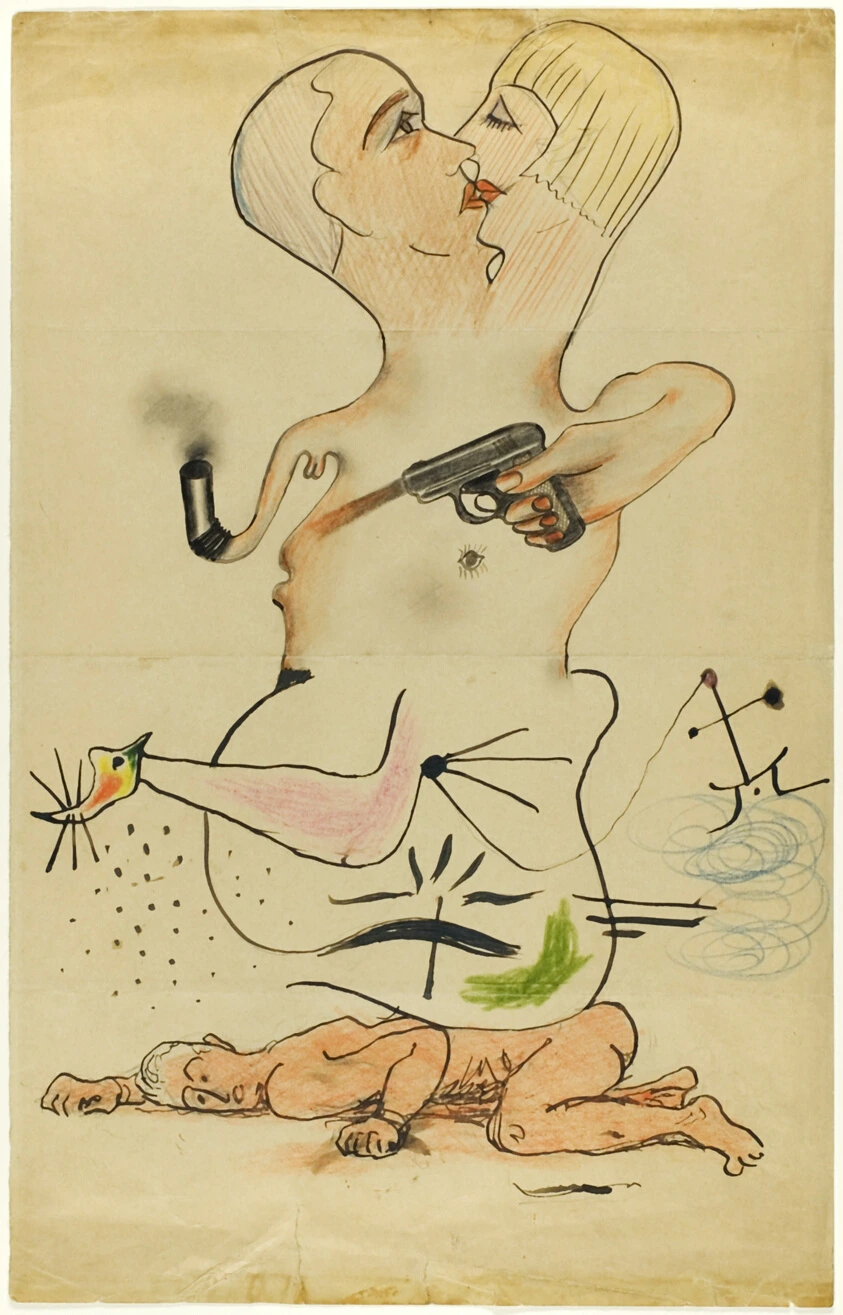
"Composition with Figures" is a 1935 watercolor that exemplifies Miró's Surrealist exploration of biomorphic abstraction, showing a field of floating signs that suggest human and animal presences without ever resolving into identifiable subjects. The composition is built on white wove paper with watercolor and black ink over graphite, the fluid medium allowing rapid transitions between drawing and painting that correspond to the automatic techniques championed by André Breton. The "figures" of the title are barely distinguishable from the surrounding space: a curved line might be an arm or a branch, a dot might be an eye or a star, and the viewer is invited to participate in the hallucinatory process of finding meaning in ambiguity. This openness is what distinguishes Miró from the more programmatic Surrealism of Dalí or Magritte: he does not illustrate the unconscious but provides triggers for the viewer's own unconscious associations. The 1935 date places the work in the most intense period of Miró's Surrealist engagement, when he was producing the proto-abstract canvases that would influence Abstract Expressionism and Color Field painting. The medium of watercolor and ink on paper was ideally suited to his improvisational method: unlike oil on canvas, which demands commitment and correction, watercolor allows the artist to follow the first impulse without revision. Art historians have connected this work to Miró's "sign" vocabulary of the 1930s, in which recurring motifs—stars, eyes, moons, birds—functioned as a private hieroglyphic language. The painting also documents the political context of 1935: the Spanish Civil War was imminent, and the violent undertones of Miró's imagery can be read as premonitions of the catastrophe to come.
Cultural Impact
This 1935 watercolor used automatic ink and wash to create a private hieroglyphic language, influencing Abstract Expressionism through its open biomorphic ambiguity and premonitory political tension.
Why It Matters
It matters because Miró drew figures that refused to be people—proving that a line could be an arm, a bird, or a scream depending on who was looking.