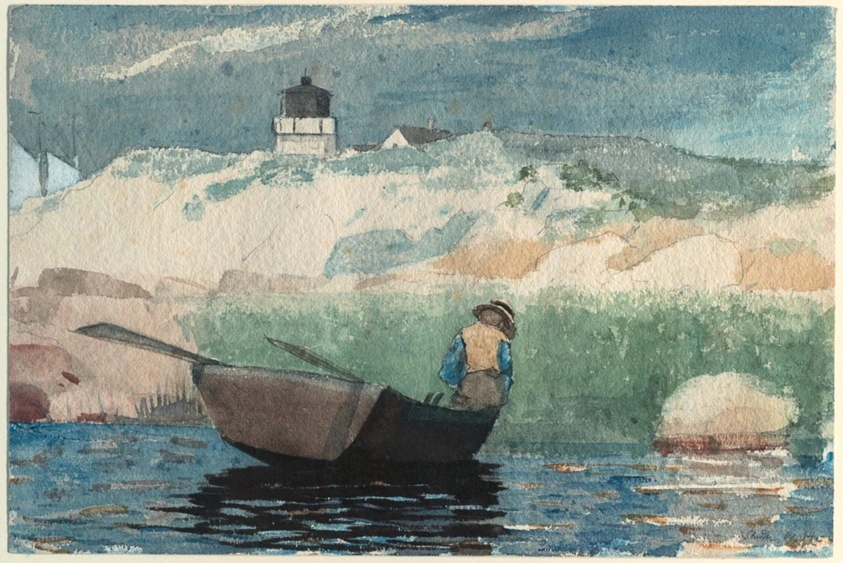
Boy in Boat, Gloucester

Description

Homer began Boy in Boat, Gloucester while staying at the lighthouse on Ten Pound Island in the harbor of the fishing town Gloucester, Massachusetts. During his time in Gloucester, the artist frequently depicted local boys playing on boats, fishing, and waiting for their fathers to return from the sea. In this watercolor he began experimenting with scraping, revealing the white of the paper to create highlights in the large rock at right. Furthermore, he was developing his skill in transparent watercolor, which he used to great effect for the reflective surface of the water.

Provenance

The artist to his brother, Charles S. Homer, Jr. (1834–1917), New York, by 1910 [according to correspondence from Abigail Booth Gerdts to the Art Institute, February 10, 2007]. Charles W. Gould (1849–1931), New York, by 1915 [Brooklyn exh. cat. 1915]. Sold by Knoedler and Company, New York, Martin A. Ryerson (1856–1932), Chicago, November 11, 1915 [invoice]; given to the Art Institute, 1933.

Boy in Boat, Gloucester

Winslow Homer

1880/81

Accession Number

16800

Medium

Transparent watercolor, with touches of opaque watercolor and scraping, over graphite, on moderately thick, rough-textured, ivory wove paper

Dimensions

23.2 × 34.9 cm (9 3/16 × 13 3/4 in.)

Classification

watercolor

Museum

The Art Institute of Chicago

Chicago, United States

Credit Line

Mr. and Mrs. Martin A. Ryerson Collection
Background & Context

Background Story

Winslow Homer's Boy in Boat, Gloucester shows a boy in a boat in the harbor of Gloucester, Massachusetts, a fishing port that Homer painted frequently. This watercolor captures the light and atmosphere of the New England coast.

Cultural Impact

Homer's Gloucester watercolors are among the finest American works in the medium.

Why It Matters

This boy in a boat captures the beauty of the New England coast.