Accession Number
32749
Medium
Watercolor and brush and black ink, with black and brown Conté crayon, on off-white wove paper, laid down on white wove paper
Dimensions
44 × 27.8 cm (17 3/8 × 11 in.)
Classification
watercolor
Credit Line
Gift of Dr. and Mrs. Gerhard D. Straus in memory of Mr. and Mrs. Jacob A. Martin
Background & Context
Background Story
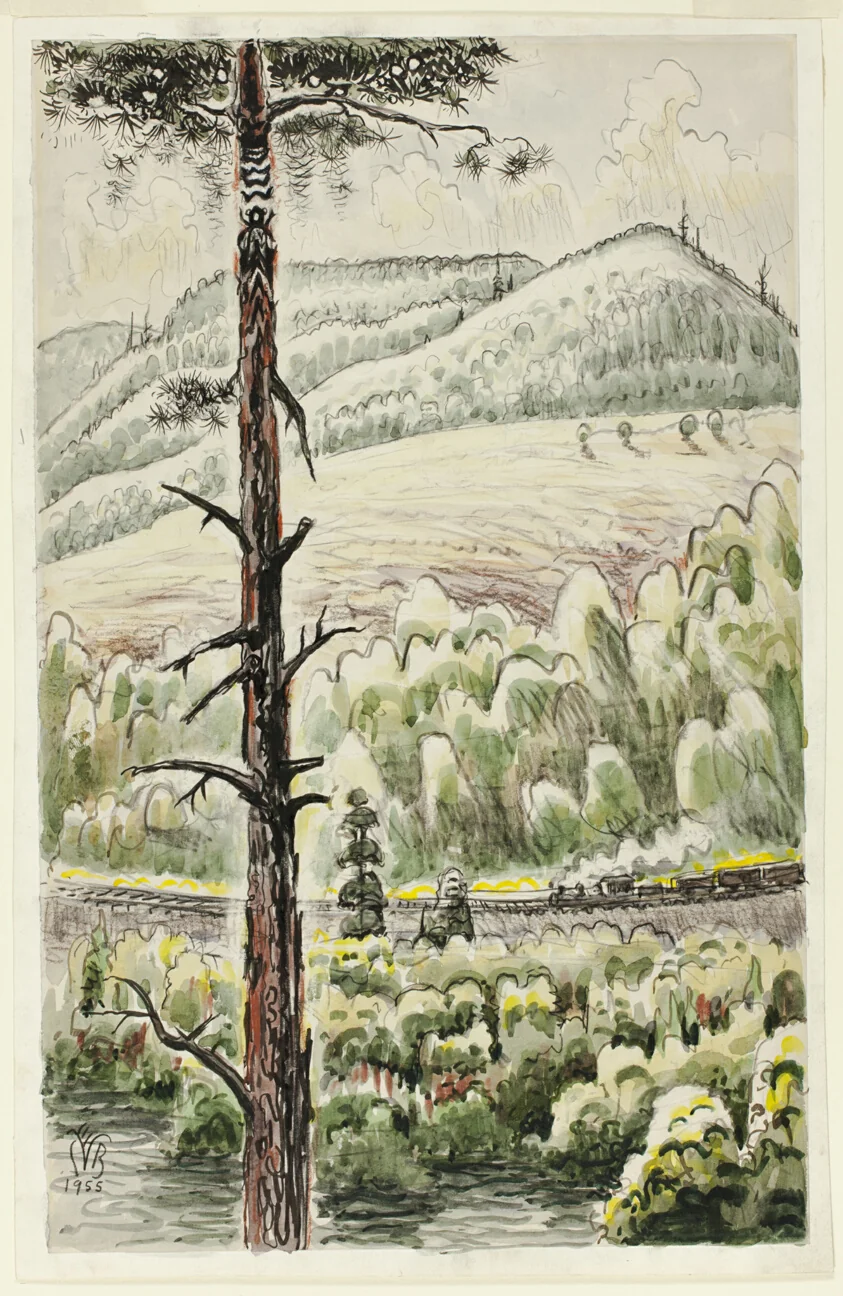
"Midsummer in the Alleghenies" is a 1955 watercolor by Charles Ephraim Burchfield that captures the American visionary painter in his most exuberant and celebratory mode, the image showing the Pennsylvania mountains in the fullness of summer with a verdant intensity that suggests both the observed reality of the landscape and the transcendent vision of the artist's imagination. The composition is a vertical format, the trees and vegetation rendered with the watercolor, ink, and crayon on off-white paper that create a surface of extraordinary texture and tonal variety, the greens and browns of the midsummer forest creating an atmosphere of growth and abundance. The 1955 date places this work in the period of Burchfield's late maturity, when he was producing the watercolors that consolidated his reputation as the leading visionary artist in America and the heir to the Romantic tradition of Emerson and Thoreau. Art historians have connected this painting to the broader tradition of the American pastoral, from the Hudson River School to the regionalist landscapes of the 1930s, noting that Burchfield's treatment is more intense, more focused on the emotional and spiritual experience of the landscape than the topographical accuracy or the nostalgic idealization of these other traditions. The work also demonstrates Burchfield's mastery of mixed media: the combination of watercolor, ink, and crayon creates a surface of extraordinary visual interest that suggests both the physical texture of the vegetation and the atmospheric effects of light and shadow.
Cultural Impact
This 1955 watercolor made Allegheny midsummer exuberantly transcendent through vertical verdant texture-variety and off-white paper tonal richness, using late-mature visionary intensity to transform Pennsylvania forest into Emersonian spiritual abundance beyond Hudson River topographical accuracy.
Why It Matters
It matters because Burchfield painted summer in the mountains and made the paper feel like it was photosynthesizing—proving that even a forest could sing if the green was loud enough.


