Accession Number
41861
Medium
Watercolor over graphite on heavy textured cream wove watercolor paper, laid down on cardboard and varnished
Dimensions
73.9 × 59.6 cm (29 1/8 × 23 1/2 in.)
Classification
watercolor
Credit Line
Watson F. Blair Purchase Prize and the Olivia Shaler Swan Memorial Collection
Background & Context
Background Story
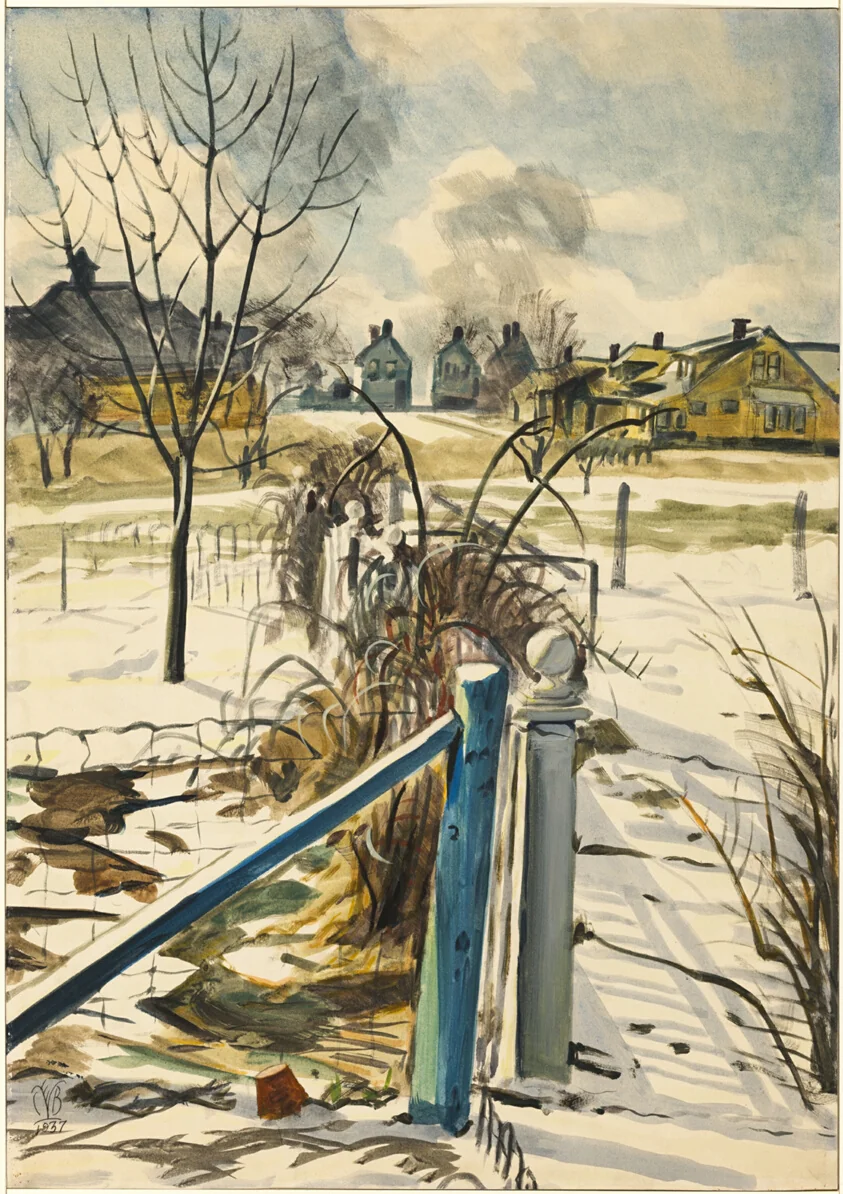
"House of Mystery" is a 1924 watercolor by Charles Ephraim Burchfield that captures the American visionary painter in his most haunted and evocative mode, the image showing a house rendered with the same attention to architectural detail and emotional atmosphere that Burchfield brought to all his subjects, but transformed by the title and the treatment into something mysterious and unsettling. The composition is a vertical format, the house depicted in a wooded setting with the watercolor over graphite on heavy textured paper creating a surface of extraordinary depth and shadow, the colors muted and somber—the browns, greys, and dark greens of a twilight world that suggests both the physical reality of the abandoned house and the psychological atmosphere of fear and curiosity. The 1924 date places this work in the period of Burchfield's early maturity, when he was producing the watercolors that established his reputation as a visionary artist and the heir to the American Romantic tradition. Art historians have connected this painting to the broader tradition of the haunted house in American art and literature, from the Gothic mansions of the nineteenth century to the suburban anxieties of the twentieth, noting that Burchfield's treatment is more naturalistic, more focused on the observed reality of the house and its setting than the supernatural or the symbolic content of these other traditions. The work also demonstrates Burchfield's mastery of watercolor as a medium for creating atmosphere: the layered washes and the textured paper create a surface that suggests both the physical decay of the house and the emotional weight of its mystery.
Cultural Impact
This 1924 watercolor made abandoned house mysteriously atmospheric through heavy-textured-paper graphite-wash layered depth and muted twilight brown-grey-green palette, using early-mature visionary naturalism to transform Gothic architectural observation into psychological curiosity beyond supernatural symbolism.
Why It Matters
It matters because Burchfield painted a house and made the paper feel like it was keeping secrets—proving that even a building could be a mystery if the shadows were deep enough.