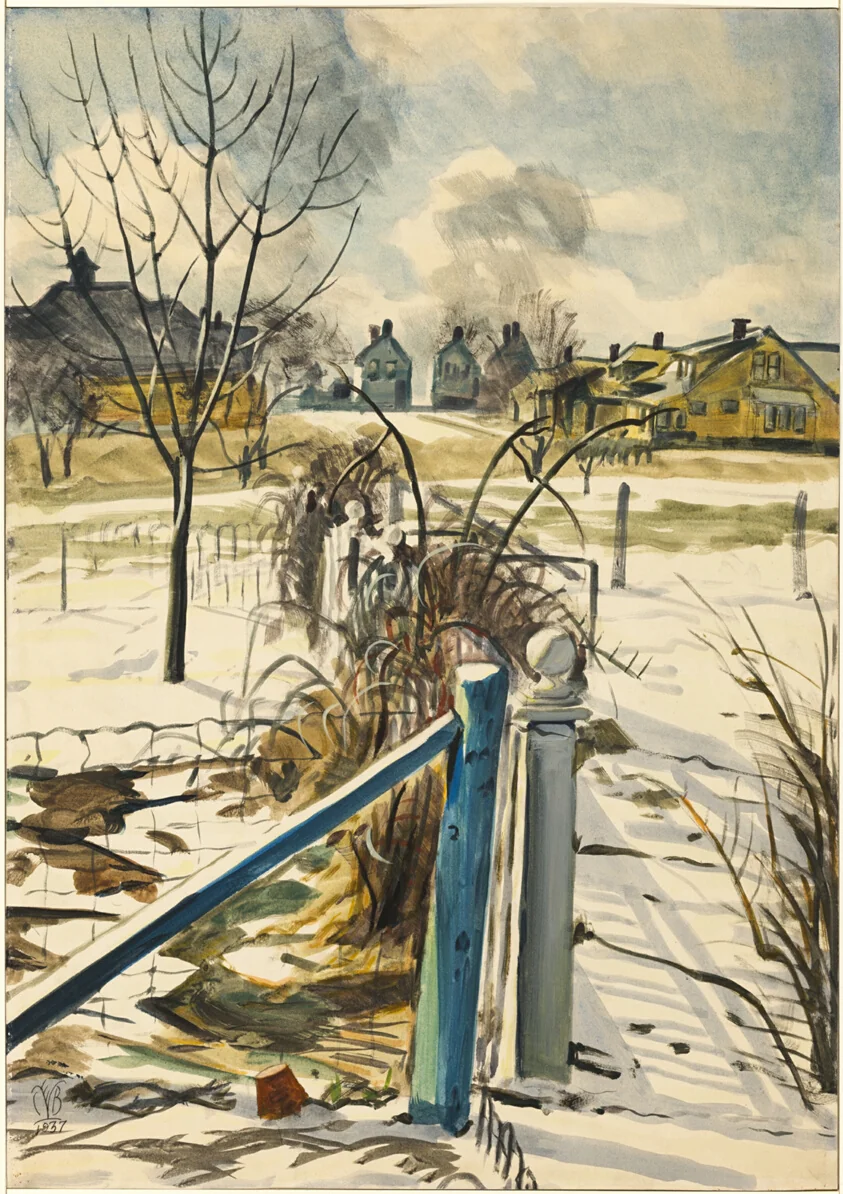
Two Fence Posts

Description

Charles Burchfield received his artistic training at the Cleveland Institute of Art, where he was exposed to Asian art, including Chinese painting and Japanese prints. An inspired practitioner of watercolor, his work focused on the natural world and the effects of industrialization on small-town America. According to Burchfield’s friend Edward Hopper, “The work of Charles Burchfield is most decidedly founded, not on art, but on life, and the life that he knows and loves best.” The artist kept many sketchbooks and journals; an excerpt from one of these has been linked to Two Fence Posts: “Give effect of light coming from above—blend as mass to lighter & finally have only an outline of mass, which itself thins out toward the light.”

Provenance

Sold by Frank K. M. Rehn Gallery, New York, to the Art Institute of Chicago, 1937.

Two Fence Posts

Charles Ephraim Burchfield

1937

Accession Number

25983

Medium

Watercolor, with gouache and traces of charcoal on cream wove paper, laid down on gray wood-pulp laminate board

Dimensions

67.8 × 47.5 cm (26 3/4 × 18 3/4 in.)

Classification

watercolor

Museum

The Art Institute of Chicago

Chicago, United States

Credit Line

Olivia Shaler Swan Memorial Collection

Background & Context

Background Story

Charles Ephraim Burchfields Two Fence Posts from 1937 transforms the most mundane of rural subjects into a site of haunting psychological intensity. Two weathered fence posts stand against a sky that seems to press down upon them with an almost palpable weight, their surfaces rendered with a tactile specificity that makes the grain and weathering of the wood feel physically present. Burchfield spent his entire career in the rural towns of Ohio and western New York, painting the weather, the seasons, and the man-made structures that mark the boundary between cultivated land and wilderness. In Two Fence Posts, the watercolor and gouache medium allows him to build the sky in layers of wet-on-wet wash that suggest impending weather, while the fence posts themselves are rendered with a dry-brush precision that contrasts with the atmospheric background. The gouache additions create opaque highlights that model the posts three-dimensionally, giving them a sculptural presence that belies their modest function as boundary markers. Burchfields best work finds the numinous in the ordinary, and these two fence posts, standing sentinel at the edge of a field under a brooding sky, become emblems of endurance against forces larger than themselves.

Cultural Impact

Burchfield is now recognized as one of the most original American watercolorists of the 20th century, combining the precision of naturalist observation with the emotional intensity of Expressionism. His influence extends to contemporary artists who seek to find the spiritual dimension in ordinary American landscapes and the weather that shapes them.

Why It Matters

A haunting watercolor by Burchfield that transforms two fence posts into emblems of endurance under a brooding sky, demonstrating his unique ability to find psychological intensity in the most ordinary rural subjects.