Description
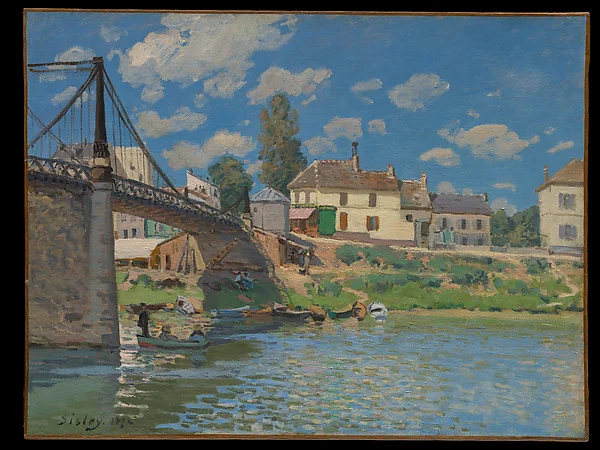
Of all the landscapes Alfred Sisley painted in and around Marly-le-Roi, where he lived from 1875 to 1878, this scene of workers dredging sand to facilitate barge traffic is perhaps the most original. Generally, the Impressionists showed the Seine River as a place of weekend leisure for Parisians, painting activities such as boating, yachting, promenading, and dining. Sisley depicted the river during the workweek, along with some of the men who depended on it for their livelihood.
Provenance
Georges Viau, Paris; his sale, Galeries Durand-Ruel, March 4, 1907, lot 74 (ill.), as La Seine à Port-Marly, 1875; bought in by Durand-Ruel [acc. to London 1992]. Georges Bernheim, Paris, April 1920 [acc. to archival Registrar card]; Martin A. Ryerson (died 1932), Chicago, June 11, 1920 [acc. to Ryerson purchase book; copy in curatorial object file]; bequeathed to the Art Institute, 1933.
Accession Number
16633
Medium
Oil on canvas
Dimensions
54.5 × 73.7 cm (21 7/16 × 29 in.); Framed: 71.5 × 90.5 × 9.6 cm (28 1/8 × 35 5/8 × 3 3/4 in.)
Classification
oil on canvas
Credit Line
Mr. and Mrs. Martin A. Ryerson Collection
Background & Context
Background Story
"The Seine at Port-Marly, Piles of Sand" is an 1875 oil on canvas by Alfred Sisley that demonstrates the British-French Impressionist's engagement with the industrial and commercial activities that coexisted with the pastoral beauty of the Impressionist landscape, the image showing the river with piles of sand that suggest both the economic life of the region and the natural materials that shaped the Impressionist palette. The composition is a horizontal view of the river, the sand piles rendered with the same attention to light and atmosphere that Sisley brought to the trees and water, the industrial subject transformed by the artist's vision into something as beautiful and serene as the natural landscape. The 1875 date places this work in the same period as "Watering Place at Marly," suggesting that Sisley was systematically exploring the possibilities of the Marly and Port-Marly landscape, each painting offering a different aspect of the Seine and its surroundings. Art historians have connected this painting to the broader tradition of the industrial landscape in Impressionism, from the railway stations of Monet to the construction sites of Caillebotte, noting that Sisley's treatment is more integrated, more focused on the harmony between the industrial and the natural than the dramatic contrast or the social observation of these other traditions.
Cultural Impact
This 1875 oil canvas harmonized industrial sand-piles with pastoral Seine serenity, using simultaneous Marly exploration to transform commercial-economic subject into light-atmosphere beauty integrated with landscape rather than socially contrasting it.
Why It Matters
It matters because Sisley painted piles of sand by a river and made them look like they belonged to the sunset—proving that even industry could be beautiful if the light was forgiving enough.