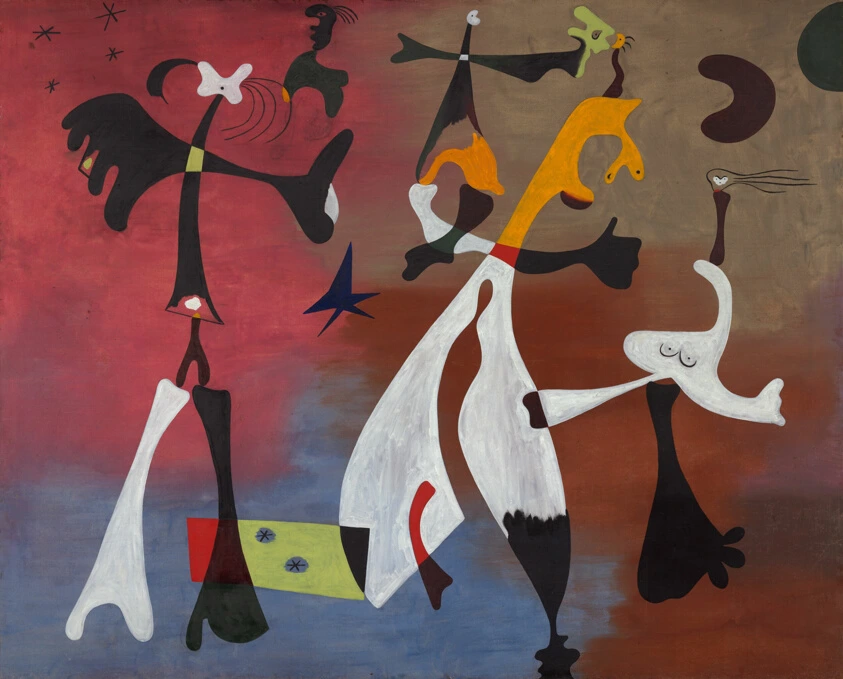
Painting (Figures with Stars)

Description

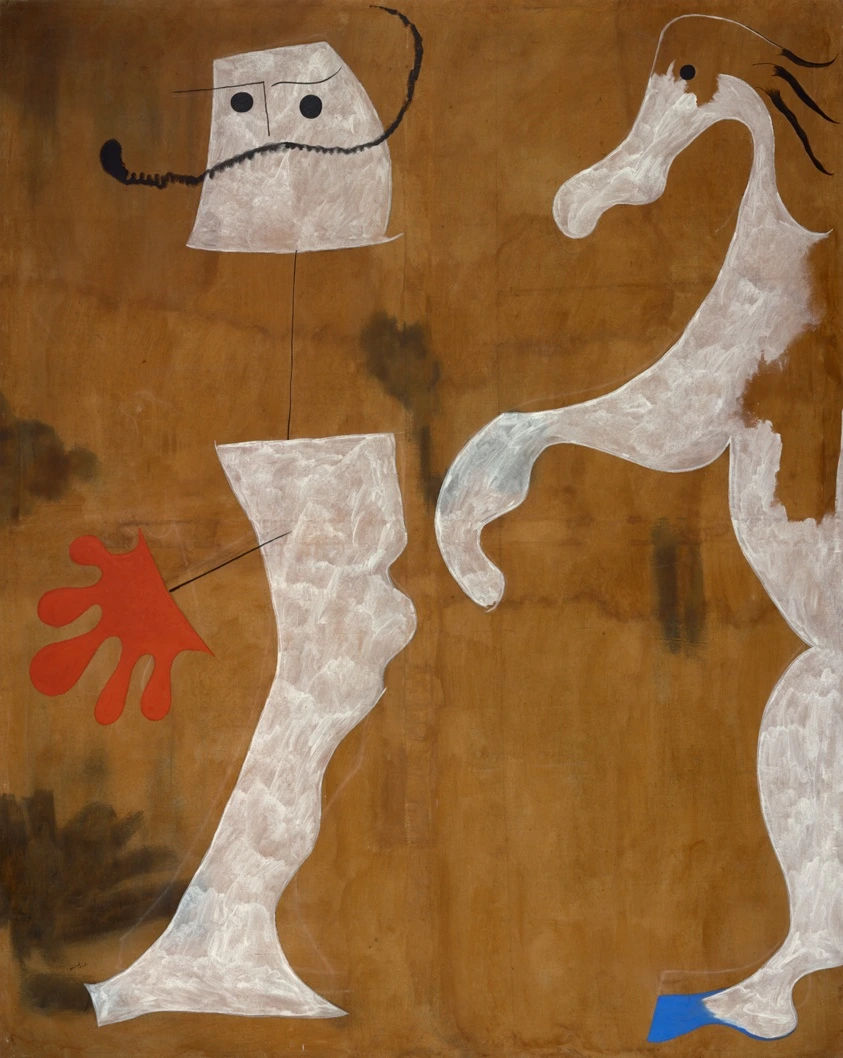
The "personages" we see here—organic figures with tiny heads, disjointed appendages, and schematic breasts—reflect the experimentation across media for which Joan Miró is best known. First in his Barcelona studio in 1933, the artist made a series of small paper collages from precisely rendered engravings of household and mechanical objects. Then, he translated these compositions into large abstract paintings, with multicolored, amorphous forms rendered in silhouette. Inspired by this series, Miró derived Paintings (Figures with Stars) as a cartoon, or full-scale preparatory work, for a tapestry commissioned by French art collector and gallery director Marie Cuttoli, effecting yet another material transformation of his original design from collage to painting to textile.

Provenance

The artist; commissioned by Marie Cuttoli, Paris, 1933 [commissioned as a tapestry design to be executed by a workshop in Aubusson, France for sale in her Paris gallery; New York 1993, London 2007]; returned to the artist for re-touching, by Dec. 14, 1951 [letter from Aimé Maeght to Pierre Matisse, Dec. 14, 1951, Pierre Matisse Gallery Archives, The Morgan Library & Museum; letter from Pierre Matisse to Courtney Donnell, Oct. 26, 1976; copies in curatorial object file]; sold to Pierre Matisse Gallery, New York, by Mar. 1952 [Aimé Maeght facilitated this sale, according to letter from Aimé Maeght to Pierre Matisse, Feb. 15, 1952, Pierre Matisse Gallery Archives, The Morgan Library & Museum; copy in curatorial file]; sold to Mr. and Mrs. Maurice E. Culberg, Chicago, by Oct. 27, 1952 [“Culberg’s Contemporaries,” 1952]; given to the Art Institute of Chicago, 1952.

Painting (Figures with Stars)

Joan Miró

1933

Accession Number

77615

Medium

Oil on canvas

Dimensions

198.1 × 246.4 cm (78 × 97 in.)

Classification

Painting

Museum

The Art Institute of Chicago

Chicago, United States

Credit Line

Gift of Mr. and Mrs. Maurice E. Culberg

Background & Context

Background Story

"Painting (Figures with Stars)" is one of Miró's largest canvases from his most intense Surrealist period, a 1933 oil painting nearly two meters wide that transforms the dream vocabulary of his smaller works into monumental public scale. The composition shows a field of floating figures, stars, and biomorphic signs against a pale ground that suggests either infinite space or blank canvas, the ambiguity itself constituting the painting's subject. The stars are particularly significant: they recur throughout Miró's iconography as symbols of aspiration, escape, and the cosmic order that transcends earthly chaos. In 1933, with fascism rising in Europe and the Spanish Republic under threat, these stellar symbols carried political weight: they suggested the possibility of freedom beyond the closing walls of dictatorship. The scale of the canvas was unusual for Miró at this period; most of his Surrealist works were modest in size, suitable for private contemplation. This enlargement reflects his growing ambition and the support of dealers like Pierre Matisse, who encouraged him to work on a scale that could compete with the Abstract Expressionists emerging in New York. The oil medium is handled with the same freedom as his watercolors: thin washes alternate with areas of thicker pigment, creating a surface that varies between atmospheric depth and tactile presence. Art historians have compared this work to the "Constellations" series that would follow, noting that the 1933 canvas establishes the vocabulary of signs that Miró would refine over the next decade. The painting also influenced the development of all-over composition in American art: Pollock's drip paintings owe something to Miró's demonstration that a canvas could be filled without a single dominant image.

Cultural Impact

This monumental 1933 canvas translated private Surrealist signs into public scale, establishing the stellar vocabulary of aspiration and political hope that influenced American all-over abstraction.

Why It Matters

It matters because Miró painted stars as big as people—proving that dreams could fill walls when the world outside was shrinking.