Provenance
Pierre Matisse Gallery, New York, 1936–60. Sold to Leigh B. Block, January 1960. Gift to Art Institute, 1960.
Accession Number
110974
Medium
Oil on copper
Dimensions
35.6 × 49.8 cm (14 × 19 5/8 in.)
Classification
Painting
Credit Line
Gift of Mary and Leigh Block
Background & Context
Background Story
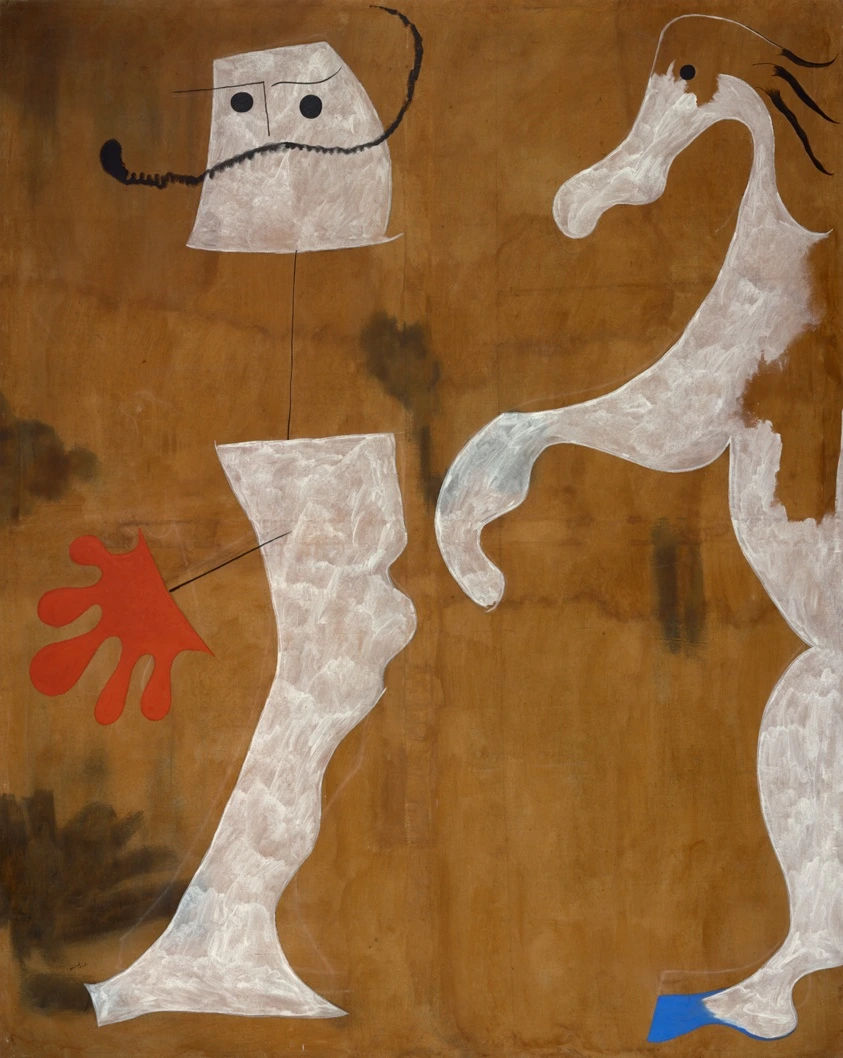
"The Two Philosophers" is a 1936 oil on copper by Joan Miró that captures the Spanish Surrealist in one of his most enigmatic and poetically suggestive compositions, the image showing two abstract figures rendered with the same biomorphic vocabulary and playful color that made Miró's work instantly recognizable and endlessly fascinating. The composition is a small painting—35.6 × 49.8 centimeters—showing two personages engaged in philosophical dialogue with the simplified forms and the bold colors that suggest both the playful innocence of a child's drawing and the profound mystery of the unconscious mind. The oil on copper creates a surface of extraordinary luminosity and smoothness, the metal support enhancing the jewel-like quality of the colors and the precision of the forms. The February 4–12, 1936 date places this work in the crucial period of Miró's Spanish period, just before the Civil War, when he was producing the paintings that expressed his deepest feelings about the political and cultural crisis of his homeland. Art historians have connected this painting to the broader tradition of the philosopher image in modern art, from the thinkers of Picasso to the intellectuals of the Surrealist circle, noting that Miró's treatment is more focused on the poetic suggestion and the playful ambiguity, the transformation of philosophical dialogue into visual metaphor, than the psychological realism or the intellectual content of these other traditions.
Cultural Impact
This February 1936 oil-on-copper made philosophers poetically enigmatic through small 35cm biomorphic dialogue jewel-like luminosity and smooth metallic support, using pre-Civil-War Spanish period to transform philosophical discourse into playful Surrealist visual metaphor beyond Picasso psychological realism.
Why It Matters
It matters because Miró painted two philosophers talking and made the copper feel like it was laughing at the mystery of thought—proving that even wisdom could be a game if the shapes were playful enough.