Provenance
Galerie Pierre Colle, Paris, by December 1932 . Yvonne Zervos, Paris. The Mayor Gallery, London. Pierre Matisse Gallery, New York, by March 1934 [according to correspondence between Pierre Matisse and The Arts Club of Chicago, 1934 in curatorial file]. Galerie Berggruen & Cie., Paris, not before 1950. Richard L. Feigen & Co., Chicago, by 1960. Mary and Leigh Block, Chicago, July 1960 [as per Leigh Block’s Index Card Inventory, in curatorial file]. Gift of Mary and Leigh Block to the Art Institute, 1988.
Accession Number
110973
Medium
Oil on panel
Dimensions
27.3 × 20 cm (10 3/4 × 7 7/8 in.)
Classification
Painting
Credit Line
Gift of Mary and Leigh Block
Background & Context
Background Story
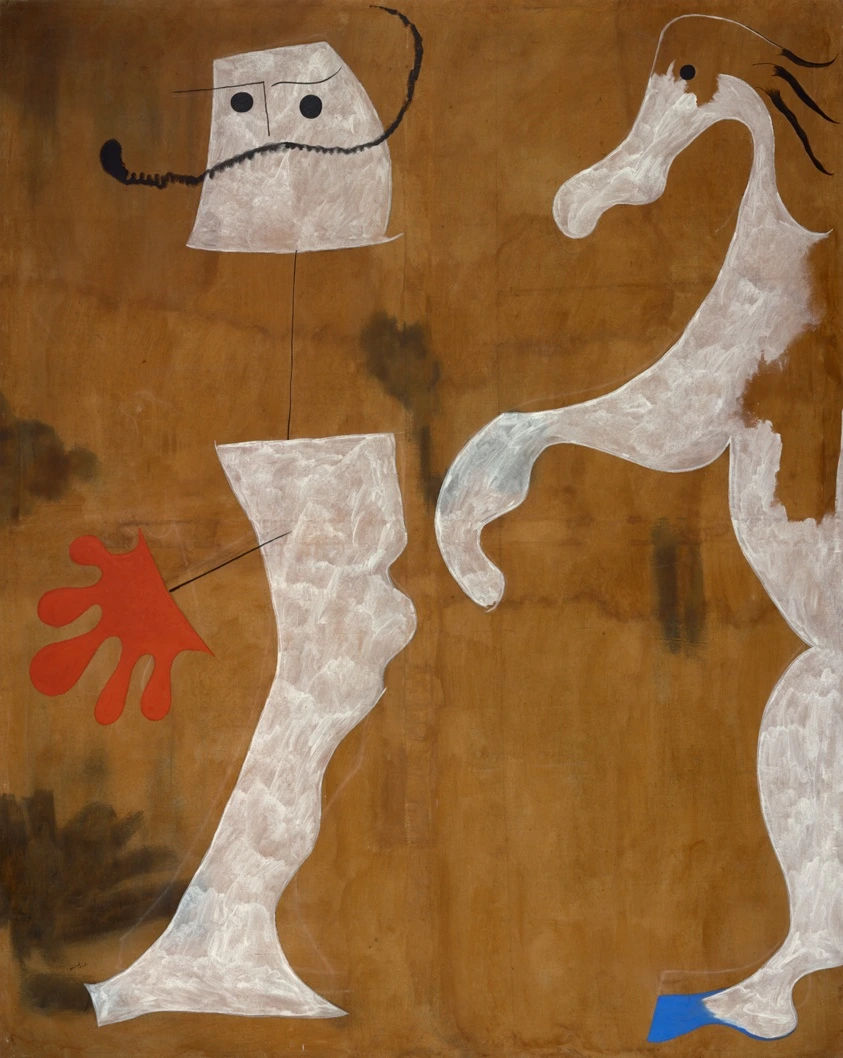
"Figure" is a 1932 oil on panel by Joan Miró that captures the Spanish Surrealist in his most radically abstract and poetically suggestive mode, the image showing a single figure rendered with the simplified forms and the bold colors that made Miró's work the definitive visual language of Surrealist biomorphism. The composition is a small painting—27.3 × 20 centimeters—showing an abstract figure with the organic shapes and the primary colors that suggest both the physical presence of the body and the dreamlike transformations of the unconscious mind. The oil on panel creates a surface of extraordinary smoothness and precision, the rigid support allowing for the meticulous rendering of the small-scale forms and the delicate balance of the composition. The 1932 date places this work in the period of Miró's most intensive production of the "savage period," when he was producing the paintings and drawings that established his reputation as the leading abstract painter of the Surrealist movement. Art historians have connected this painting to the broader tradition of the abstract figure in modern art, from the sculptures of Brancusi to the paintings of Kandinsky, noting that Miró's treatment is more focused on the poetic suggestion and the playful ambiguity, the transformation of the human figure into a visual poem, than the formal analysis or the spiritual transcendence of these other traditions.
Cultural Impact
This 1932 oil panel made abstract figure poetically biomorphic through small 27cm simplified organic-shape primary-color smooth precision, using savage-period Surrealist vocabulary to transform human presence into visual poem beyond Brancusi formal sculptural analysis.
Why It Matters
It matters because Miró painted a figure and made the panel feel like it was dancing with itself—proving that even a single body could be a universe if the shapes were free enough.