Jacob and Esau

Description

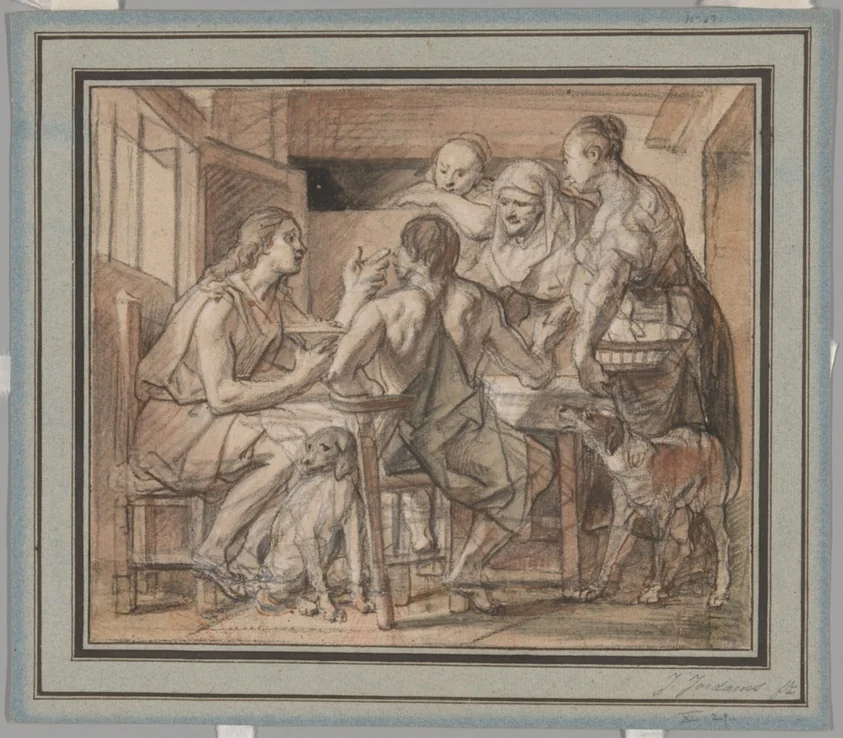
This energetic drawing represents the moment when Jacob compels his older twin brother, Esau, to exchange his birthright for a bowl of stew. The brothers are surrounded by their mother, two maidservants, and two dogs. Jacob Jordaens set this Old Testament narrative in a domestic setting and filled it to the point of bursting. Indeed, the composition outgrew the original boundaries of the drawing support, prompting Jordaens to extend it by adding strips of paper to all four sides in order to complete his work.

Provenance

Sold, Bonhams, London, July 4, 2012, lot 1.  Sold by Jean-Luc Baroni, London, to Dorothy Braude Edinburg, Brookline, Mass., 2013; given to the Art Institute of Chicago, 2014.

Jacob and Esau

Jacob Jordaens

c. 1655

Accession Number

218914

Medium

Charcoal, pen and brown ink, and brush and brown washes, heightened with opaque white watercolor, on pieced cream laid paper, laid down on blue laid paper, ruled in pen and brown ink, laid down on tan laid paper

Dimensions

Primary support: 25.4 × 29.7 cm (10 × 11 3/4 in.); Secondary/tertiary supports: 32.2 × 36.6 cm (12 11/16 × 14 7/16 in.)

Classification

charcoal

Museum

The Art Institute of Chicago

Chicago, United States

Credit Line

Gift of Dorothy Braude Edinburg to the Harry B. and Bessie K. Braude Memorial Collection
Background & Context

Background Story

Jacob Jordaenss Jacob and Esau from around 1655 is a monumental charcoal and wash drawing that depicts the Old Testament story of the twin brothers whose rivalry and reconciliation resonated throughout Baroque religious art as a typological prefiguration of Christian reconciliation. Jordaens, the leading painter in Antwerp after the deaths of Rubens and van Dyck, brought to his biblical subjects the same robust physicality and jovial energy that distinguish his genre scenes, and Jacob and Esau is no exception: the figures are rendered with a sculptural mass and dramatic gesture that give the biblical narrative a physical immediacy rare in 17th-century religious drawing. The story of Jacob and Esau, in which the younger brother tricks the older out of his birthright and blessing before being reconciled with him years later, allowed Jordaens to explore themes of sibling rivalry, deception, and forgiveness that resonated with his own artistic concerns with the physical and emotional dynamics of human interaction. The drawing technique is characteristically Jordaens: bold charcoal strokes define the major forms, pen and brown ink provide contour and detail, brown washes create atmospheric shadow and volume, and opaque white watercolor heightening adds highlights that make the figures emerge from the dark ground with sculptural force. The multiple layers of support, the drawing laid down on blue paper ruled in brown ink which is itself laid down on tan paper, preserve a work that was clearly valued by collectors from an early date.

Cultural Impact

Jordaens biblical drawings are essential documents for understanding the continuation of the Rubens tradition in Antwerp after the masters death, and their robust physicality and dramatic narrative energy influenced the development of Baroque religious art throughout Northern Europe. Jacob and Esau exemplifies the combination of monumental form and populist energy that made Jordaens the most important painter in Antwerp in the mid-17th century.

Why It Matters

A monumental charcoal and wash drawing by Jordaens depicting the biblical story of Jacob and Esau with robust physicality and sculptural mass, combining bold charcoal strokes, pen and ink contours, brown washes, and white heightening to give the narrative dramatic immediacy.