
Provenance
John Skippe. Edward Holland Martin, Esquire. Mrs. A. C. Rayner-Wood, by 1934 [Birmingham 1934 exh. cat.]; sold, Christie’s, Nov. 20–21, 1958, lot 272, to Dr. R. Schilling (for 150 pounds) [annotated sale catalogue and Baden-Baden 1968 exh. cat.]. Kurt Meissner (1909–2004), Zurich and Zolliken [stamp (Lugt 4665), on mount, recto, lower left, in black]. British Rail Pension Fund; sold by Lexbourne Ltd., London, to the Art Institute of Chicago, 1989.
Accession Number
74224
Medium
Pen and brown ink and brush and brown wash, with traces of black chalk and opaque white watercolor, on cream laid paper, laid down on cream laid paper
Dimensions
Primary support: 28.4 × 19.2 cm (11 3/16 × 7 9/16 in.)
Classification
pen and ink drawings
Credit Line
Clarence Buckingham Collection
Background & Context
Background Story
Samuel van Hoogstratens Seated Female Nude from 1647-78 is a pen and brown ink and brush and wash drawing with traces of black chalk and opaque white watercolor on cream laid paper that exemplifies the Dutch artists approach to the figure, combining the influence of his teacher Rembrandt with the theoretical interests in perspective and trompe loeil that would make him one of the most important art theorists of the 17th century. Van Hoogstraten, who studied in Rembrandts workshop in the 1640s and went on to produce paintings, prints, and drawings that explored the relationship between illusion and reality with a sophistication that anticipated the concerns of modern art, brought to the figure the same attention to light, shadow, and atmospheric depth that he brought to his perspective boxes and trompe loeil paintings. The seated nude, rendered in pen and ink and wash with the subtractive highlights and opaque white corrections that characterize Rembrandts best drawings, demonstrates the influence of his teacher on van Hoogstratens draftsmanship while also revealing the younger artists interest in the theoretical principles that would inform his treatise on painting, the Inleyding tot de Hooge Schoole der Schilderkonst of 1678. The traces of black chalk underdrawing reveal the working process of an artist who began with a structural sketch and then refined the drawing in pen and ink and wash, and the opaque white watercolor corrections demonstrate the same willingness to revise and correct that characterizes Rembrandts drawings.
Cultural Impact
Van Hoogstratens drawings are significant documents for understanding the dissemination of Rembrandts draftsmanship and the development of Dutch art theory, and the Seated Female Nude demonstrates the combination of Rembrandtian influence and theoretical sophistication that makes his work significant. His drawings influenced the development of art theory and the broader tradition of art that explores the relationship between illusion and reality.
Why It Matters
A pen and ink and wash drawing by van Hoogstraten from 1647-78 of a seated female nude with black chalk underdrawing and white watercolor corrections, combining Rembrandtian draftsmanship with the theoretical interest in perspective and illusion that would inform his treatise on painting.
Related Artworks

Resurrection of Christ
Samuel van Hoogstraten

Jacob and Esau (recto); Head of a Young Woman Asleep (verso)
Samuel van Hoogstraten

The Annunciation of the Death of the Virgin
Samuel van Hoogstraten
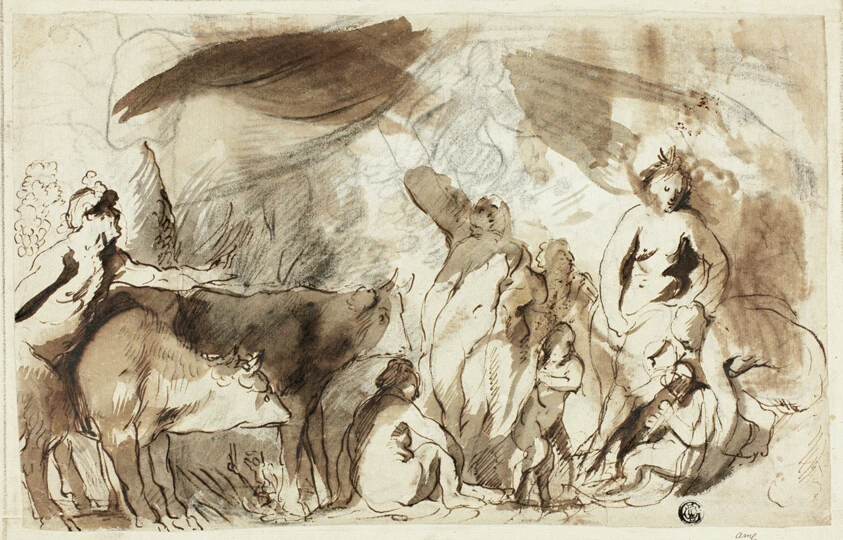
Study for the Sine Baccho et Cerere Friget Venus (recto); Family of Darius before Alexander (verso)
Jacob Jordaens