Provenance
15th Earl of Shrewsbury (1753–1827), Alton Towers, Staffordshire, England [Deering collection records]. Charles Deering (1852–1927), Chicago [stamp (Lugt 516) verso, lower right, in blue]; by descent to his daughters, Mrs. Chauncey McCormick (née Marion Deering; 1886–1965), Chicago and Mrs. Richard Ely Danielson (née Barbara Deering; 1885–1957), Chicago; given to the Art Institute of Chicago, 1927.
Accession Number
113025
Medium
Pen and brown ink, with brush and brown wash (recto and verso) on ivory laid paper
Dimensions
9.4 × 15.6 cm (3 3/4 × 6 3/16 in.)
Classification
pen and ink drawings
Credit Line
The Charles Deering Collection
Background & Context
Background Story
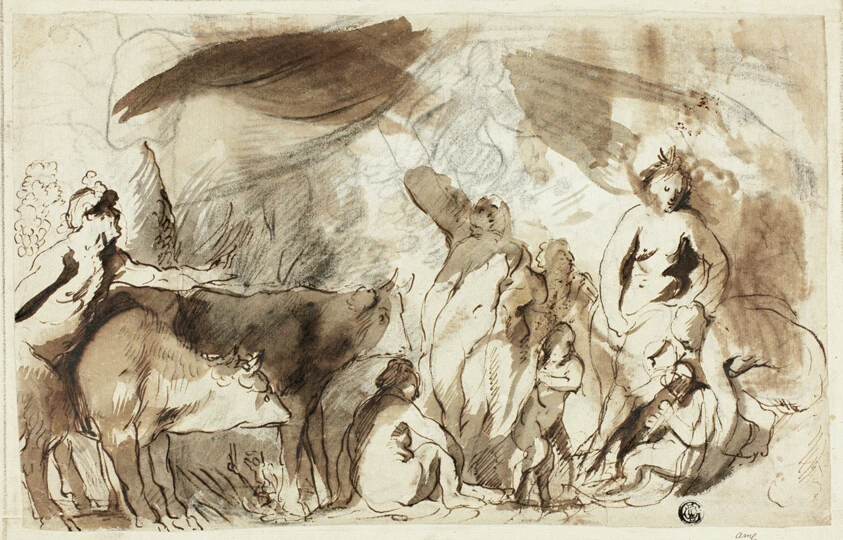
Samuel van Hoogstratens Jacob and Esau on the recto with Head of a Young Woman Asleep on the verso from 1647-78 is a double-sided pen and brown ink and brush and wash drawing on ivory laid paper that demonstrates the Dutch artists ability to combine narrative composition on one side of the sheet with informal figure study on the other, revealing the range of his practice from the ambitious biblical narrative to the quick observation of everyday life. The subject of Jacob and Esau, the biblical story of the twin brothers whose rivalry over their fathers blessing and birthright is one of the foundational narratives of the Judeo-Christian tradition, provided van Hoogstraten with a dramatic subject that allowed him to demonstrate his mastery of figure composition and narrative expression. The head of a young woman asleep on the verso, rendered with the rapid pen and wash technique that characterizes the best Dutch figure drawings, reveals the more informal side of van Hoogstratens practice, in which the observation of everyday life produces drawings of extraordinary freshness and spontaneity. The double-sided format, in which two different subjects occupy opposite sides of the same sheet, was common in the practice of 17th-century Dutch artists, who used every available surface of their paper to avoid waste and to capture observations and compositional ideas as they occurred. The years 1647-78 bracket the period of van Hoogstratens maturity, when he was producing works that combined the influence of his teacher Rembrandt with his own theoretical interests.
Cultural Impact
Van Hoogstratens double-sided drawings are significant documents for understanding the working practice of Dutch artists and the dissemination of Rembrandts style, and Jacob and Esau demonstrates the range of his practice from narrative composition to informal figure study. His drawings influenced the development of Dutch art theory and the broader tradition of biblical narrative.
Why It Matters
A double-sided drawing by van Hoogstraten from 1647-78 with Jacob and Esau on the recto and a Head of a Young Woman Asleep on the verso, combining ambitious biblical narrative composition on one side with rapid informal figure observation on the other in pen and ink and wash on ivory laid paper.