Description
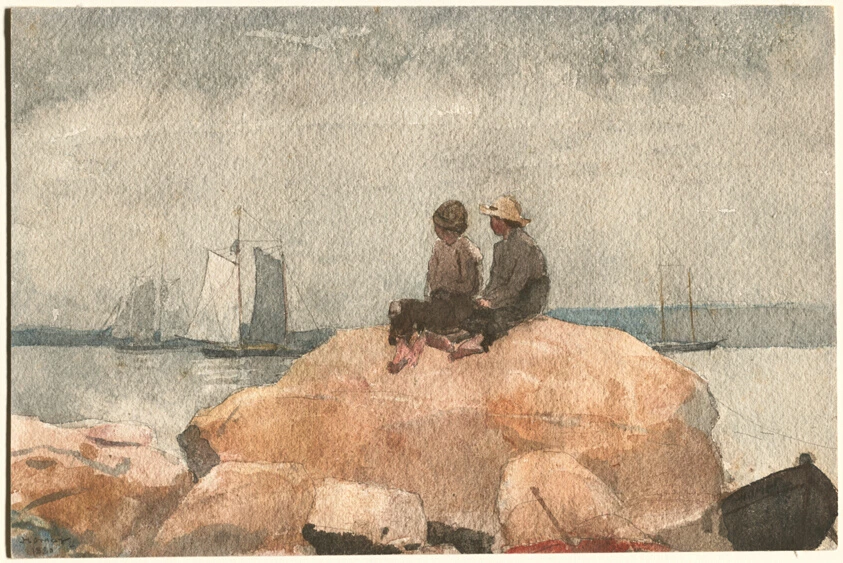
Created in 1880 during Homer's second visit to Gloucester, Massachusetts, Two Boys Watching Schooners shows two boys perched on an enormous rock, a vantage point from which they could keep an eye on the comings and goings of the fishing fleet. In this work, the artist juxtaposed the figures and shore (rendered in warm tones) with the cool blue tones of the harbor, sky and schooner. In this way, he emphasized the psychological isolation of those who waited on shore, hoping and watching for the safe return of those who made their living from the sea.
Provenance
The artist to his brother, Charles S. Homer, Jr. (1834–1917), New York, by 1910 [according to correspondence from Abigail Booth Gerdts to the Art Institute, February 10, 2007]. Charles W. Gould (1849–1931), New York, by 1915 [Brooklyn exh. cat. 1915]. Sold by Knoedler and Company, New York, to Martin A. Ryerson (1856–1932), Chicago, November 11, 1915 [invoice]; given to the Art Institute, 1933.
Accession Number
16803
Medium
Watercolor, with graphite, on moderately thick, rough-textured, ivory wove paper
Dimensions
22.7 × 34 cm (8 15/16 × 13 7/16 in.)
Classification
watercolor
Credit Line
Mr. and Mrs. Martin A. Ryerson Collection
Background & Context
Background Story
Winslow Homer's Two Boys Watching Schooners shows boys observing ships, a subject that captures the fascination of the sea for inland children. Homer's work often explores the relationship between people and the sea.
Cultural Impact
Homer's scenes of observation capture the wonder of the natural world.
Why It Matters
These boys watching ships capture the fascination with the sea.