Dancing Girl

Description

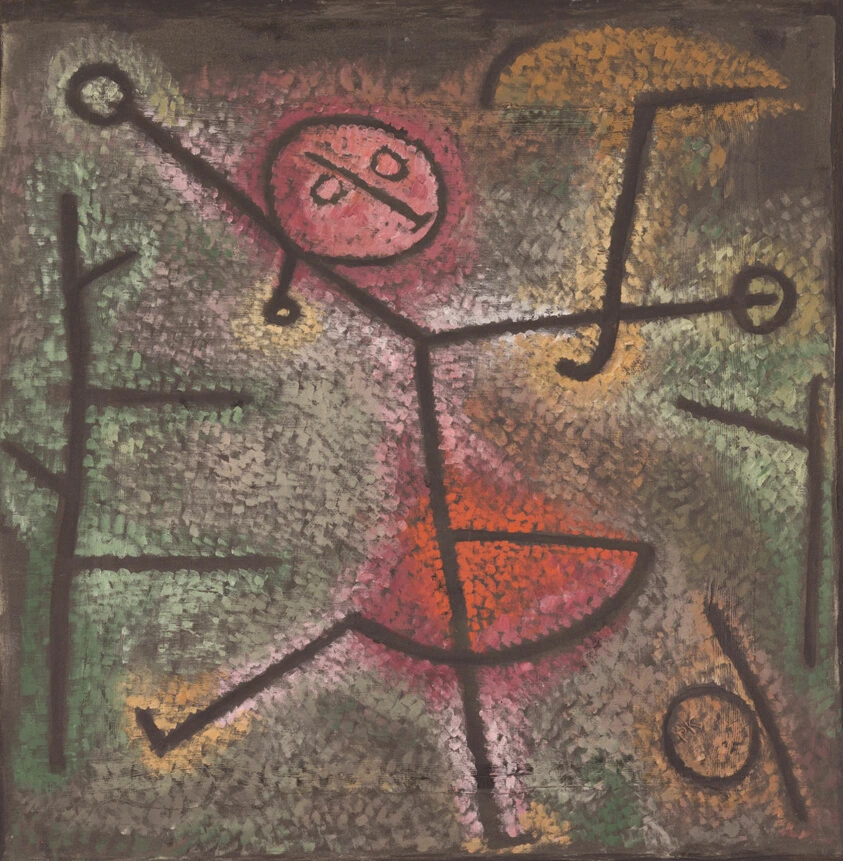
Directly affected by the Nazis’ ascent to power, Paul Klee was dismissed in 1933 from his teaching post at Dusseldorf Academy, where he had spent two years after leaving the Bauhaus. Exiled to Switzerland, Klee suffered physically and psychologically, and his artistic output diminished significantly. Between 1937 and 1940, however, Klee regained artistic momentum and produced several hundred paintings and over 1,500 drawings. In these later works, Klee continued to experiment with unusual media and techniques to produce multidimensional effects. Dancing Girl also reveals Klee’s limitless humor—his signature at the lower right was made by a monogrammed handkerchief, which he laid over the surface to begin his painting.

Provenance

The artist, Bern; by descent to his wife, Lily Klee (1876–1946), Bern, 1940 [this and the following according to Paul-Klee Stiftung 2004]; sold to the Klee Gesellschaft, Bern, 1946; sold to Curt Valentin (1902–1954), Berlin and New York, 1948 [March 26, 1951 letter from Curt Valentin to Sally Fairweather, copy in curatorial file]; sold to Lynne Thompson, New York, 1948 [this and the following according to conversation notes with George B. Young, March 15, 1977; in curatorial object file]; with Fairweather-Garnett Gallery, Evanston, IL, 1950; sold to George B. and Mary Young, Chicago, Jan. 22, 1951; given to the Art Institute, 1959.

Dancing Girl

Paul Klee

1940

Accession Number

10018

Medium

Oil on cloth

Dimensions

53.3 × 51.2 cm (21 × 20 7/8 in.)

Classification

Painting

Museum

The Art Institute of Chicago

Chicago, United States

Credit Line

Gift of George B. Young

Background & Context

Background Story

"Dancing Girl" is a 1940 oil painting on cloth that belongs to Paul Klee's final Swiss period, when he was living in Bern and producing some of his most joyous and life-affirming works despite the darkening European situation and his own deteriorating health. The composition shows a dancing figure rendered in Klee's characteristic style of simplified, almost childlike forms that convey movement and rhythm through the arrangement of color and line rather than through naturalistic description. The cloth support is unusual for Klee, who more commonly worked on paper or canvas; the textured weave of the fabric creates a subtle ground pattern that interacts with the painted forms, adding a layer of visual complexity that paper or canvas would not provide. The palette is warm and buoyant—reds, yellows, and oranges that suggest the energy of dance and the pleasure of physical movement. The figure itself is barely human: it is a rhythm made visible, a color pattern that happens to suggest a body in motion. This abstraction is characteristic of Klee's mature work: he was not interested in depicting the external appearance of dance but in translating its internal feeling into visual form. Art historians have connected this painting to the broader tradition of dance imagery in modern art, from Degas's ballet scenes to Matisse's "Dance," noting that Klee's treatment is more abstract, more focused on the essential rhythm rather than the social or theatrical context. The 1940 date places the work in the same year as Klee's death, suggesting that it may represent a final celebration of life, a defiant assertion of joy in the face of mortality.

Cultural Impact

This 1940 oil on cloth translated dance rhythm into childlike color abstraction, using textured fabric support to add visual complexity while asserting joy as defiance against mortality and war.

Why It Matters

It matters because Klee danced on cloth while Europe burned—proving that even a dying man could make paint move like music.