Accession Number
236523
Medium
Black chalk, over graphite, on cream wove paper
Dimensions
Sight: 48.4 × 61.3 cm (19 1/16 × 24 3/16 in.)
Classification
chalk
Credit Line
Gift of The Leonard and Ruth Horwich Family Foundation
Background & Context
Background Story
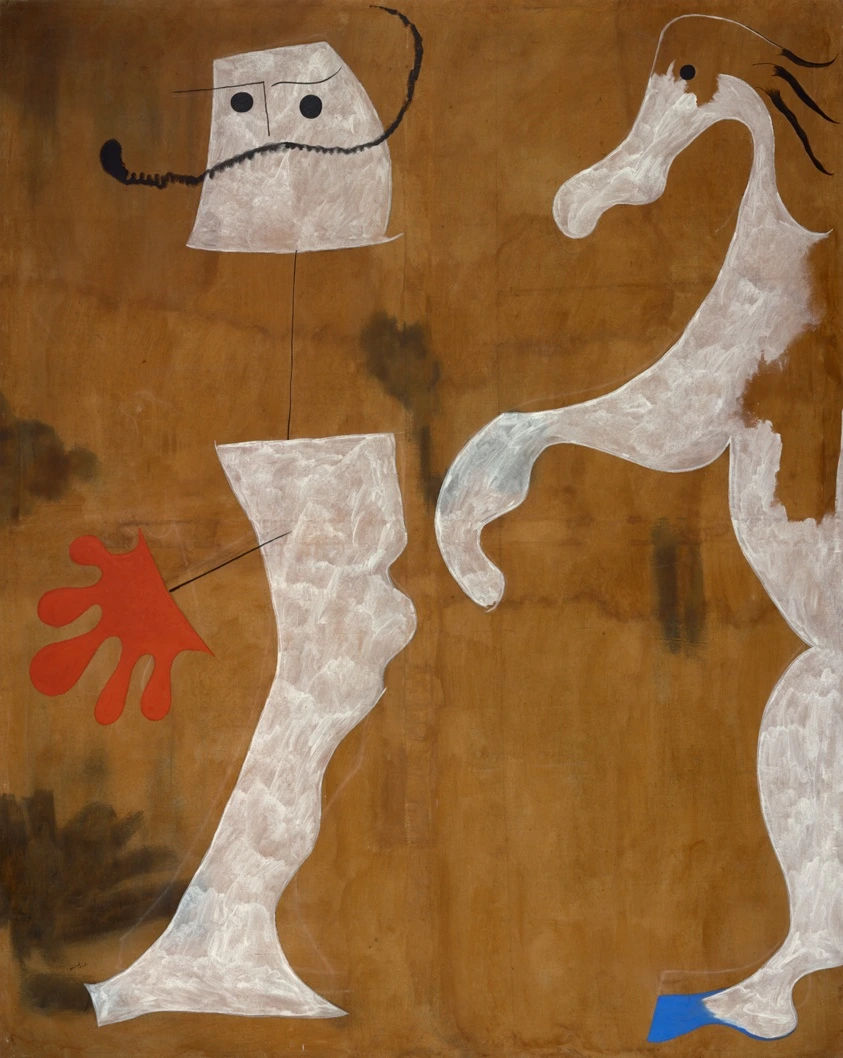
Joan Miro's Composition with Foot (May 1928) is a black chalk drawing over graphite on cream wove paper. This work from 1928 belongs to the period when Miro had fully developed his mature surrealist style. The title Composition with Foot suggests that the work incorporates a representation of a foot within an otherwise abstract composition. Miro's characteristic vocabulary of simplified forms, lines, and dots is deployed across the paper, with the foot perhaps recognizable among the abstract elements. The black chalk technique allows for both precise lines and broad areas of tone. Miro's drawings from this period are among the most freely inventive of his career, as he explored the possibilities of automatic drawing and the visual language of the unconscious. Composition with Foot is a record of that exploration, a playful, poetic configuration of forms that hovers between abstraction and representation.
Cultural Impact
Miro's late 1920s drawings represent the peak of his surrealist period, when his exploration of automatic drawing and the language of the unconscious was at its most intense.
Why It Matters
This chalk drawing transforms a foot into an element of an abstract composition, Miro's characteristic vocabulary creating a playful, poetic work that hovers between representation and abstraction.