Provenance
Estate of the artist (sale, Fifth Avenue Galleries, New York [George Inness executor's sale], February 12-14, 1895, no. 72, as Harvest, Montclair, New Jersey, 1884. This painting is clearly identifiable in an installation photograph of the auction sale preview.) F.T. Leland, purchased at auction, 1895; with Newman E. Montross, New York (sale, American Art Association, new York, February 8, 1923, no. 39, as Harvest: Montclair dated 1884, repro.) With Thomas E. Finger, New York, purchased at auction, 1923. With Dalzell-Hatfield Galleries, Los Angeles, 1930. Edwin A. Seipp, by 1930 to 1946; by descent to Pauline Seipp Armstrong; given to the Art Institute of Chicago, 1974.
Accession Number
47669
Medium
Oil on canvas
Dimensions
73.7 × 96.6 cm (29 × 38 3/4 in.)
Classification
Painting
Credit Line
Gift of Mrs. Julian Armstrong Jr.
Background & Context
Background Story
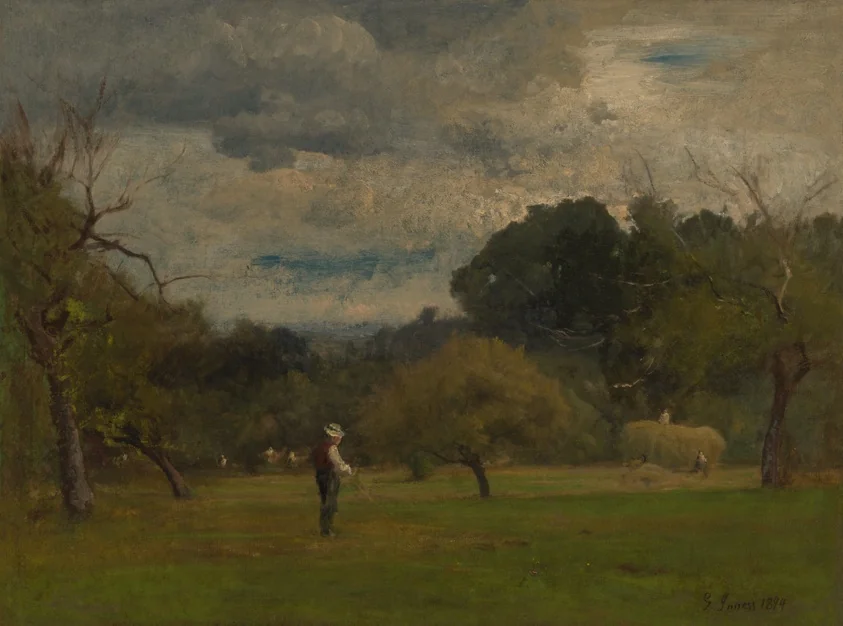
George Inness's "Harvest, Montclair, New Jersey" (1884) is an oil on canvas depicting the harvest season in Montclair, the New Jersey town where Inness spent the final decades of his life. By 1884, Inness had fully developed the Tonalist style that defined his late career: soft, atmospheric, and imbued with spiritual meaning. The painting shows a harvest scene with fields, workers, and the golden light of late summer or early autumn. The palette is warm and harmonious, with golden yellows, soft greens, and warm earth tones. The brushwork is loose and expressive, the forms dissolving into the light. Inness believed that the landscape was a revelation of divine presence, and his late works seek to capture not just the appearance of nature but its spiritual essence. The harvest, with its associations of abundance, completion, and the cycles of life, was a subject well suited to this vision. Montclair, with its rolling hills and rural character, provided Inness with endless material for his meditations on nature and spirit.
Cultural Impact
Inness's late Montclair landscapes represent the fullest expression of his Tonalist vision, creating a body of work that sought to represent the spiritual dimension of the American landscape.
Why It Matters
This harvest scene captures the golden light of late summer in New Jersey, Inness's soft handling and warm palette transforming a scene of rural labor into a vision of nature's spiritual abundance.