Provenance
William T. Evans, New York, by 1900; Fishel, Adler & Schwartz, New York, purchased at auction, 1900; Emerson McMillin, New York, from 1901 to 1911; M. Knoedler & Co., New York, 1911; Reinhardt Galleries, Chicago, 1911; sold to Edward B. Butler, Chicago, 1911; given to the Art Institute of Chicago, 1911.
Accession Number
64745
Medium
Oil on canvas
Dimensions
56.4 × 68.6 cm (22 1/8 × 27 in.)
Classification
Painting
Credit Line
Edward B. Butler Collection
Background & Context
Background Story
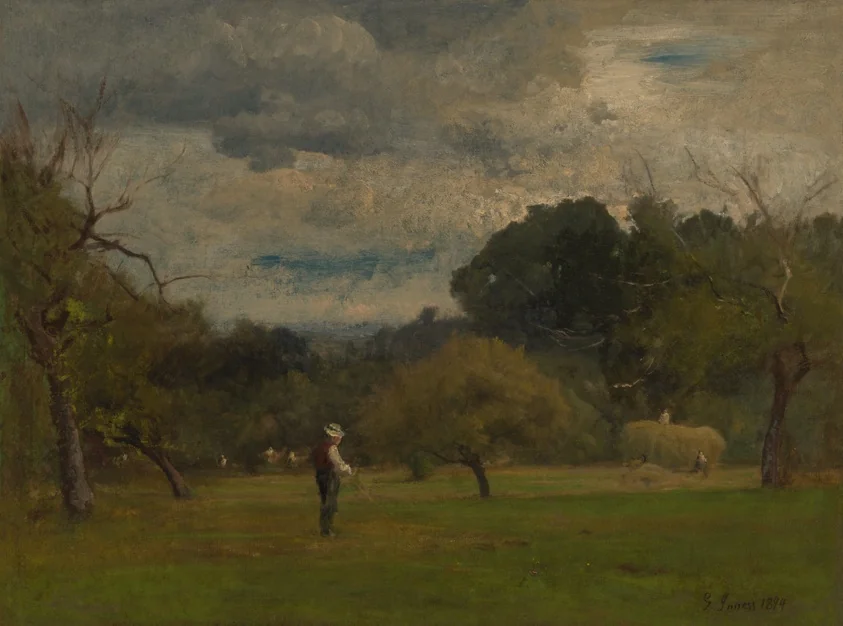
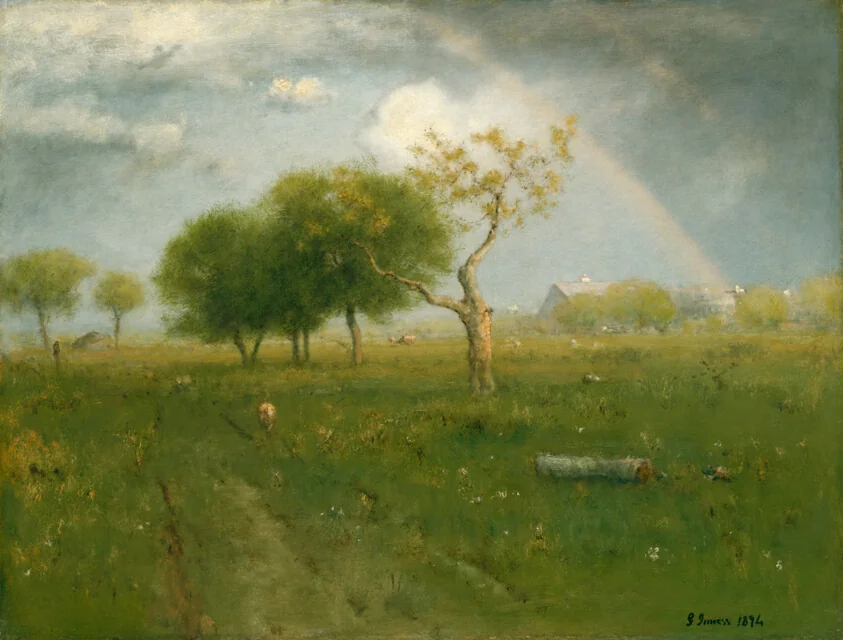
George Inness's "The Moon at Night" (1890) is an oil on canvas showing the landscape illuminated by moonlight. Moonlight was a favorite subject for Tonalist painters, allowing them to explore the subtle, monochromatic harmonies that defined their style. Inness's treatment of the moonlit landscape is characteristically atmospheric: the forms of the landscape are reduced to soft masses of tone, the moonlight creating a silver-gray illumination that transforms the familiar into the mysterious. The palette is restricted to a narrow range of cool grays, silvers, and deep blues, creating a mood of quiet contemplation. The moon itself may be visible as a pale disk in the sky, its light reflected in water or on the surfaces of the landscape. This painting belongs to the period of Inness's fullest maturity as a Tonalist painter, when his technique had achieved the perfect balance between representation and abstraction, observation and imagination. The moonlight scene becomes a meditation on the mysteries of night and the spiritual dimensions of the natural world.
Cultural Impact
Inness's moonlight paintings are among the most poetic works of American Tonalism, capturing the quiet beauty and spiritual mystery of the night landscape.
Why It Matters
This moonlit landscape transforms the familiar American countryside into a realm of mystery and beauty, the cool tones and soft handling creating a vision of nature as a source of spiritual contemplation.