Description
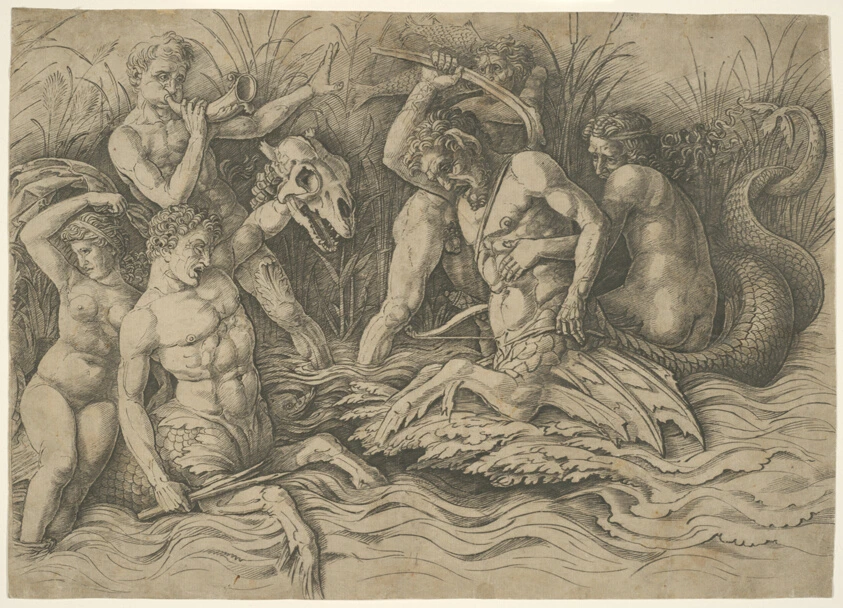
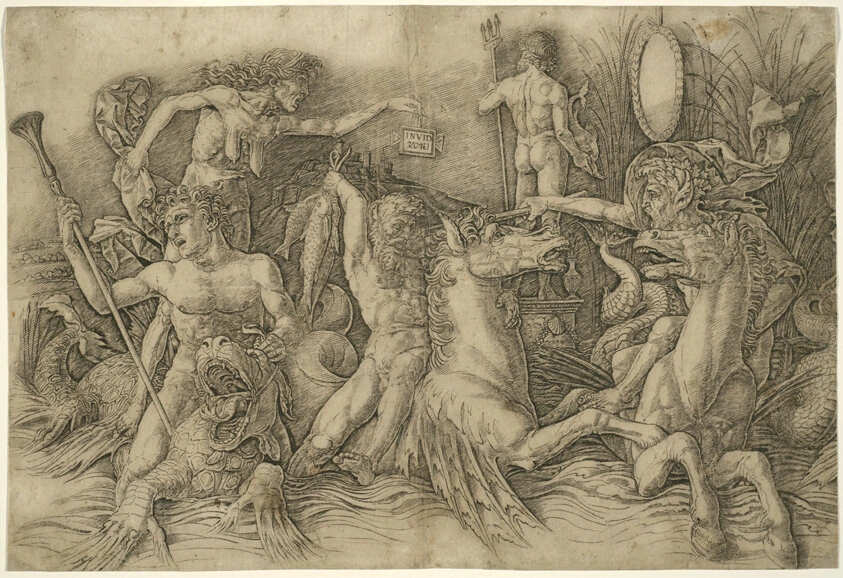
Andrea Mantegna was an artist with a deep interest in antiquity, and much of his work resembled Greco-Roman sculpture, which he translated into widely circulating and frequently copied engravings. This is the left half of a pair of prints; the adjoining print Bacchanal with Silenos (1956.1010) is also in the Art Institute’s collection. Mantegna’s frieze-shaped bacchanalian subjects portray the god of wine and his drunken revelers. Dionysos may be the standing youth on the left, who is being crowned with a wreath of grape leaves. His noble bearing and contrapposto stance link him particularly to ancient sculptures.
Accession Number
4281
Medium
Engraving on cream laid paper
Dimensions
31.2 × 45 cm (12 5/16 × 17 3/4 in.)
Classification
engraving
Credit Line
Bequest of Mrs. Potter Palmer, Jr.
Background & Context
Background Story
Andrea Mantegnas Bacchanal with a Wine Vat, engraved around 1470, depicts a riotous wine-making scene from classical mythology in which satyrs, maenads, and putti cavort around a massive wine vat, stomping grapes and celebrating the rites of Bacchus. The engraving demonstrates Mantegnas revolutionary approach to printmaking: his figures possess the sculptural solidity and classical erudition that characterize his paintings, but translated into the linear medium of the burin with an ingenuity that would define the possibilities of engraving for generations. The wine vat itself serves as a compositional anchor, a cylindrical form that organizes the figural chaos around its steady geometry. Mantegna was among the first Italian artists to recognize prints potential as an independent art form rather than merely a reproductive medium, and his seven surviving engravings are among the most influential prints of the 15th century. The Bacchanal compositions draw on ancient Roman sarcophagi and relief sculptures that Mantegna studied avidly in Padua and Verona, but he transforms these classical sources into dynamic, multi-figured compositions that fill the picture plane with muscular bodies in complex spatial arrangements.
Cultural Impact
Mantegnas engravings established printmaking as a medium for original artistic invention in Italy and, through wide circulation, influenced the development of Northern European printmaking. The Bacchanal compositions were especially influential, inspiring numerous copies and adaptations by printmakers from Schongauer to Rubens.
Why It Matters
A landmark engraving by Mantegna that transforms classical Bacchic imagery into a dynamic multi-figure composition, establishing the engraving as an independent art form and influencing the development of European printmaking for centuries.