Bacchanal with Silenus

Description

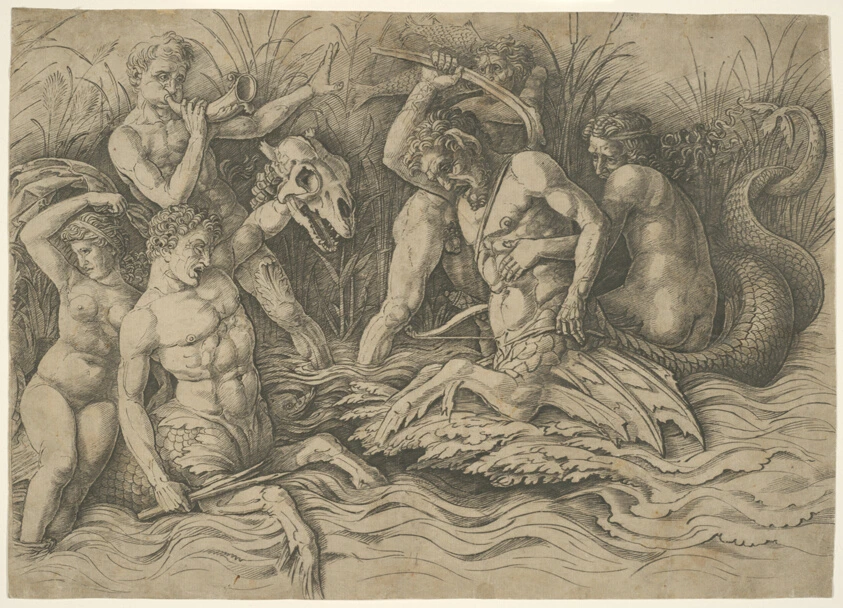
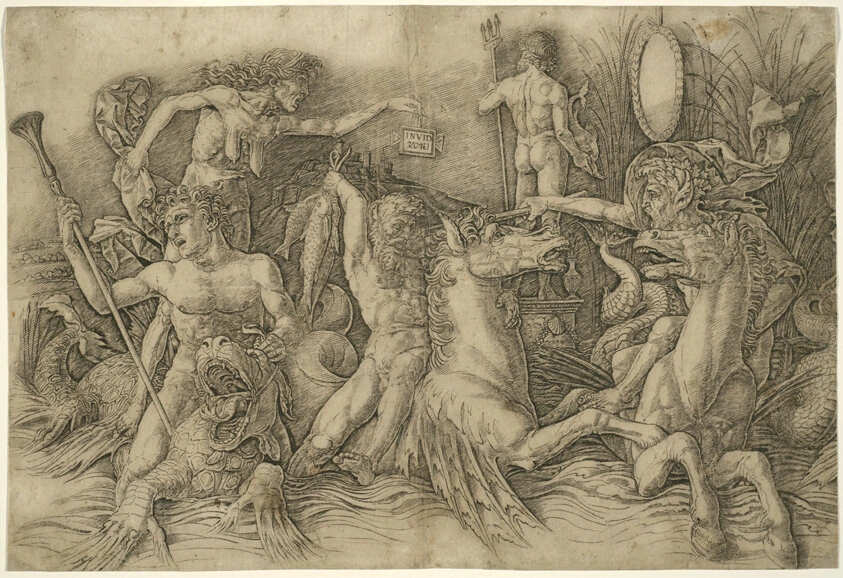
Andrea Mantegna’s adoption of ancient Roman motifs contributed to their prominence during the Italian Renaissance, especially when translated into widely circulating and frequently copied engravings. Mantegna’s oblong bacchanalian subjects particularly extol the wonders of the god of wine as well as the excesses of his entourage. Indeed, in this print of a procession-like grouping of figures, Dionysos’s portly, inebriated sidekick Silenos receives mock preferential treatment as he is lifted by satyrs and crowned with grapevines. The drunken satyrs, nymphs, and humans sing, make music, and grapple with unwieldy flesh as they cross a pool of wine and press on through the vineyard.

Bacchanal with Silenus

Andrea Mantegna

1475/80

Accession Number

4278

Medium

Engraving on laid paper

Dimensions

Sheet: 31.2 × 44.3 cm (12 5/16 × 17 1/2 in.)

Classification

engraving

Museum

The Art Institute of Chicago

Chicago, United States

Credit Line

Bequest of Mrs. Potter Palmer, Jr.

Background & Context

Background Story

Andrea Mantegnas Bacchanal with Silenus, engraved around 1475-80, is a companion piece to the Bacchanal with a Wine Vat, depicting the drunken procession of Silenus, the aged companion of Bacchus, being carried by satyrs through a rocky landscape. Where the Wine Vat composition is centered on communal activity around a geometric form, the Silenus print emphasizes procession and movement: the figures advance from left to right in a rhythmic sequence that echoes ancient Roman sarcophagus reliefs. Silenus himself, corpulent and sway-backed, is the compositional and thematic center, his inebriated vulnerability contrasting with the muscular vigor of his bearers. Mantegna renders the rocky landscape with the same archaeological precision he brought to his paintings, each stone and plant seemingly drawn from direct observation of the terrain around Padua and Verona. The engraving technique is more developed than in the earlier Wine Vat, with finer hatching that creates smoother tonal transitions and greater atmospheric depth. This suite of Bacchanal engravings circulated widely throughout Europe and became prototypes for the depiction of classical revelry in Renaissance and Baroque art, influencing artists from Durer to Rubens.

Cultural Impact

The paired Bacchanal engravings by Mantegna are among the most widely circulated and imitated classical compositions of the Renaissance. They established a visual vocabulary for Dionysian subject matter that persisted through the Baroque and into the Neoclassical period, and their archaeological approach to classical sources set a standard for historical accuracy in mythological art.

Why It Matters

A masterwork of Renaissance engraving depicting Silenus in procession with satyrs, combining archaeological fidelity to classical sources with dynamic composition, and establishing a prototype for Bacchic imagery that would influence European art for three centuries.