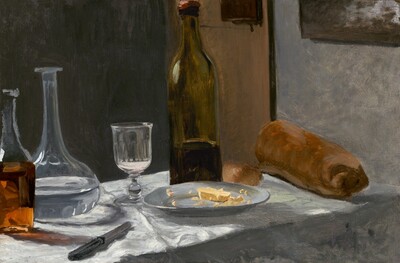
Provenance
Ernest Hoschedé [1837-1891], Paris; (Hoschedé sale, Paris, 5 June 1878, no. 48); purchased by A. Dachery, Paris; (Dachery sale, Hôtel Drouot, Paris, 30 May 1899, no. 40). Ernest Cognacq [1839-1928], Paris; by inheritance to his grand-nephew Gabriel Cognacq [1880-1951], Paris; (Cognacq sale, Galerie Charpentier, Paris, 14 May 1952, no. 49); acquired by (Alex Reid & Lefevre, London) probably for Capt. Edward H. Molyneux [1891-1974], Paris;[1] sold 15 August 1955 to Ailsa Mellon Bruce [1901-1969], New York;[2] bequest 1970 to NGA.
[1]Acquired by Molyneux after the 1952 United States exhibition of his collection. See letter from Molyneux to Ailsa Mellon Bruce dated 30 July 1955 in Gallery Archives RG39, copy in NGA curatorial records.
[2]See Ailsa Mellon Bruce notebook now in NGA Gallery Archives.
Accession Number
1970.17.43
Medium
oil on canvas
Dimensions
overall: 37.7 x 46 cm (14 13/16 x 18 1/8 in.) | framed: 59.7 x 68 x 10.2 cm (23 1/2 x 26 3/4 x 4 in.)
Classification
Painting
Credit Line
Ailsa Mellon Bruce Collection
Tags
Painting Impressionist & Modern (1851–1900) Oil Painting Canvas French Color: Blue Color: Gray
Background & Context
Background Story
Monet's Ships Riding on the Seine at Rouen (1872/1873) captures the maritime commerce of Rouen, one of France's most important inland ports. The Seine at Rouen was a highway of commercial traffic—ocean-going vessels traveled upriver to unload cargo at the city's docks, and the industrial activity of this major port provided a subject very different from the leisure scenes Monet painted at Argenteuil. The 1872-73 date places this work at the dawn of Impressionism: Monet had moved to Argenteuil in 1871 and was developing the broken-color technique that would define the movement. Rouen, accessible from Argenteuil by train, offered an urban subject that complemented the suburban leisure scenes he was painting at home. The ships—ocean-going vessels reduced to the scale of the river—demonstrate the Seine's dual identity as scenic waterway and commercial artery. Monet's treatment of water—reflections broken by the ships' movement, the river's surface animated by wind and wake—demonstrates his developing mastery of the Impressionist water effect. The Rouen port subject also connects to Monet's later, more famous series of Rouen Cathedral façades, which he would paint twenty years later, suggesting a long attachment to this industrial city that most people associate only with the cathedral paintings.
Cultural Impact
Monet's Rouen maritime paintings influenced how French commercial ports were represented in Impressionist art, establishing a model for finding beauty in industrial subjects. The paintings influenced later urban Impressionists who similarly found aesthetic interest in commercial activity. The Rouen subject also influenced how the Seine's commercial function was visually represented, documenting river traffic that would largely disappear in the 20th century as ports modernized.
Why It Matters
This painting matters because it demonstrates that Impressionism could serve industrial and commercial subjects as effectively as leisure scenes. The ships at Rouen are not picturesque vessels but working craft, and Monet's treatment finds visual interest in their commercial function—a democratic impulse that aligned with the movement's broader commitment to representing modern life in all its dimensions.