Accession Number
39554
Medium
Oil on canvas
Dimensions
60 × 73 cm (23 5/8 × 28 3/4 in.); Framed: 83.9 × 96.6 × 7.7 cm (33 × 38 × 3 in.)
Classification
Painting
Credit Line
A. A. Munger Collection
Background & Context
Background Story
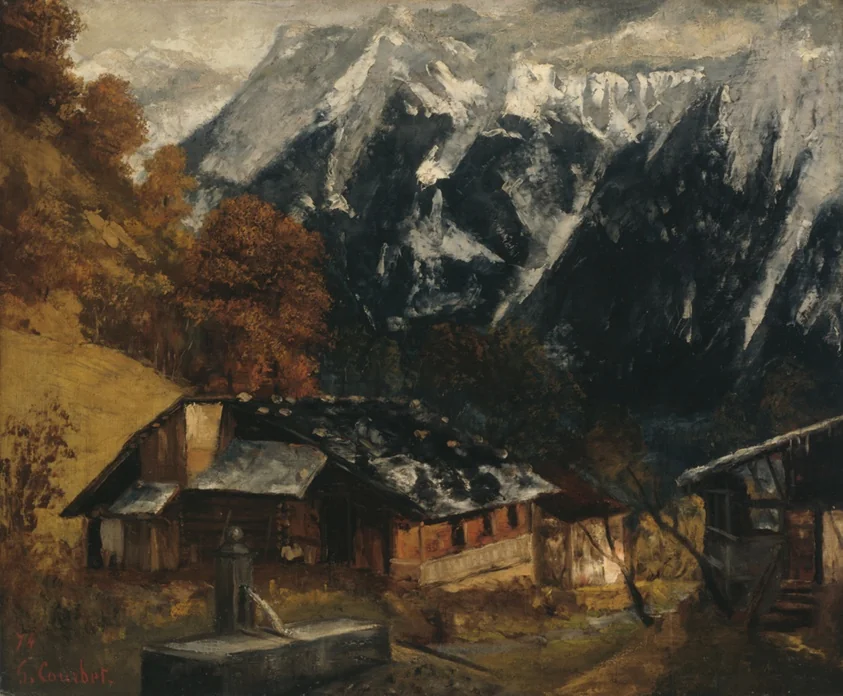
"An Alpine Scene" is an 1874 oil on canvas by Gustave Courbet that captures the French Realist in his late period, when he was living in exile in Switzerland after the fall of the Paris Commune and producing landscapes that combined his lifelong commitment to direct observation with the romantic grandeur of mountain scenery. The composition shows an Alpine landscape—probably near Lake Geneva or in the Jura mountains—with the snow-capped peaks, rocky slopes, and atmospheric depth that Courbet rendered with the thick, tactile brushwork that had made his technique famous. The palette is cool and luminous—blues, greys, and whites that suggest both the physical reality of the high mountains and the emotional chill of the artist's exile, the warmth of his native Franche-Comté replaced by the austerity of Swiss peaks. The 1874 date places this work in the same year as the first Impressionist exhibition in Paris, and while Courbet was physically separated from the artistic developments of his homeland, his influence on the younger generation was profound: the Impressionists had learned from his example of painting outdoors, his refusal of academic convention, and his commitment to the visible world. Art historians have compared this painting to the mountain landscapes of the Romantic period, from the sublime vistas of Friedrich to the dramatic compositions of Turner, noting that Courbet's treatment is more grounded, more focused on the material reality of rock and ice than the spiritual or emotional content of these predecessors. The work also demonstrates Courbet's mastery of the landscape genre: the spatial depth, the atmospheric perspective, and the solid construction of the mountain forms all reflect the skills that he had developed over a lifetime of outdoor painting.
Cultural Impact
This 1874 Alpine canvas combined tactile Realist observation with Commune-exile romantic grandeur, using cool blue-grey luminous austerity to influence Impressionist plein-air refusal while remaining materially grounded in rock and ice.
Why It Matters
It matters because Courbet painted mountains in exile and made the snow feel like homesickness—proving that even the Alps could carry a broken heart if the grey was deep enough.