Provenance
Jean-Paul Mazaroz-Ribalier, Paris, by 1890; sold Hôtel Drouot, May 13–14, 1890, no. 13 for 1,250 francs [price according to an annotated copy of the sale catalogue in the Rijksbureau voor Kunsthistorische Documentatie, The Hague]. Durand-Ruel Paris, by June 5, 1890 [according to a receipt in the Martin A. Ryerson files, Art Institute Archives; it is possible Durand-Ruel acted as an agent for Ryerson]; sold to Martin A. Ryerson, New York, October 27, 1890, for $2,000 [according to the receipt of sale, Art Institute Archives]; on loan to the Art Institute from 1913; bequeathed to the Art Institute, 1933.
Accession Number
16490
Medium
Oil on canvas
Dimensions
46.5 × 55.7 cm (18 1/4 × 21 7/8 in.)
Classification
oil on canvas
Credit Line
Mr. and Mrs. Martin A. Ryerson Collection
Background & Context
Background Story
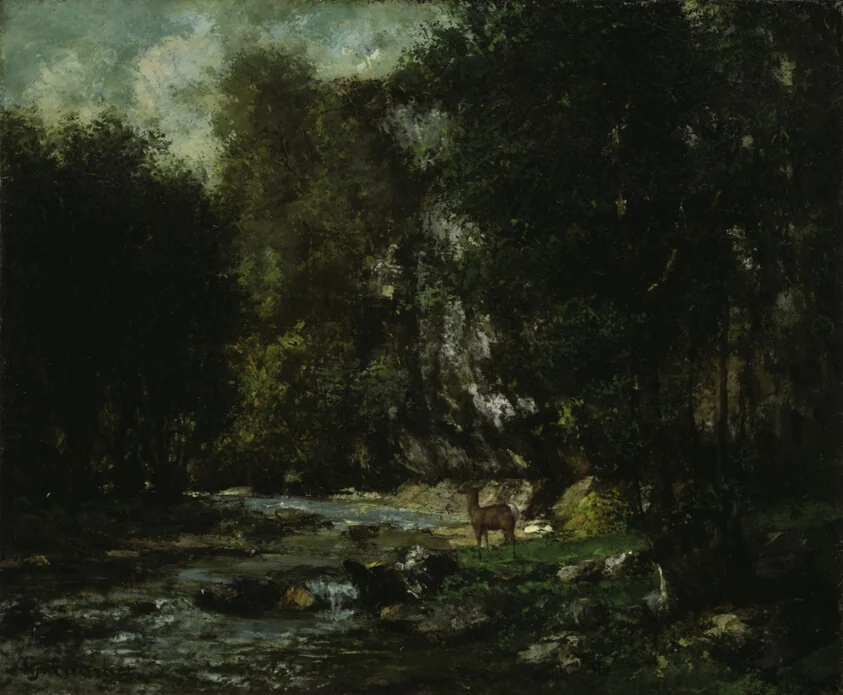
Gustave Courbet's "The Brook of Les Puits-Noir" (c. 1855) is an oil on canvas depicting a forest stream in the Puits-Noir region. This earlier treatment of the Puits-Noir subject (compare with the 1868 version) shows a closer, more intimate view of the stream and its surroundings. The composition focuses on the water as it flows over rocks and between trees, the dense forest creating a secluded, enclosed space. Courbet's handling is detailed and precise, capturing the texture of the rocks, the movement of the water, and the density of the foliage. The palette is rich and varied, with the greens of the vegetation and the browns of the rocks and earth dominating the composition. The play of light on the water is rendered with particular attention. This painting, from c. 1855, belongs to the period when Courbet was emerging as the leader of the Realist movement, and it shows the commitment to the direct observation of nature that would define his career. The forest stream, a simple subject, becomes through Courbet's treatment a study of the material substance of the natural world.
Cultural Impact
Courbet's forest stream paintings demonstrate his ability to find inexhaustible interest in the most ordinary natural subjects, transforming everyday landscape features into subjects of profound artistic attention.
Why It Matters
This painting of a forest brook captures the intimate beauty of the natural world, Courbet's careful observation and rich palette transforming a simple stream into a study of light, water, and the textures of the forest.