Provenance
Mrs. H. O. Havemeyer (died 1929), New York, to 1930; her sale, American Art Association and Andersen Galleries, Inc., April 10, 1930, no. 68, as Verdure d’Automne for $550 [price according to an annotated copy of the sale catalogue in the Ryerson Library, Art Institute]. Mrs. Siegfried G. Schmidt, Chicago; given to the Art Institute, 1968.
Accession Number
29401
Medium
Oil on canvas
Dimensions
49.5 × 59.4 cm (19 1/2 × 23 3/8 in.)
Classification
Painting
Credit Line
Gift of Mrs. Siegfried Schmidt
Background & Context
Background Story
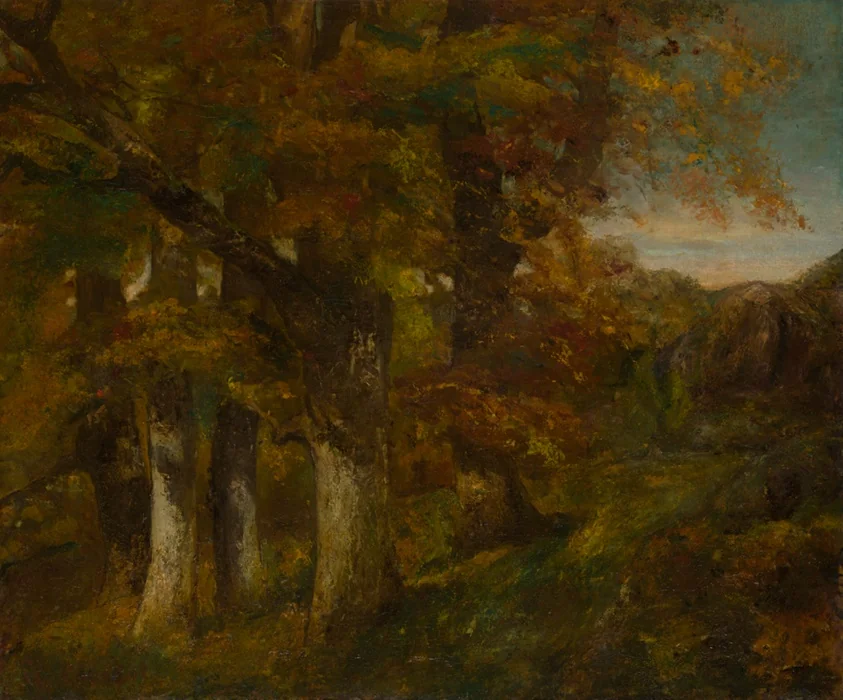
Gustave Courbets Wooded Landscape from 1860-65 is an oil painting that demonstrates the artists mastery of the forest interior, a subject that occupied him throughout his career and that allowed him to develop the techniques of direct observation and painterly naturalism that made him the leader of the Realist movement. Courbet painted the forests of his native Franche-Comte and the surrounding regions with a conviction that the landscape itself, rather than its classical or romantic associations, was a worthy subject for serious art. In Wooded Landscape, the trees fill the canvas from edge to edge and top to bottom, their trunks and branches creating a dense network of verticals and diagonals that denies the viewer a clear path into the composition and instead demands that the eye move across the surface as it would across the bark and foliage of a real forest. The paint handling is characteristically Courbet: thick, dark impasto in the shadows, with lighter tones dragged across the surface to create the effect of light filtering through dense canopy. The years 1860-65 place this work in the period after Courbets triumph at the 1855 Exposition Universelle with his Pavilion du Realisme, when he was producing some of his most accomplished landscape paintings, and before the political upheavals of the Paris Commune that would lead to his imprisonment and exile. The painting can be read as a manifesto of Realist landscape: no classical ruins, no romantic moonlight, just the森林 itself, observed with the intensity and honesty that Courbet brought to every subject he painted.
Cultural Impact
Courbets forest interiors are among the most influential landscape paintings of the 19th century, establishing a tradition of direct, unmediated engagement with nature that extended through the Impressionists to Cezanne and beyond. Their rejection of classical and romantic landscape conventions in favor of empirical observation redefined the possibilities of landscape painting.
Why It Matters
A Realist forest interior by Courbet in which trees fill the canvas edge to edge with thick impasto and direct observation, refusing classical or romantic convention in favor of an honest encounter with the forest itself that redefined landscape painting.