Mère Grégoire

Description

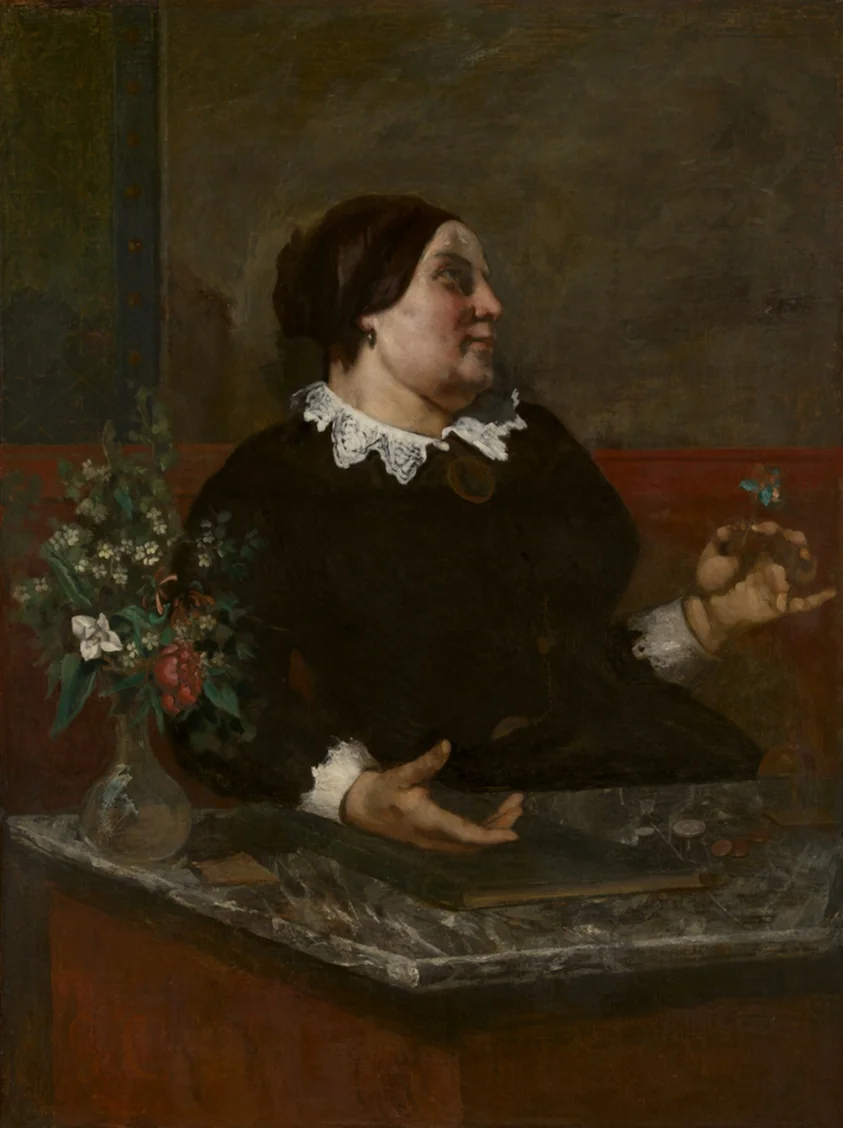
The demurely dressed subject of Mère Grégoire was inspired by the lead character in a popular song written in the 1820s by French lyricist Pierre-Jean de Béranger. Béranger often penned ribald lyrics; his “Madame Grégoire” was the proprietor of a house of prostitution. Gustave Courbet began this work in 1855 as a simple head on a horizontal canvas, but enlarged it to its present dimensions and transformed it into an elaborate genre scene between 1857 and 1859. The artist depicted the woman here in the midst of a transaction, with coins scattered on a marble-topped counter and a ledger beneath her right hand. Under her other hand is the small bell used to summon her female employees. She holds a flower, a symbol of love, which she presumably offers to an unseen customer on the other side of the counter.

The painting may also have had a political subtext. Béranger was a fierce opponent of the monarchy, while Courbet followed in his footsteps as a dissident of the Second Empire. In the mid-1850s, when Courbet began this painting, the government had harshly attacked Béranger’s songs in an eff ort to restrict free expression. Courbet’s decision to portray the songwriter’s Madame Grégoire—whose flower exhibits the blue, white, and red of the French flag—may represent a protest not only against government censorship but also against the Second Empire itself. Thus the artist transformed the character into a heroine who embodies the rights to freedom in life and love that were forbidden under the repressive regime.

Courbet played a crucial role in the development of modern French painting as the leader of the Realist movement, which rejected Romanticism’s dramatic subjects and emotions in favor of portraying everyday people and events with truth and accuracy, warts and all. Critics and the public did not easily accept his large, naturalistic, and unsentimental depictions of commonplace, often rural subjects, earning him the nickname the “apostle of ugliness.”

Provenance

Possession of the artist [for this and the following until 1873 see Riat 1906 and Fernier 1977]; stolen between 1872–73; found by Étienne Baudry at an art dealer in Paris, 1873. Galerie Barbzanges, Paris, by 1912 [Saint Petersburg 1912]. Possibly Alexandre Louis Philippe Marie Berthier, 4th Prince of Wagram (died 1918), Paris [according to Art Institute of Chicago 1961 and Fernier 1977]; possibly at his death to his sister, Elisabeth de la Tour d’Auvergne (née Elisabeth Bertier de Wagram), Paris (according to Art Institute of Chicago 1961 and Fernier 1977). Alex Reid & Lefèvre, Ltd., London, by 1929 [according to the receipt of sale to the Art Institute, dated November 20, 1929]; purchased by the Art Institute, 1929; accessioned 1930.

Mère Grégoire

Gustave Courbet

1855, reworked 1857–59

Accession Number

4428

Medium

Oil on canvas

Dimensions

129 × 97.5 cm (50 3/4 × 38 3/8 in.); Framed: 168 × 137.2 × 16.2 cm (66 1/8 × 54 × 6 3/8 in.)

Classification

Painting

Museum

The Art Institute of Chicago

Chicago, United States

Credit Line

Wilson L. Mead Fund

Background & Context

Background Story

Gustave Courbets Mere Gregoire from 1855, reworked between 1857 and 1859, is a portrait of a market woman that exemplifies the artists commitment to depicting ordinary people with the seriousness and formal ambition traditionally reserved for grand manner subjects. Mere Gregoire, whose real identity remains uncertain, may have been a vendor at the market in Ornans, Courbets hometown in the Franche-Comte, and her weathered face and plain clothes identify her as a woman of the working class whose existence the academic tradition would have considered beneath the notice of serious painting. Courbet paints her with the same physical presence that he brings to his self-portraits and his depictions of stonebreakers and funerals: the face is modeled with thick, dark impasto that gives the sitters features a sculptural weight, and the plain background pushes the figure forward into the viewers space with an insistence that refuses the distance that academic portraiture typically maintains between sitter and viewer. The fact that Courbet reworked the painting over a period of four years reveals his struggle to get the likeness right, a process of revision and correction that contradicts the popular image of Courbet as a painter of instinctive spontaneity and suggests that his Realist technique involved as much deliberation and reconsideration as any academic method.

Cultural Impact

Courbets portraits of ordinary people are foundational works in the history of Realism, demonstrating that the formal means of grand manner portraiture could be applied to sitters from any social class. Mere Gregoire, with its frank depiction of working-class features, challenged the hierarchical assumptions of academic art and opened portraiture to subjects previously excluded.

Why It Matters

A Realist portrait by Courbet of a market woman painted with the sculptural presence and formal ambition of grand manner portraiture, its multiple reworkings over four years revealing the deliberation behind the apparent spontaneity of Courbets technique.