Accession Number
81561
Medium
Oil on canvas
Dimensions
60 × 73.2 cm (23 7/8 × 28 7/8 in.)
Classification
oil on canvas
Credit Line
Potter Palmer Collection
Background & Context
Background Story
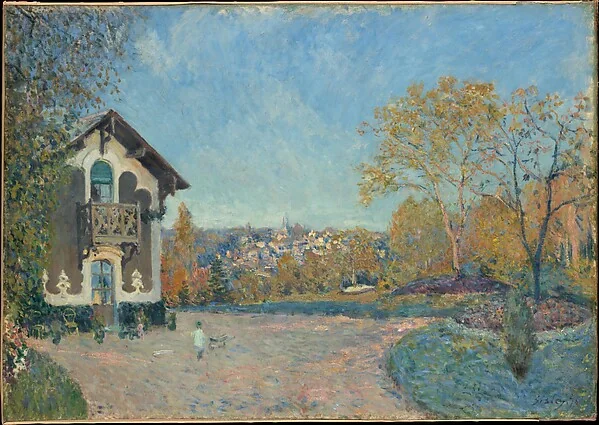
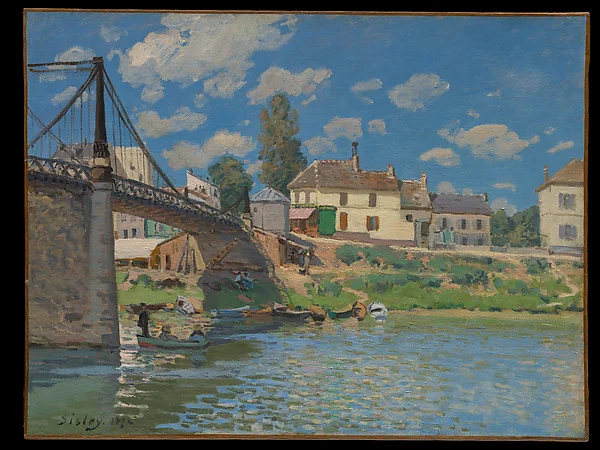
Alfred Sisley's "Street in Moret" (c. 1890) captures a quiet street scene in the small town of Moret-sur-Loing, where the artist spent the final years of his life. Sisley (1839–1899) was one of the founding members of Impressionism, and throughout his career he remained the most consistently faithful to the movement's original principles: painting outdoors (plein air), capturing the effects of light and atmosphere, and choosing landscapes and rural scenes over the urban subjects favored by his colleagues. Moret-sur-Loing, located southeast of Paris, became Sisley's home and primary subject after 1880. This painting shows a street lined with buildings rendered in soft, warm tones, with the characteristic play of light and shadow that marks Sisley's mature style. His brushwork is delicate and feathery, building form through touches of color rather than strong contours. Unlike Monet, who pursued ever more radical experiments with color and light, or Renoir, who moved toward a more classical style, Sisley remained committed to the gentle observation of nature, producing works of quiet beauty that are sometimes overlooked but reveal deeper appreciation.
Cultural Impact
Sisley is often called the "forgotten Impressionist," but his consistent dedication to landscape painting and his sensitivity to atmospheric effects make his work essential to understanding the full range of Impressionist achievement.
Why It Matters
This quiet street scene embodies Sisley's unique contribution to Impressionism: a gentle, unforced poetry of ordinary places, where the beauty of a provincial street at a particular moment of light becomes worthy of the artist's deepest attention.