Description
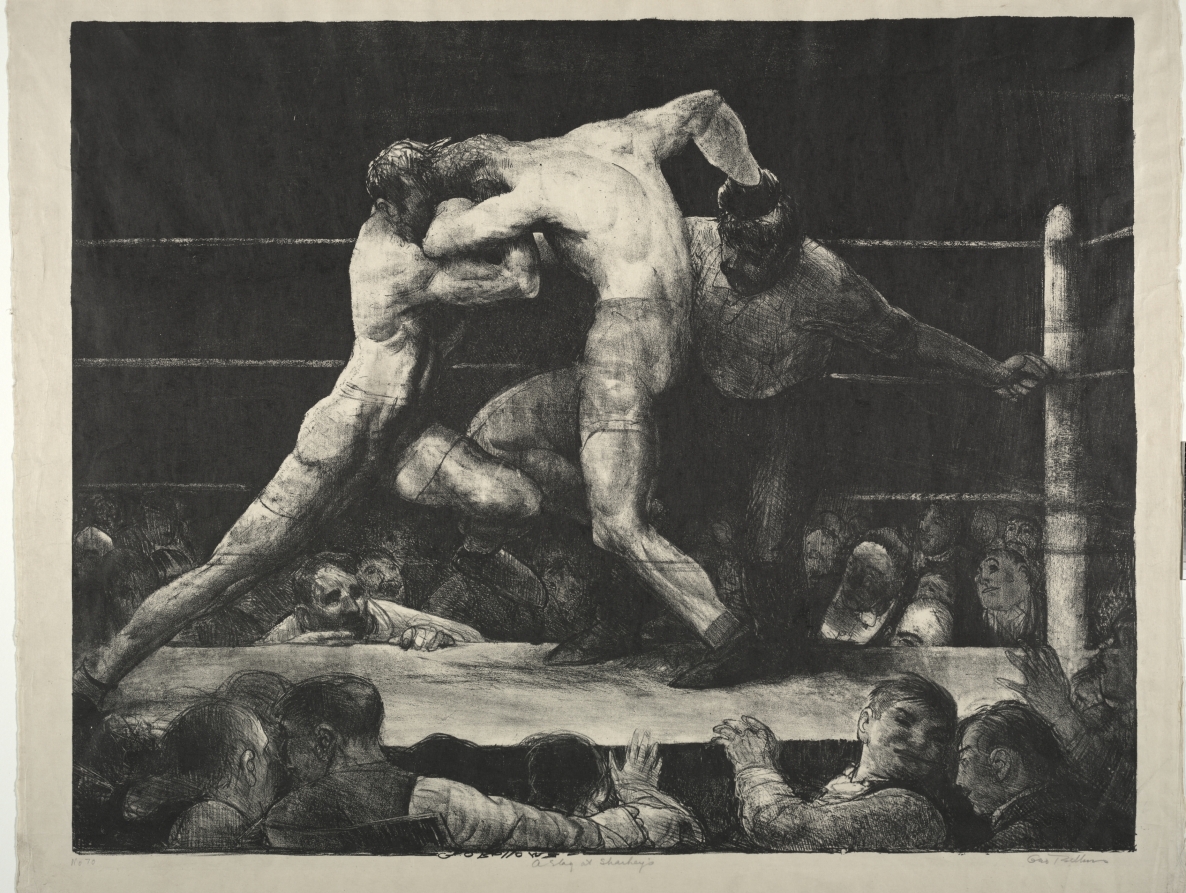
Bellows was no stranger to Sharkey’s Athletic Club, a raucous saloon with a backroom boxing ring, located near his studio. Founded by Tom “Sailor” Sharkey, an ex-fighter who had also served in the US Navy, the club attracted men seeking to watch or participate in matches. Because public boxing was illegal in New York at the time, a private event had to be arranged in order for a bout to take place. Participation was usually limited to members of a particular club, but whenever an outsider competed, he was given temporary membership and known as a “stag.” Although boxing had its share of detractors who considered it uncouth at best or barbaric at worst, its proponents—among them President Theodore Roosevelt—regarded it a healthy manifestation of manliness. Around the time Bellows painted Stag at Sharkey’s, boxing was moving from a predominantly working-class enterprise to one with greater genteel appeal. For some contemporaries, boxing was a powerful analogy for the notion that only the strongest and fittest would flourish in modern society.
Provenance
(Marie Sterner, New York, sold to the Cleveland Museum of Art) (By 1922); The Cleveland Museum of Art, Cleveland, OH (1922-)
Accession Number
1922.1133
Medium
oil on canvas
Dimensions
Framed: 110 x 140.5 x 8.5 cm (43 5/16 x 55 5/16 x 3 3/8 in.); Unframed: 92 x 122.6 cm (36 1/4 x 48 1/4 in.)
Classification
Painting
Credit Line
Hinman B. Hurlbut Collection
Tags
Painting Early Modern (1901–1950) Oil Painting Canvas American Color: Orange Color: Blue
Background & Context
Background Story
Stag at Sharkey's (1909) is perhaps George Bellows's most famous painting, depicting a boxing match at Tom Sharkey's Athletic Club, a saloon and fight venue on Manhattan's Lower East Side. The title's 'stag' refers to the all-male policy of the club—only men were admitted to the fight nights, creating an environment of raw masculine energy that Bellows captures with unprecedented intensity. The two fighters are locked in a clinch, their bodies intertwined in a composition that suggests both violence and an almost sculptural beauty—the interlocking forms create a single mass of straining muscle that has been compared to Michelangelo's Battle of Cascina cartoon. Around the ring, a dark crowd of male faces presses forward, their expressions ranging from excitement to grim determination. Bellows compresses the ring and crowd into a tight, vertical composition that amplifies the claustrophobic intensity of the club interior. The 1909 date places this at the height of Bellows's boxing period and at a moment when boxing was being debated in New York politics—would the sport be legalized? Bellows's painting contributed to public awareness of the boxing world, making the underground prizefight visible to a wider audience. The painting's fame rests on its unprecedented combination of journalistic detail with formal sophistication.
Cultural Impact
Stag at Sharkey's became the single most reproduced image of boxing in American art, influencing every subsequent depiction of the sport. The painting influenced film—every boxing movie from The Champ to Raging Bull owes something to Bellows's visual vocabulary of the ring, the crowd, and the overhead light. The work also influenced how masculinity and male violence were represented in American culture, establishing an image of primal male combat that persisted through 20th-century popular culture. The painting remains the most recognized work of the Ashcan School movement.
Why It Matters
This painting matters because it achieves a rare synthesis: it is simultaneously a record of a specific social world, a formal composition of extraordinary sophistication, and a meditation on violence, masculinity, and spectatorship. That Stag at Sharkey's can be all these things simultaneously—without any dimension diminishing the others—is what makes it one of the greatest American paintings. It demonstrates that realism and formal ambition are not incompatible and that popular culture can generate images as complex and rewarding as any classical subject.