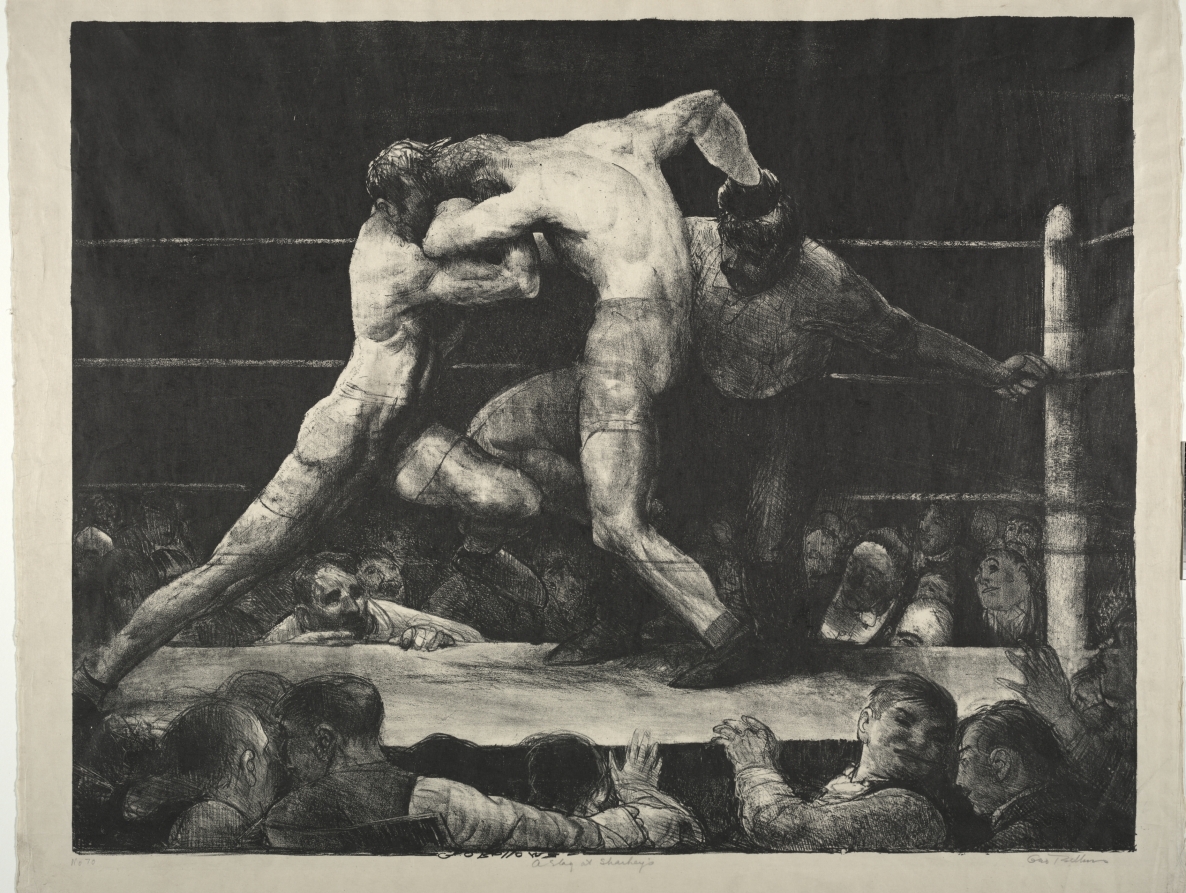
Description
The Hag and the Young Man was one of 15 drawings Bellows made to illustrate The Wind Bloweth, a story by Donn Byrne set in Ireland. This illustration was reproduced on page 96 of the May 1922 issue of The Century Magazine. For some reason, however, this illustration was not used when the novel was reprinted as a book later in 1922. Bellows's interest in Irish subjects was probably sparked by his friendship with the Irish painter John Butler Yeats (1839–1922).
Provenance
Frank K.M. Rehn, New York, NY (?-1937); The Cleveland Museum of Art, Cleveland, OH (December 20, 1937)
Accession Number
1937.512
Medium
black lithographic crayon (rubbed in sky)
Dimensions
Image: 45.6 x 36.8 cm (17 15/16 x 14 1/2 in.); Sheet: 58.6 x 54 cm (23 1/16 x 21 1/4 in.)
Classification
Drawing
Credit Line
Leonard C. Hanna Jr. Fund
Tags
Color: Brown Color: Gray
Background & Context
Background Story
George Bellows's "The Hag and the Young Man" (probably 1922) is a powerful drawing in black lithographic crayon that showcases the artist's raw, muscular draftsmanship. Bellows (1882–1925) was one of America's foremost realist painters and draftsmen, associated with the Ashcan School—a group of artists committed to depicting everyday urban life with unflinching honesty. This drawing shows an elderly woman (the "hag") in conversation with a young man, their faces and bodies rendered in Bellows's characteristic bold, rubbed strokes. The lithographic crayon allowed Bellows to create a range of tones from deep, velvety blacks to soft grays where the crayon was rubbed into the paper's grain. The subject—an encounter between age and youth, experience and naivety—was a recurring theme in Bellows's work. In his final years, Bellows had moved away from the boxing scenes and urban street life that first made his reputation toward more psychological and allegorical subjects. This drawing belongs to that late period, when his draftsmanship had achieved an expressive freedom that his early, more academic work had only promised.
Cultural Impact
Bellows was a leading figure in the Ashcan School and the broader American realist movement, and his drawings demonstrate the fusion of journalistic observation with fine art technique that defined early 20th-century American realism.
Why It Matters
This drawing shows Bellows's mature style at its most expressive, using the rough texture of lithographic crayon to create a scene charged with psychological tension between age and youth, wisdom and recklessness.