Provenance
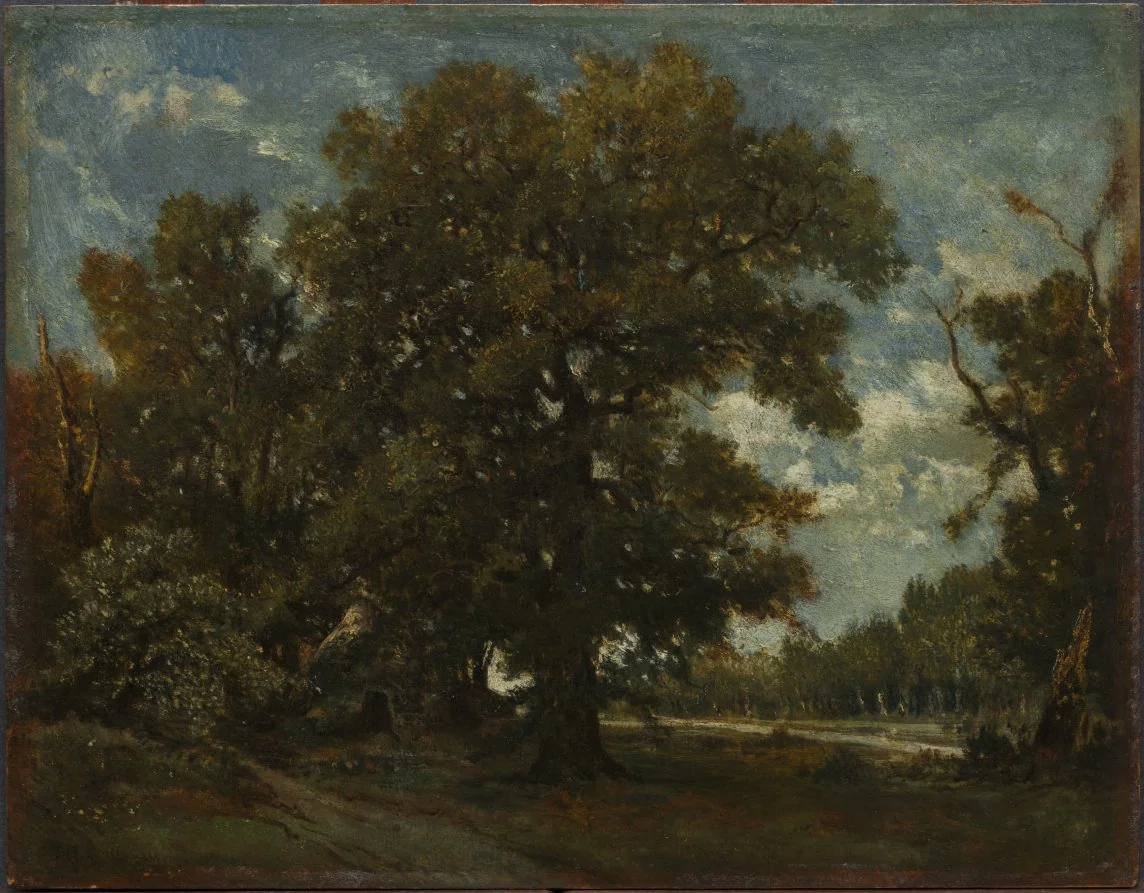
Possibly Goupil Paris/New York (according to label on reverse). Terms collection, Liège. Galerie Delmonico, Paris, New York. Bought from them in 1892 by Mr. and Mrs. Jeptha Wade, Cleveland. Given to the CMA in 1916.
Accession Number
1916.1052
Medium
oil on paper mounted on wood panel
Dimensions
Unframed: 26.4 x 28.6 cm (10 3/8 x 11 1/4 in.)
Classification
Painting
Credit Line
Gift of Mr. and Mrs. J. H. Wade
Tags
Painting Neoclassical & Romantic (1751–1850) Oil Painting Panel Painting French Color: Yellow
Background & Context
Background Story
The Oak Tree presents Rousseau's most iconic subject: a single, massive oak dominating the composition like a portrait of an individual tree rather than a landscape element. The oak—particularly the gnarled, ancient oaks of Fontainebleau's forest—became Rousseau's signature motif, the vehicle through which he expressed his deepest convictions about nature, resilience, and artistic truth. In the French landscape tradition, the oak carried rich associations: strength, longevity, national identity (the oak was associated with Gaul and France's pre-Roman heritage), and the specific beauty of France's ancient forests. Rousseau's treatment anthropomorphizes the tree without anthropocentrizing it—the oak is not decorative backdrop for human activity but the primary subject, worthy of the same close attention a portrait painter would give a face. Each branch, each knob of bark, each hollow trunk receives focused attention, suggesting that the tree's form encodes its history of survival through storms, droughts, and human encroachment. This work belongs to a tradition of single-tree portraiture in European art that includes Albrecht Altdorfer, Caspar David Friedrich, and later Van Gogh, but Rousseau's approach is distinctive: naturalistic rather than symbolic, observational rather than romantic.
Cultural Impact
Rousseau's oak tree paintings influenced how trees were represented in art, shifting the convention from decorative backdrop to primary subject. This elevation of the individual tree influenced later painters from Van Gogh's olive trees to Mondrian's abstracted trees to contemporary environmental art that treats individual trees as subjects rather than objects. The paintings also influenced conservation thinking: Rousseau's oaks made viewers aware that ancient trees represent irreplaceable living history.
Why It Matters
The Oak Tree matters because it establishes the principle that a single natural object—a tree—can be a worthy subject for serious art without symbolic or narrative justification. The tree is sufficient as itself. For contemporary environmental artists and conservation photographers, Rousseau's approach provides historical precedent for treating individual organisms as subjects rather than scenery.