Description
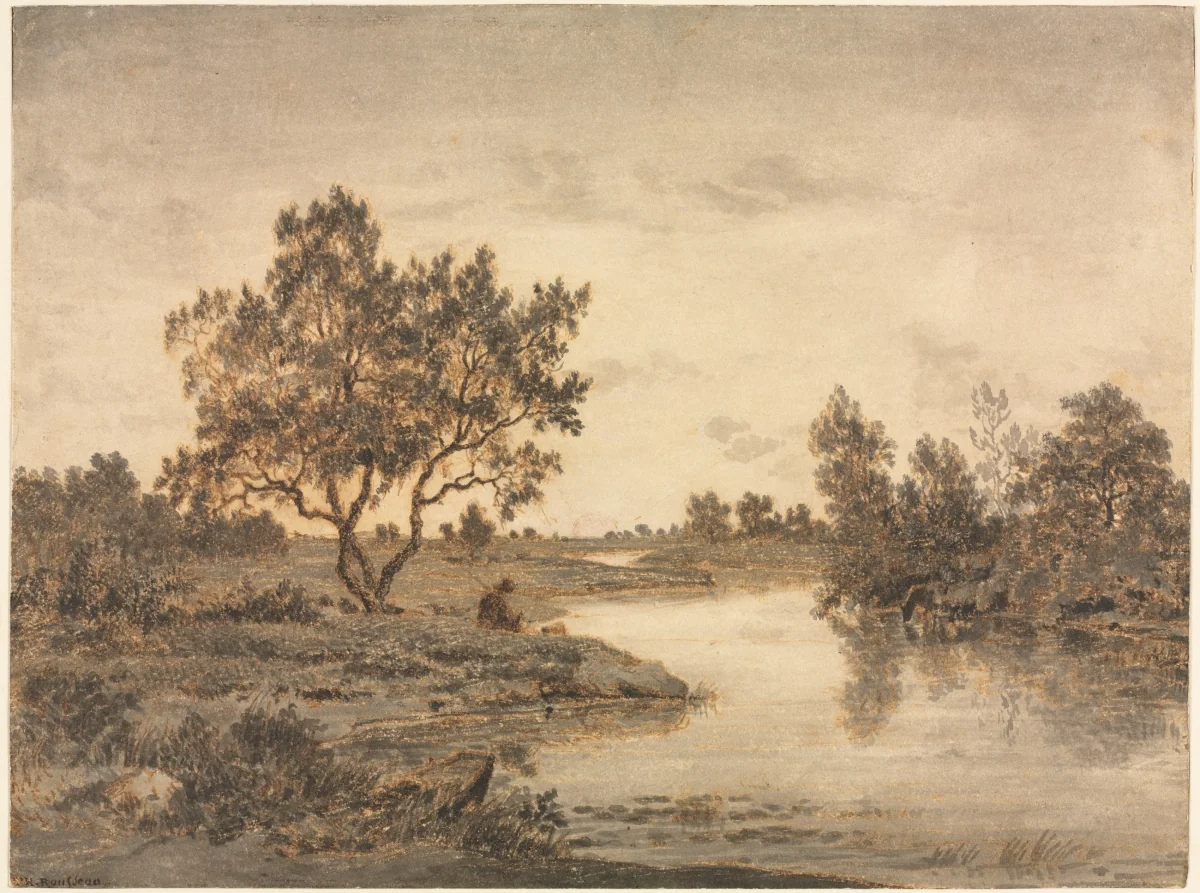
The quintessential Barbizon artist, Rousseau was romantically in love with nature. He spent the better part of twenty years living in near poverty in a cottage in the village of Barbizon, painting in a converted barn. The Fisherman is an early drawing by the artist, probably executed on the outskirts of Paris. The tree, the foreground grasses and rocks, and the humble form of the fisherman at rest are rendered with great specificity. Rousseau thought of each tree in the Forest of Fontainebleau as being almost human, each marked by a particular fate and struggle.
Provenance
[Schaeffer Galleries, New York]
Accession Number
1980.18
Medium
pen and brown ink and brush, gray and black wash (scratched away in places), with touches of pink watercolor
Dimensions
Sheet: 20.9 x 28 cm (8 1/4 x 11 in.); Secondary Support: 20.9 x 28 cm (8 1/4 x 11 in.); Tertiary Support: 29.6 x 37.9 cm (11 5/8 x 14 15/16 in.)
Classification
Drawing
Credit Line
John L. Severance Fund
Tags
Drawing Neoclassical & Romantic (1751–1850) Watercolor Ink French Color: Brown Color: White
Background & Context
Background Story
The Fisherman, executed around 1840-45 in pen and brown ink with brush and wash, reveals Rousseau as a masterful draftsman whose graphic works rival his oil paintings in expressive power. The mixed-media technique—ink, wash, scratched-away areas, and touches of pink watercolor—creates a richly layered surface that simultaneously evokes the fisherman's environment: water, sky, vegetation, and the fisherman himself. The scratched-away technique is particularly notable: by removing material from the surface, Rousseau creates highlights that seem to emerge from within the composition rather than being applied to it—an approach that parallels his painterly method of building tonal relationships through layering rather than line. The fisherman as subject connects this drawing to the broader Barbizon tradition of depicting rural labor with dignity. 1840-45 places this work in Rousseau's difficult period, when the Salon was consistently rejecting his submissions. Drawing offered a medium free from institutional judgment, allowing Rousseau to work with complete independence. The touches of pink watercolor—unusual in a predominantly brown drawing—suggest dawn or dusk light, adding a chromatic dimension to what would otherwise be a monochrome study.
Cultural Impact
Rousseau's graphic works influenced the tradition of mixed-media landscape drawing in France, demonstrating that ink, wash, and watercolor could be combined with subtractive techniques to create richly atmospheric effects. The drawings influenced later French printmakers and draftsmen who sought to capture landscape effects through similar means. The fisherman subject, treated with such technical sophistication, also elevated genre drawing to the level of fine art.
Why It Matters
This drawing matters because it demonstrates that working on paper could be as ambitious and expressive as painting on canvas. Rousseau's willingness to experiment with mixed media and subtractive techniques in a drawing context expanded the possibilities of graphic art. For contemporary artists working across media, The Fisherman provides a historical precedent for combining materials in unconventional ways to achieve specific visual effects.