Provenance
J. Léger, Paris. Galerie Claude Aubry, Paris. Severance and Greta Millikin, Cleveland. Given to the CMA in 1964.
Accession Number
1964.290
Medium
oil on wood panel
Dimensions
Unframed: 15.9 x 24.6 cm (6 1/4 x 9 11/16 in.)
Classification
Painting
Credit Line
Severance and Greta Millikin Collection
Tags
Painting Neoclassical & Romantic (1751–1850) Oil Painting Panel Painting French Color: Gold
Background & Context
Background Story
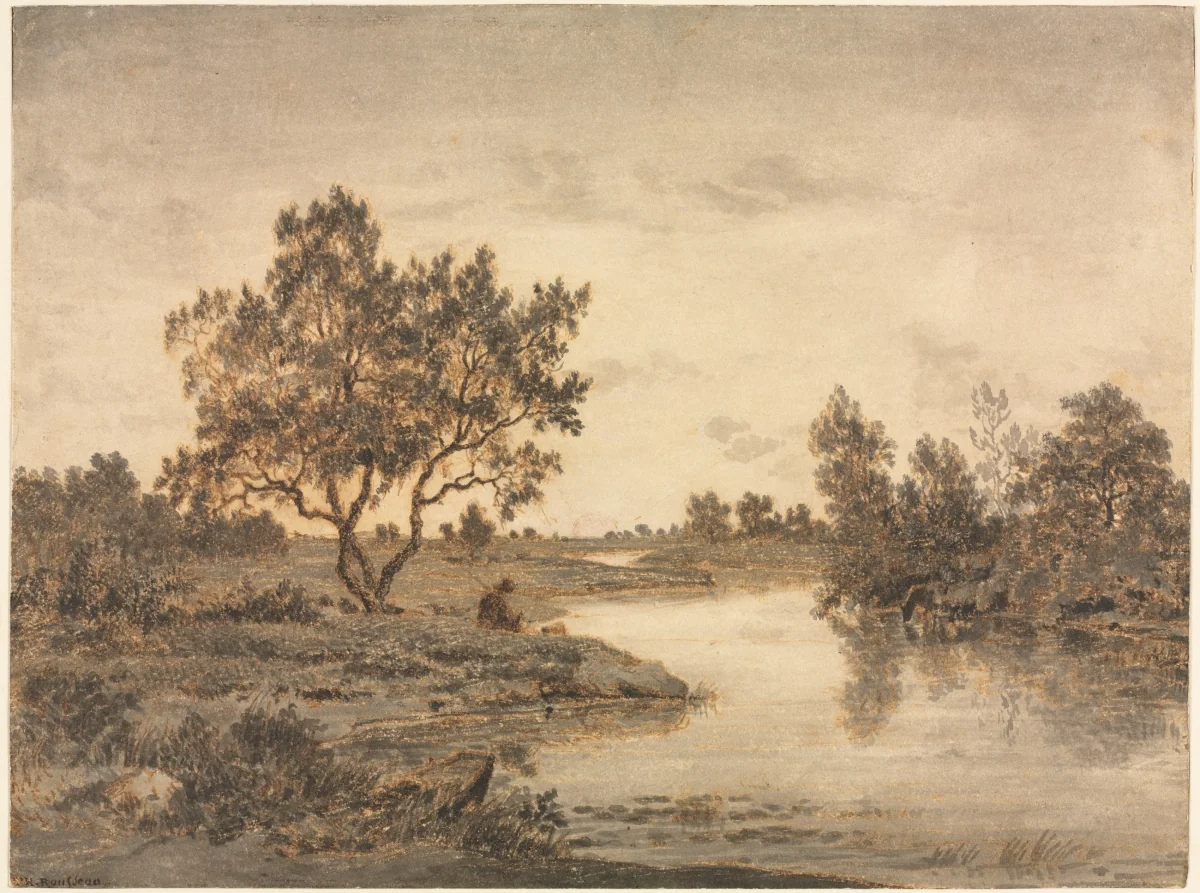
Rousseau's Marshlands depicts the wetland landscapes that were among the most challenging subjects in 19th-century landscape painting. Marshland resisted the picturesque conventions that had organized landscape art since Claude Lorrain: it had no dramatic peaks, no classical ruins, no elegant waterfalls—only flat, waterlogged terrain, reed beds, and the subtle gradations of green, brown, and gray that characterize wetland environments. By choosing this subject, Rousseau continued his democratic expansion of landscape painting's territory, insisting that even the most visually humble terrain contained artistic possibilities. His handling likely emphasizes the atmospheric effects that marshlands generate: the mists rising from standing water, the reflections in shallow pools, the subtle color transitions between different types of wetland vegetation. Oil on wood panel—the medium Rousseau often preferred for small-scale works—allows the paint to sit on the surface with a density and texture that conveys the marshland's material qualities: damp, dense, and resistant to the foot as well as the brush. The 19th-century context is environmentally significant: France's marshlands were being systematically drained for agriculture, eliminating ecosystems that would later be recognized as critically important for biodiversity and water management.
Cultural Impact
Rousseau's marshland paintings influenced later artists who sought out marginal landscapes—from the watery meadows of Daubigny to the tidal flats of American Luminist painting. The paintings also contributed to evolving perceptions of wetland landscapes, which were historically dismissed as unhealthy wastelands but are now recognized as essential ecosystems. In this sense, Rousseau's art anticipated 20th-century environmental awareness by more than a century.
Why It Matters
Marshlands matters because it challenges the assumption that artistic value requires visual drama. Rousseau found beauty in terrain that most viewers would overlook or even avoid, demonstrating that the artist's task is not to select beautiful subjects but to reveal beauty through attentive seeing. For contemporary artists working in threatened ecosystems, Rousseau's marshland paintings provide a model for elevating overlooked environments through artistic seriousness.