Accession Number
1917.67
Medium
oil on canvas
Dimensions
Unframed: 34.3 x 59.5 cm (13 1/2 x 23 7/16 in.)
Classification
Painting
Credit Line
Gift of Albert Rosenthal
Tags
Painting Neoclassical & Romantic (1751–1850) Oil Painting Canvas American Color: Brown Color: Gray
Background & Context
Background Story
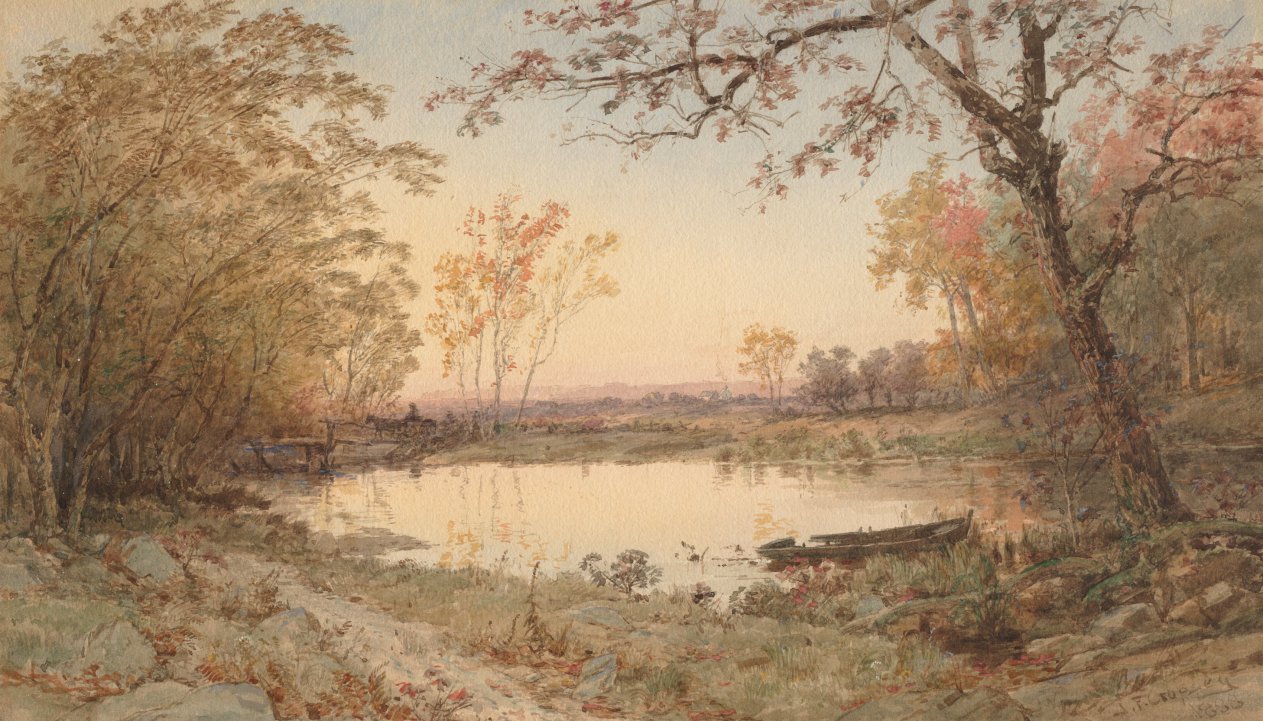
Jasper Francis Cropsey's Landscape (before 1918, likely painted much earlier) exemplifies the Hudson River School painter's approach to the American wilderness as a manifestation of divine creation. Cropsey, known as America's painter of autumn for his brilliant renderings of fall foliage, approached landscape painting as both aesthetic practice and spiritual exercise. His typical compositions feature dramatic vistas with atmospheric perspective—near foreground details dissolving into hazy distance—creating a sense of nature's immensity that was central to the Hudson River School's vision. The American landscape, for Cropsey and his contemporaries, was not merely scenery but evidence of God's handiwork, a natural cathedral that elicited the same awe as European churches. Cropsey's handling of autumn color—his signature subject—involved chromatic virtuosity: the reds, golds, and oranges of fall foliage rendered with an intensity that some critics found excessive but that Cropsey defended as truthful to nature's actual color at peak season. The painting likely features the Catskill or White Mountain scenery that provided Cropsey's most characteristic subjects—the mountain valleys, rushing streams, and forest canopies that defined the Hudson River School's vision of America's wilderness.
Cultural Impact
Cropsey's autumn landscapes influenced how American fall scenery was culturally perceived, establishing visual conventions for representing autumn color that persist in tourism imagery and popular imagination. His paintings influenced the Hudson River School's broader reputation as America's first significant landscape tradition and contributed to the conservation movement by presenting wilderness as a national treasure. The paintings also influenced American interior decoration, where autumn landscapes became staples of middle-class taste.
Why It Matters
This painting matters because it represents the Hudson River School at its most characteristic: the American landscape as a site of natural revelation, where wilderness serves spiritual as well as aesthetic functions. For contemporary audiences concerned about environmental degradation, Cropsey's paintings provide evidence of what the American landscape looked like before industrial development—making them both aesthetic objects and environmental documents.