Description
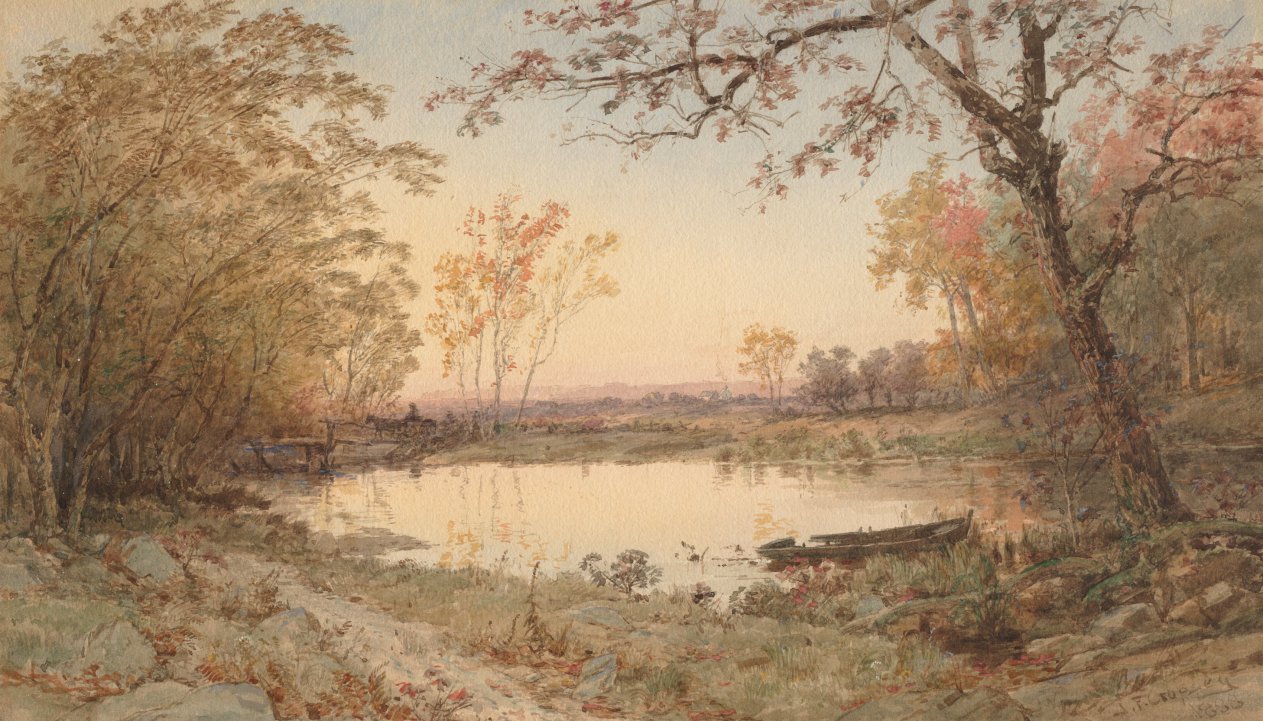
Cropsey practiced architecture but painted in his spare time, exhibiting a landscape painting to favorable reviews at the National of Design, New York, in 1843. This view of Orange County, New York, is one of Cropsey’s earliest known works. Commanding trees and rocks in the foreground are rapidly indicated, while carefully rendered topographical details in the distant landscape reveal greater attention to nature’s complexity and expanse. This drawing provided the basis for an oil painting of 1845, View of Greenwood Lake, New Jersey. Cropsey became a leading artist of the Hudson River school in the 1840s and 1850s.
Provenance
Collection of William P. Wright, Weehawken, NJ (?–?); Mr. J.W.L. Jones, Tiffin, OH, given to The Cleveland Museum of Art, Cleveland, OH (?–1933); The Cleveland Museum of Art, Cleveland, OH (December 28, 1933–)
Accession Number
1933.401
Medium
pen and black ink, and brown wash heightened with white, over traces of graphite
Dimensions
Sheet: 24.2 x 37.8 cm (9 1/2 x 14 7/8 in.)
Classification
Drawing
Credit Line
Gift of J. W. L. Jones
Tags
Drawing Neoclassical & Romantic (1751–1850) Ink Graphite & Pencil American Color: White
Background & Context
Background Story
A View from Bald Mountain, Orange County, N.Y. (1843) is an early work depicting the landscape of Orange County in the Hudson Valley—terrain that was readily accessible from New York City and that attracted many Hudson River School painters. The painting's specific topographical designation—Bald Mountain—reflects the Hudson River School's commitment to representing actual American places rather than generalized Italianate compositions. Cropsey, only 20 when this was painted, was already demonstrating the topographical precision and atmospheric sensitivity that would characterize his mature work. The year 1843 was a formative one for American landscape painting: Thomas Cole, the Hudson River School's founder, was at the height of his powers, and Asher Durand was establishing the more naturalistic approach that would distinguish the second generation. Cropsey's early view from Bald Mountain shows Cole's influence in the dramatic composition while anticipating Durand's more observational approach in the foreground detail. The painting also documents a specific American landscape at a specific moment—Orange County before suburban development transformed the Hudson Valley's rural character. The mountain's 'bald' summit, likely cleared by fire or logging, provides the viewpoint from which the valley unfolds in a composition that celebrates both the specific place and the general principle of American natural beauty.
Cultural Impact
Cropsey's Orange County paintings influenced how the Hudson Valley was perceived and represented in American art, establishing a visual vocabulary for its characteristic terrain that influenced later painters and tourism imagery. The early works influenced understanding of Cropsey's artistic development, providing evidence of how the Hudson River School's conventions were absorbed and transformed by the next generation. The paintings also documented the Hudson Valley's appearance before railroad-driven suburbanization.
Why It Matters
This painting matters because it documents both an artist's development and a landscape's history. The young Cropsey painting Bald Mountain in 1843 was learning his craft while recording a place that would change dramatically over the following century. For contemporary viewers, the painting provides a baseline for understanding both artistic tradition and environmental change in the Hudson Valley.