Provenance
Emerson McMillin, New York (Sale: American Art Association, NY Jan. 20-23, 1913 no. 46); M. Knoedler & Co., New York; Charles W. Harkness, New York; Eward S. Harkness, New York
Accession Number
1927.392
Medium
oil on canvas
Dimensions
Unframed: 50.8 x 61 cm (20 x 24 in.)
Classification
Painting
Credit Line
The Charles W. Harkness Gift
Tags
Painting Impressionist & Modern (1851–1900) Oil Painting Canvas American Color: Orange
Background & Context
Background Story
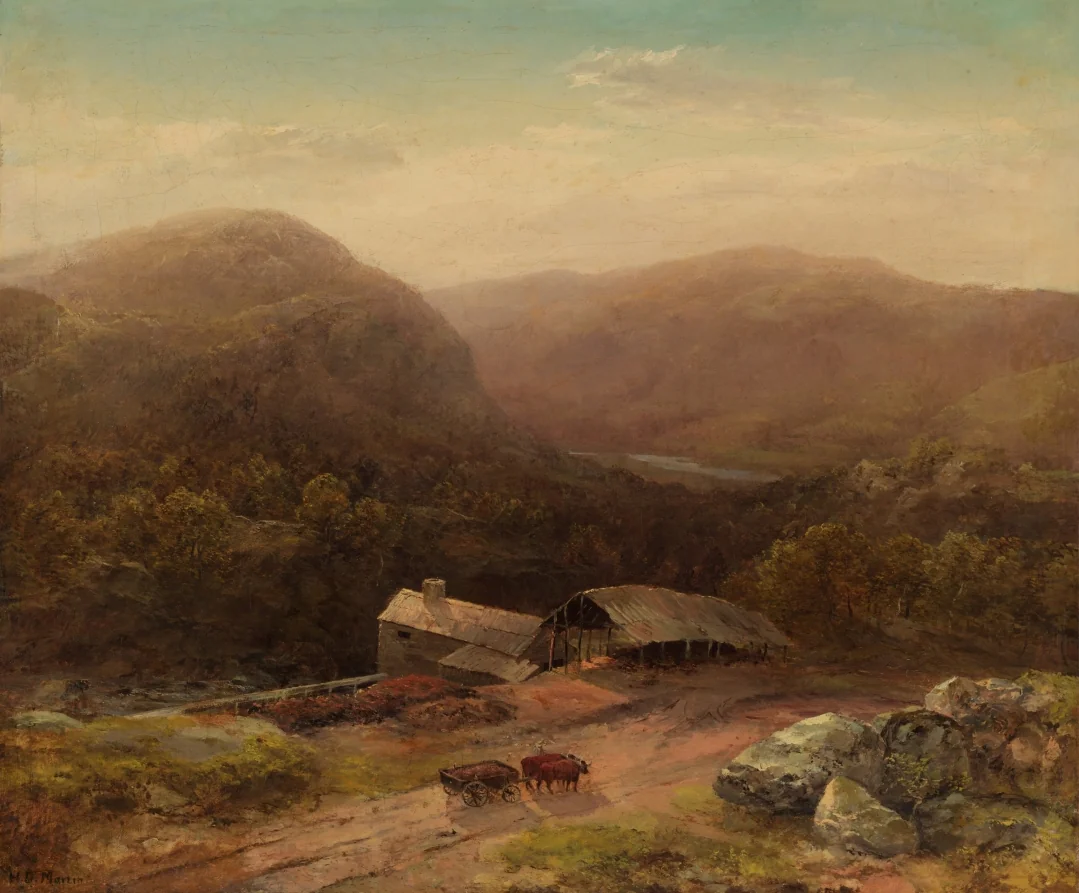
In the Housatonic Valley is an early work from the late 1850s, showing Martin under the influence of the Hudson River School — the dominant American landscape tradition of the mid-19th century. The Housatonic Valley, with its rolling hills, agricultural patterns, and river meandering through a broad floodplain, provided Martin with the kind of idyllic pastoral subject that Hudson River painters favored. The composition is organized around the conventional devices of the tradition: a central water feature, receding hills in atmospheric perspective, and a panoramic viewpoint that takes in the entire valley.
Cultural Impact
Martin's early Housatonic Valley paintings are important precisely because they show how far his style would travel from this Hudson River starting point. By the 1880s, his brushwork would loosen, his palette would darken, and his compositions would simplify to the point of near-abstraction. In the Housatonic Valley painting, we see the tradition that Martin would transform — the conventions he learned before he learned to break them.
Why It Matters
In the Housatonic Valley is the 'before' picture of Martin's career: Hudson River School conventions applied to a Connecticut valley with competence and feeling. Knowing that Martin would later strip these conventions down to their essence makes this early work more interesting as a document of artistic origins.