Accession Number
1946.291
Medium
watercolor
Dimensions
Overall: 24.8 x 34.4 cm (9 3/4 x 13 9/16 in.)
Classification
Drawing
Credit Line
In memory of Ralph King, gift of Mrs. Ralph King; Ralph T. Woods, Charles G. King; and Frances King Schafer
Tags
Drawing Impressionist & Modern (1851–1900) Watercolor American Color: White Color: Gray
Background & Context
Background Story
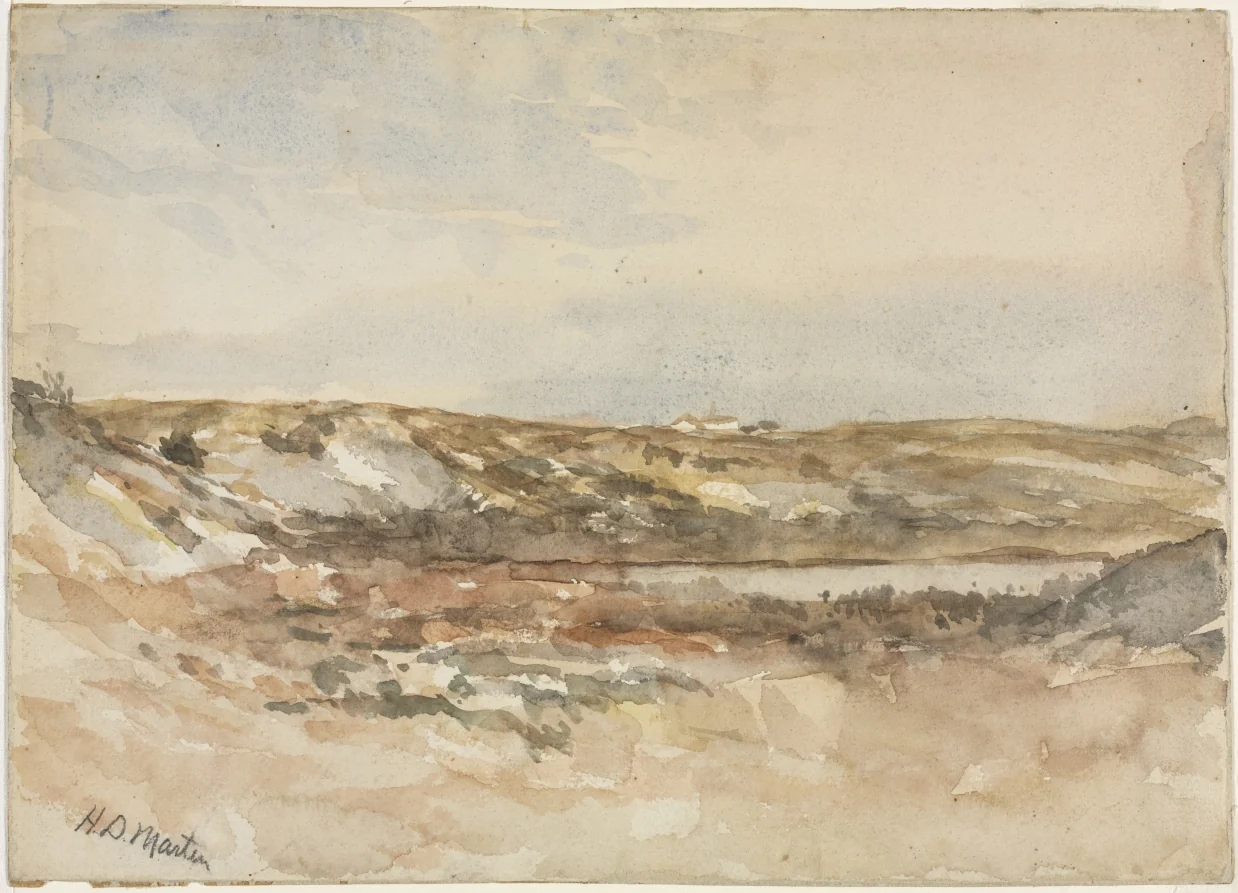
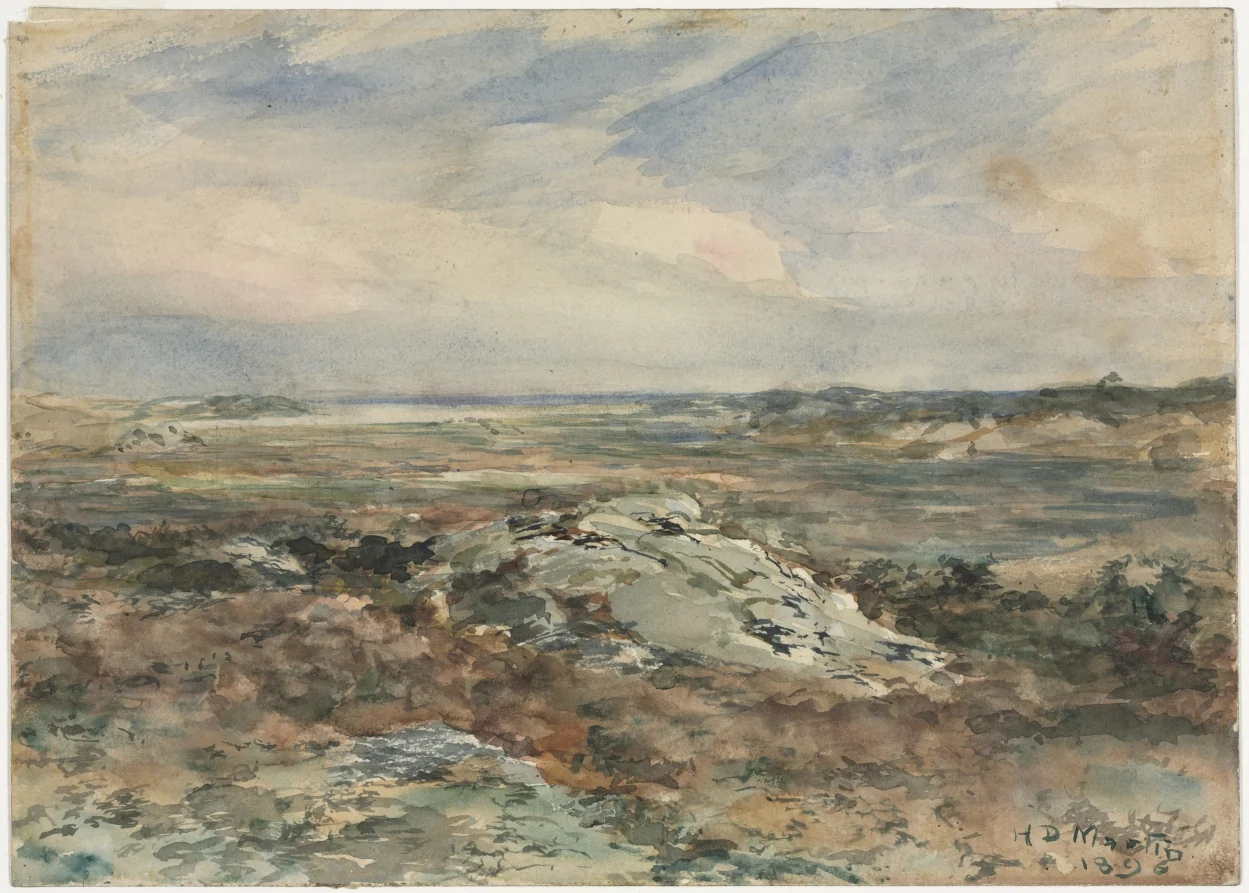
By 1896, the year before his death, Martin's landscape style had simplified to the point where the subject — trees, fields, sky — is barely distinguishable beneath layers of atmospheric paint. This watercolor landscape from his final year is among his most abstract works: the forms are suggested rather than described, the colors are tonally unified rather than locally specific, and the composition is organized around broad areas of light and dark rather than recognizable topographic features. The watercolor medium suits Martin's late style because its transparency and fluidity allow for the kind of dissolved, atmospheric effect that he was pursuing in oil.
Cultural Impact
Martin's late works are among the most radical landscapes in American art, anticipating the dissolution of form that would characterize early 20th-century modernism. His watercolors of the 1890s, in particular, approach adegree of abstraction that was not seen again in American landscape painting until Marsden Hartley and Arthur Dove a generation later.
Why It Matters
Landscape (1896) is Martin at his most radical: a watercolor where the subject has almost dissolved into atmosphere. Trees, fields, and sky are barely distinguishable — only light, dark, and color remain. This is American landscape painting on the edge of abstraction, a generation before abstraction became the point.