Accession Number
1929.465
Medium
oil on fabric
Dimensions
Unframed: 54.5 x 65.5 cm (21 7/16 x 25 13/16 in.)
Classification
Painting
Credit Line
Gift of the Estate of Charles F. Brush
Tags
Painting Impressionist & Modern (1851–1900) Oil Painting French Color: Yellow
Background & Context
Background Story
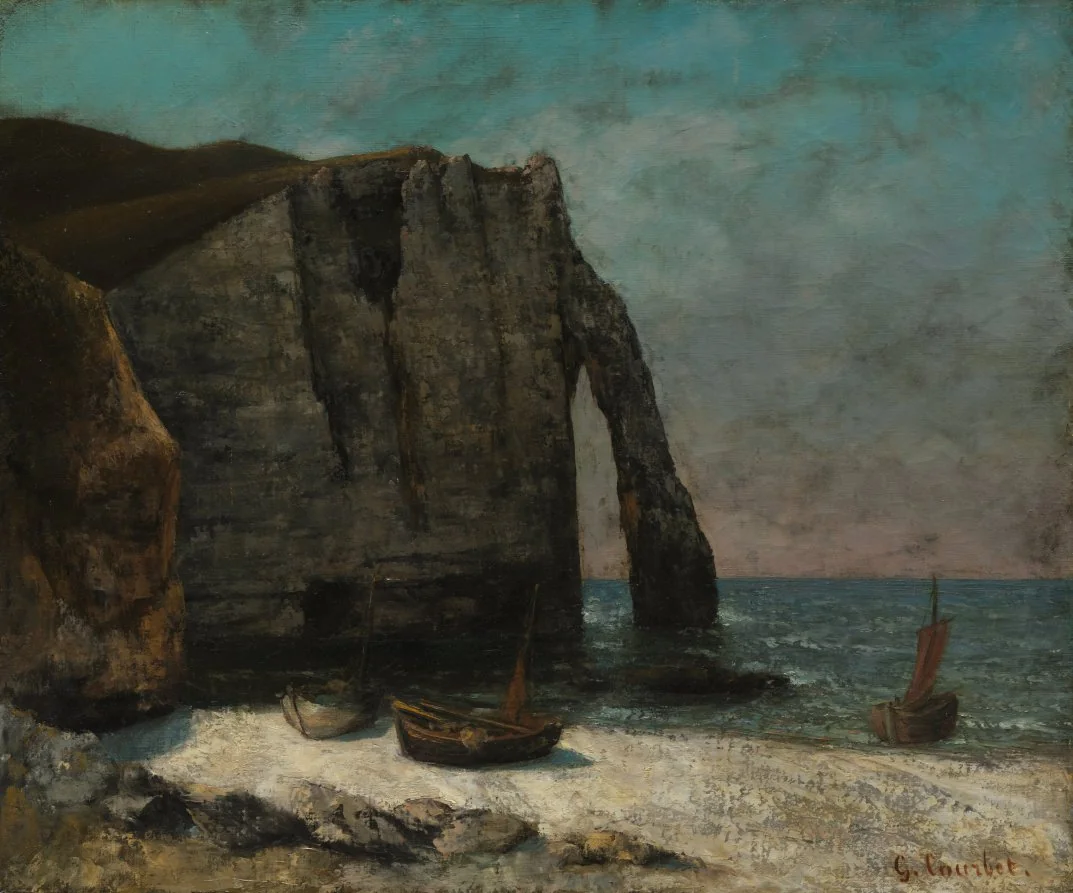
The Cliff at Étretat (after 1872) depicts the iconic chalk formations—the Porte d'Aval and the Aiguille—that make Étretat one of the most recognizable landscapes in France. Courbet's treatment of this famous subject differs from both the tourist views that already circulated and from Monet's later, more atmospheric interpretations. Courbet renders the cliff's geological character with an emphasis on material presence: the chalk's whiteness, the rock's physical mass, and the sea's constant action against the formation. The Porte d'Aval—the natural arch through which the sea flows—becomes in Courbet's composition a geological event rather than a scenic attraction. The painting's creation after 1872 places it during Courbet's late period, when his exile from France had changed his relationship with French landscapes. Étretat's cliffs, visible from the beaches where he had painted earlier, likely existed in his visual memory with particular clarity—the dramatic formations would resist forgetting. Courbet's handling of the cliff's white chalk against the dark sea creates a contrast of extraordinary physicality—the paint seems to embody the rock's resistance to the water's erosion, creating a painting that is itself an object of geological force rather than merely a picture of one.
Cultural Impact
Courbet's Étretat cliff paintings influenced how the Normandy chalk coast was represented in art, establishing a material rather than atmospheric approach that contrasted with Monet's later treatment. The paintings influenced tourism imagery for Étretat and contributed to the cliffs' cultural status as icons of French natural heritage. The subject also influenced geological art, demonstrating that landscape painting could serve scientific observation as effectively as aesthetic enjoyment.
Why It Matters
This painting matters because it demonstrates how a single landscape can yield radically different artistic interpretations depending on the artist's priorities. Where Monet's Étretat explores light and atmosphere, Courbet's explores mass and material—a distinction that reveals each artist's deepest convictions about what painting should do. The comparison between their treatments of the same subject provides perhaps the clearest illustration of the difference between Realist and Impressionist landscape approaches.