Description
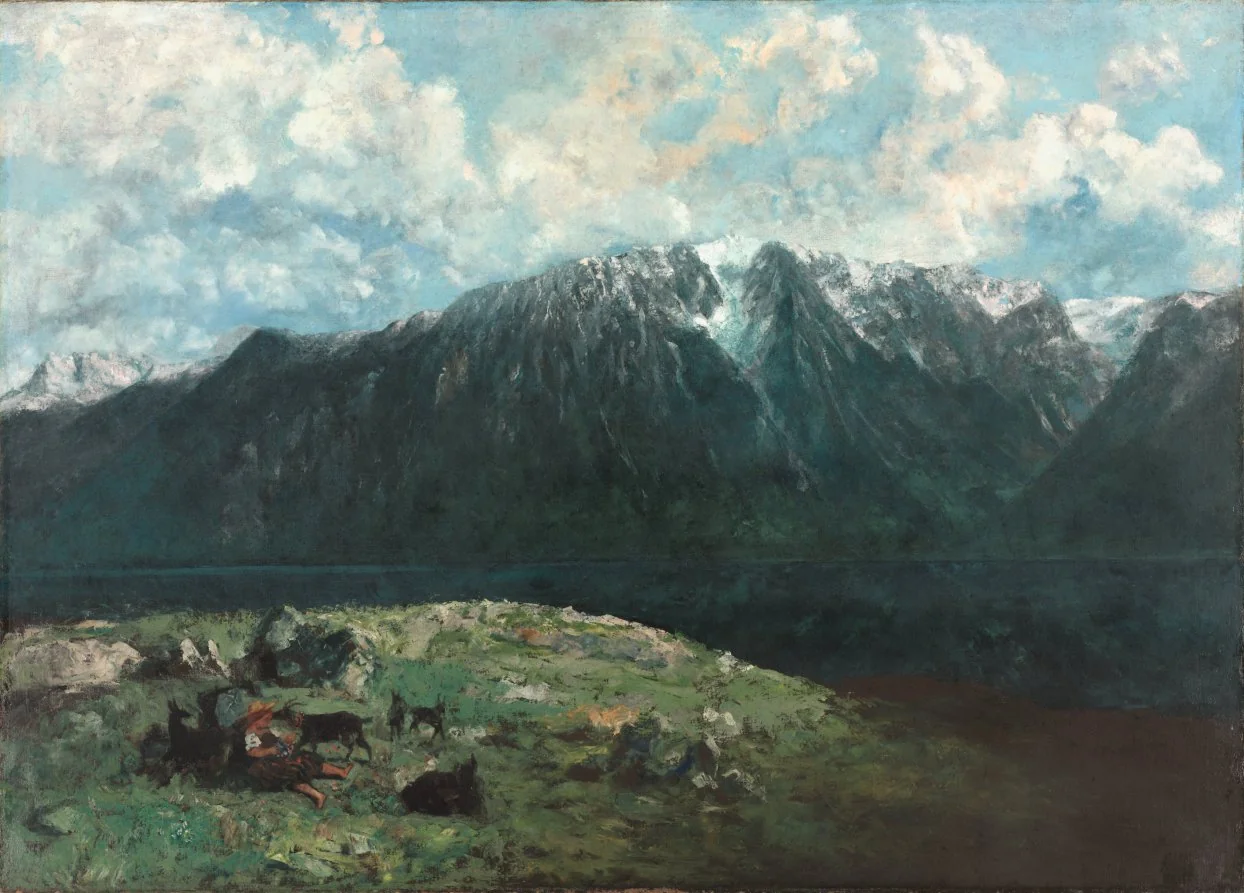
Courbet was still working on this large landscape, intended for the Paris Universal Exposition of 1879, when he died in December 1877. He painted it during his exile in Switzerland, where he had fled after being condemned for subversive activities in the Paris Commune of 1871. The view looks south over Lake Geneva toward the mountains called Les Dents du Midi. While some areas are heavily worked with a palette knife, the lower right remains unfinished.
Provenance
Juliette Courbet [1831-1915], sister of the artist, by descent to Mmes de Tastes and Lapierre (?-1915); Mmes de Tastes and Lapierre (1915-1919); (Galerie Georges Petit, Paris, France, July 9, 1919 (lot 12), La Dent du Midi, sold to Galerie Barbazanges) (1919); (Galerie Barbazanges, Paris, France) (1919); Mrs. Hennet Collection, Paris, France; Private collection, Paris, France; (Hirschl & Adler, New York, NY, sold to the Cleveland Museum of Art) (?-1964); The Cleveland Museum of Art, Cleveland, OH (1964-)
Accession Number
1964.420
Medium
oil on fabric
Dimensions
Framed: 172 x 230 x 8.5 cm (67 11/16 x 90 9/16 x 3 3/8 in.); Unframed: 151.2 x 210.2 cm (59 1/2 x 82 3/4 in.)
Classification
Painting
Credit Line
John L. Severance Fund and various donors by exchange
Tags
Painting Impressionist & Modern (1851–1900) Oil Painting French Color: Teal
Background & Context
Background Story
Courbet's Panoramic View of the Alps, Les Dents du Midi (1877) belongs to the artist's final years in Swiss exile and depicts the Alpine mountain range visible from his exile location near Lake Geneva. The Dents du Midi—the jagged peaks whose name translates literally as 'Midday Teeth'—create one of the most recognizable Alpine silhouettes, and Courbet renders them with the physical emphasis that characterizes his late landscape style. This painting represents a significant departure from Courbet's usual subjects: his native Jura hills and the Norman coast had dominated his landscape output, but exile forced him to find new territories. The Alps—vast, vertical, and overwhelming—provided a landscape commensurate with the emotional scale of Courbet's exile experience. The year 1877 was one of the last in which Courbet was productive; he would die in 1879, still in exile, still hoping to return to France. The panoramic format—wide and expansive—allows Courbet to encompass the Alpine range's full breadth, creating an image that matches the landscape's grandeur with compositional ambition. His handling of Alpine light—the clear, thin atmosphere that makes mountain painting uniquely challenging—shows his undiminished technical mastery even in deteriorating health.
Cultural Impact
Courbet's Alpine paintings influenced how mountain landscapes were represented in French art, demonstrating that Realist techniques could serve Alpine subjects as effectively as the Romantic approaches previously dominant. The paintings influenced tourism imagery for the Swiss Alps and contributed to the cultural perception of Alpine landscapes as sites of both natural grandeur and human smallness. The panoramic format influenced later Alpine painters who similarly sought to match their compositions to the landscape's scale.
Why It Matters
This painting matters because it represents an artist finding new subjects and new compositional strategies in the final years of his life, refusing to repeat familiar formulas even under the pressure of exile and declining health. For contemporary artists facing major life changes, Courbet's late Alpine paintings demonstrate that creative reinvention is possible at any stage, and that new landscapes can generate new artistic energy.