Description
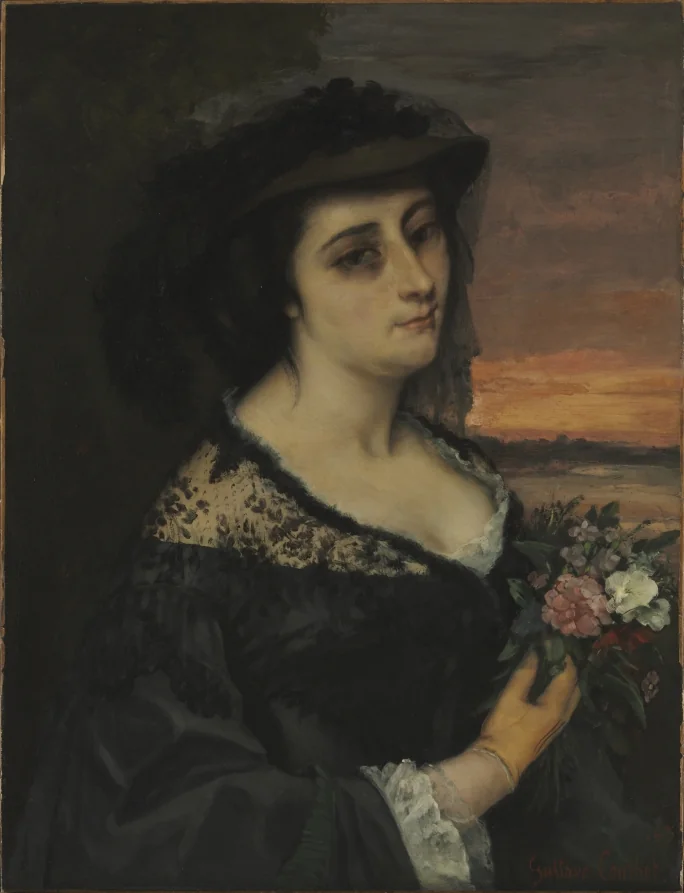
Painted during Courbet's stay in the Saintonge region of western France, this portrait depicts Laure Borreau, owner of a fabric store and ladies confectionery. As the leader of the Realist movement in France, Courbet aimed to convey his democratic and socialist ideals by portraying ordinary people in a truthful, unidealized manner. While considering himself a radical innovator, Courbet nonetheless exhibited this portrait under the title Mme L... at the Paris Salon of 1863.
Provenance
(Drouot, Paris, France, Artist's estate sale, December 9, 1881, lot 11, stock number 2070, sold to Durand-Ruel) (1881); (Durand-Ruel, Paris France, December 10, 1881, sold to Max Flersheim) (1881); (Paul Rosenberg and Company, New York, NY by 1934, sold to the Cleveland Museum of Art, 1962) (by 1934-1962); The Cleveland Museum of Art, Cleveland, OH (1962-)
Accession Number
1962.2
Medium
oil on fabric
Dimensions
Framed: 112.4 x 93 x 12.1 cm (44 1/4 x 36 5/8 x 4 3/4 in.); Unframed: 81 x 61.2 cm (31 7/8 x 24 1/8 in.)
Classification
Painting
Credit Line
Leonard C. Hanna Jr. Fund
Tags
Painting Impressionist & Modern (1851–1900) Oil Painting French Color: Brown
Background & Context
Background Story
Courbet's portrait of Madame L... (Laure Borreau), painted in 1863, represents his engagement with formal portraiture—a genre he approached with the same uncompromising Realism he brought to landscapes and genre scenes. Madame L... is identifiable as Laure Borreau, and the portrait reveals Courbet's ability to capture individual character with the same material specificity he brought to geological formations. The year 1863 is significant: this was the year of the Salon des Refusés, where Manet's Déjeuner sur l'herbe scandalized the public, and artistic conventions were being challenged across Paris. Courbet's portrait, while less publicly provocative than his earlier Origin of the World, demonstrates the Realist approach applied to portraiture: the sitter is represented exactly as she appears, without the idealization that conventional portraiture typically applied. The portrait's candidness—the unflattered representation of a real individual with real physical characteristics—connects it to Courbet's broader project of representing truth regardless of convention. Madame Borreau presumably commissioned the portrait, accepting Courbet's Realist approach to her appearance—an act of courage or vanity depending on interpretation.
Cultural Impact
Courbet's portraits influenced the development of Realist portraiture in France, demonstrating that the Realist method could serve individual representation as effectively as landscape or genre subjects. His approach influenced later French portrait painters who similarly refused idealization, and the portrait influenced how women's portraiture was understood—challenging the convention of feminine idealization with the same rigor he brought to all his subjects.
Why It Matters
This portrait matters because it demonstrates that Realism in portraiture is itself a form of honesty—perhaps the most challenging form, since the subject is a living person who must live with the result. Courbet's refusal to flatter his sitter represents an ethical position as much as an aesthetic one, raising questions about portraiture's obligations that remain relevant in an age of curated self-images and photographic filters.