Provenance
Guy Bellingham Smith; (Colnaghi & Co., London, England), sold to The Cleveland Museum of Art, Cleveland, OH (?-1929); The Cleveland Museum of Art, Cleveland, OH (July 31, 1929-)
Accession Number
1929.551
Medium
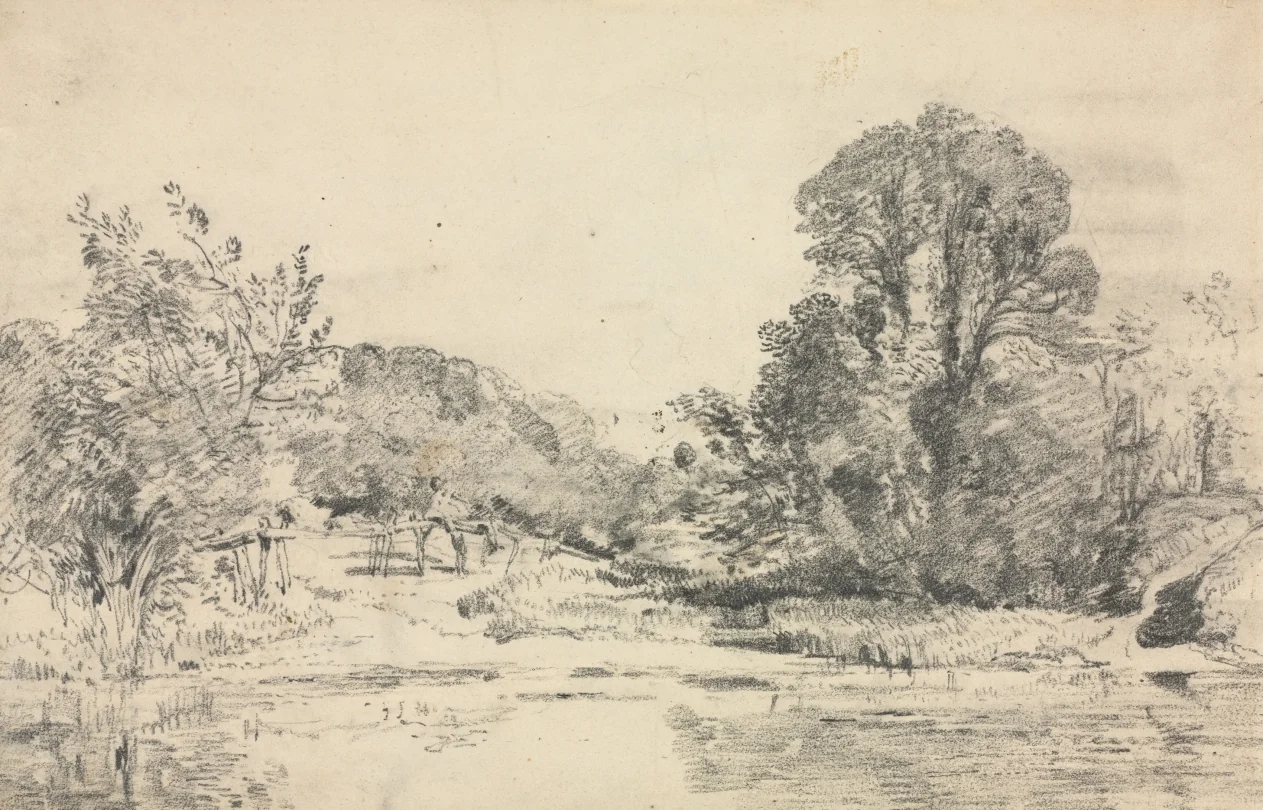
graphite
Dimensions
Sheet: 19.5 x 31.1 cm (7 11/16 x 12 1/4 in.)
Classification
Drawing
Credit Line
Dudley P. Allen Fund
Tags
Color: White Color: Gray
Background & Context
Background Story
John Constable's "Landscape with Trees Surrounding a Pond" (c. 1800–1837) is a graphite drawing that exemplifies the artist's lifelong practice of sketching directly from nature. Constable (1776–1837) was one of England's greatest landscape painters, whose revolutionary approach to capturing the natural world—particularly the skies, light, and vegetation of his native Suffolk countryside—transformed landscape painting forever. This drawing shows a tranquil pond surrounded by trees, likely in the Stour Valley area that Constable made famous. His graphite technique is distinctive: he builds form through parallel hatching and delicate stippling, capturing the mass and texture of foliage without resorting to the picturesque conventions favored by his contemporaries. Constable believed that painting should be grounded in direct observation, and he filled countless sketchbooks with drawings like this one—records of specific places at specific times that would later inform his great six-foot exhibition canvases. The dating of this drawing (c. 1800–1837) spans his entire career, and the style suggests it belongs to his mature period, when his observation of nature had become both deeply personal and scientifically precise.
Cultural Impact
Constable's dedication to sketching from nature established the practice of plein-air observation that would become fundamental to the Barbizon School and Impressionism, making him a key precursor to modern landscape art.
Why It Matters
This quiet graphite drawing contains the seeds of Constable's revolutionary approach: the conviction that a true landscape needed to be built from honest observation rather than inherited formulas, one tree and cloud at a time.