Description
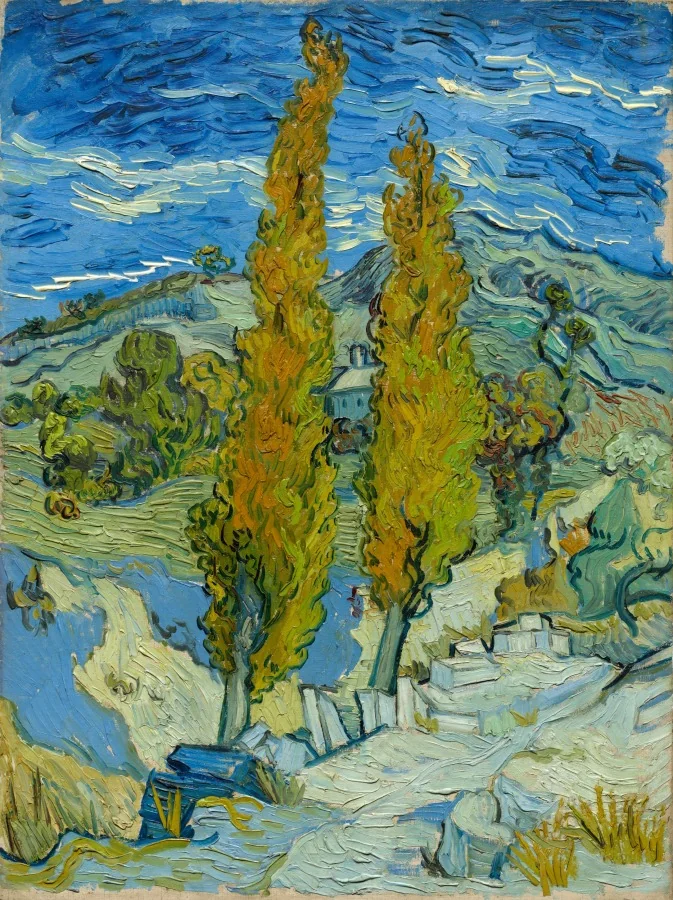
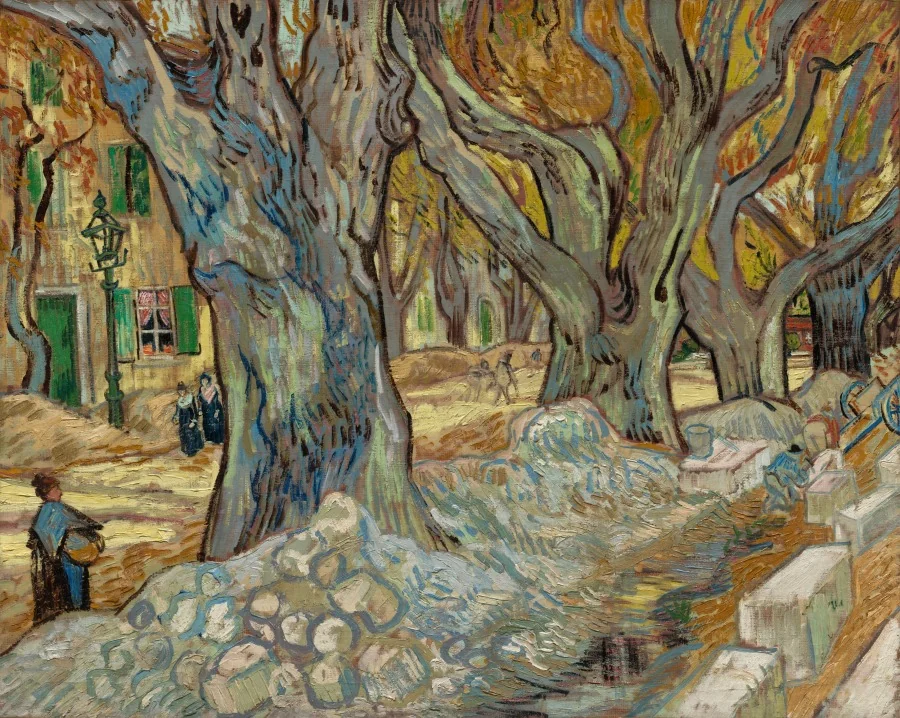
Like Two Poplars in the Alpilles near Saint-Rémy (on view nearby), Vincent van Gogh painted this autumnal landscape while living in a psychiatric hospital near Saint-Rémy in southern France where he was treated for severe depression. Understanding that painting from nature eased his symptoms, Van Gogh’s physician permitted the artist to paint landscapes outside. Van Gogh described this painting in a letter to his brother Theo: “The last study I did is a view of the village, where they were at work under some enormous plane trees—repairing the pavements. . . . There are heaps of sand, stones, and the gigantic trunks—the leaves yellowing and here and there you can get a glimpse of a house front and small figures.”
Provenance
Theo van Gogh [1857-1891], Paris, France (1890); Julien Leclercq [1865-1901] Paris, France (see document b1533 v/1962 in the archive of the Van Gogh Museum; (Schuffenecker Brothers, Paris, France, sold to Gustave Fayet, Igny, France); Gustave Fayet [1865-1925], Igny, France; Gilbert E. Fuller, Boston, MA (1929-1931); (Paul Rosenberg, New York, NY, July 18, 1947, sold to the Cleveland Museum of Art); The Cleveland Museum of Art, Cleveland, OH (1947-)
Accession Number
1947.209
Medium
oil on fabric
Dimensions
Framed: 104.5 x 124.5 x 7.6 cm (41 1/8 x 49 x 3 in.); Unframed: 73.4 x 91.8 cm (28 7/8 x 36 1/8 in.)
Classification
Painting
Credit Line
Gift of the Hanna Fund
Tags
Painting Impressionist & Modern (1851–1900) Oil Painting Dutch Color: Gray
Background & Context
Background Story
Van Gogh painted this view of plane trees lining a road near the asylum at Saint-Rémy in the autumn of 1889, during one of his most productive periods. The massive trunks and golden-yellow foliage fill the canvas from edge to edge, with tiny figures of road workers visible beneath the canopy. Van Gogh made two versions of this composition — one on a large scale (in the Cleveland Museum of Art) and this smaller version. The painting demonstrates his ability to find monumental drama in an ordinary Provençal roadside, transforming shade trees into cathedral columns.
Cultural Impact
The plane trees of southern France became one of Van Gogh's most powerful subjects during his year at Saint-Rémy. Living in the asylum, he could see these trees from the window and paint them en plein air during his permitted outings. The vertical trunks and horizontal road create a natural grid that appealed to his structural instincts, while the foliage allowed him to deploy the yellows and greens that were the signature of his Provençal palette.
Why It Matters
The Large Plane Trees shows Van Gogh finding order and beauty in an utterly ordinary subject. The road workers are almost invisible — this is not a painting about labor but about the magnificence of ordinary trees seen with extraordinary intensity.