Description
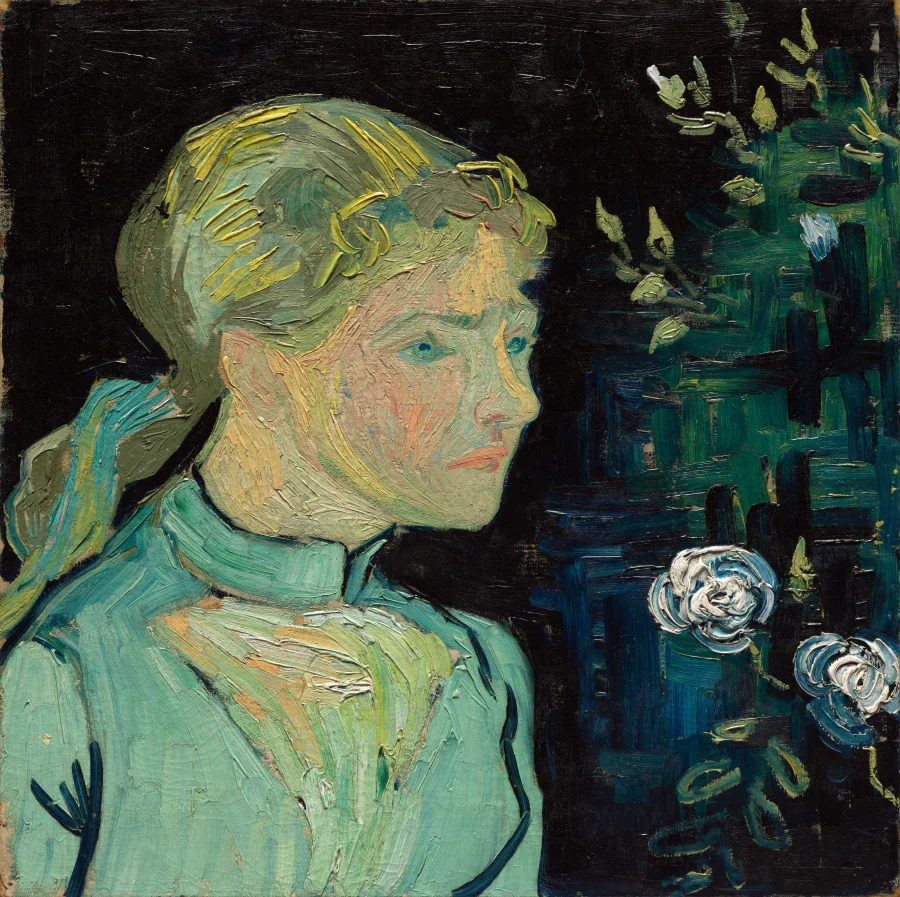
In May 1890, Vincent van Gogh arrived in Auvers, a small town north of Paris, where he rented a room at the inn of Arthur Ravoux. This portrait, completed during the last months of the artist’s life, depicts Ravoux’s 13-year-old daughter, Adeline. Van Gogh wrote that rather than photographic resemblance, he wanted his portraits to convey the “impassioned aspects” of contemporary life through the “modern taste for color.”
Provenance
Johanna Van Gogh-Bonger [1862-1925], the wife of Theo van Gogh, Amsterdam, Netherlands.; (Artz and de Bois, The Hague, Netherlands) (1912); Katherine S. Dreier [1877-1952], New York, NY (1912-1929); Mrs. Cornelius Sullivan [1877-1939], New York, NY (-1939); (Parke-Bernet Galleries, New York, NY, December 6-7, 1939, sold to Leonard C. Hanna Jr.) (1939); Leonard C. Hanna Jr. [1889-1957], Cleveland, OH, bequeathed to the Cleveland Museum of Art (1939-1958); The Cleveland Museum of Art, Cleveland, OH (1958-)
Accession Number
1958.31
Medium
oil on fabric
Dimensions
Framed: 72.5 x 73.5 x 8.5 cm (28 9/16 x 28 15/16 x 3 3/8 in.); Unframed: 50.2 x 50.5 cm (19 3/4 x 19 7/8 in.)
Classification
Painting
Credit Line
Bequest of Leonard C. Hanna Jr.
Tags
Painting Impressionist & Modern (1851–1900) Oil Painting Dutch Color: Green
Background & Context
Background Story
Adeline Ravoux was the daughter of the innkeeper at Auvers where Van Gogh lodged during the last months of his life. She was about thirteen when Van Gogh painted her portrait, and she later became one of the most important firsthand witnesses to his final days. The portrait is straightforward and dignified — Adeline looks directly at the viewer with a composed expression, her blue dress and the blue background creating a harmonious tonal envelope. Van Gogh painted her without the emotional turbulence of his self-portraits and landscapes, as if the calm of childhood were a refuge from his own turmoil.
Cultural Impact
Van Gogh's portraits from Auvers are among his most moving works. In the seventy days he spent in the town, he painted numerous locals — the doctor, the innkeeper's daughter, a girl with sheaves of wheat — with a directness and dignity that recall the Dutch portrait tradition of his homeland. Adeline Ravoux later published her recollections of Van Gogh, providing invaluable testimony about his final months.
Why It Matters
Adeline Ravoux is Van Gogh at his most tender. The painting has none of the turbulence of his self-portraits; instead it offers a child the respect and attention that he himself craved but rarely received.