Description
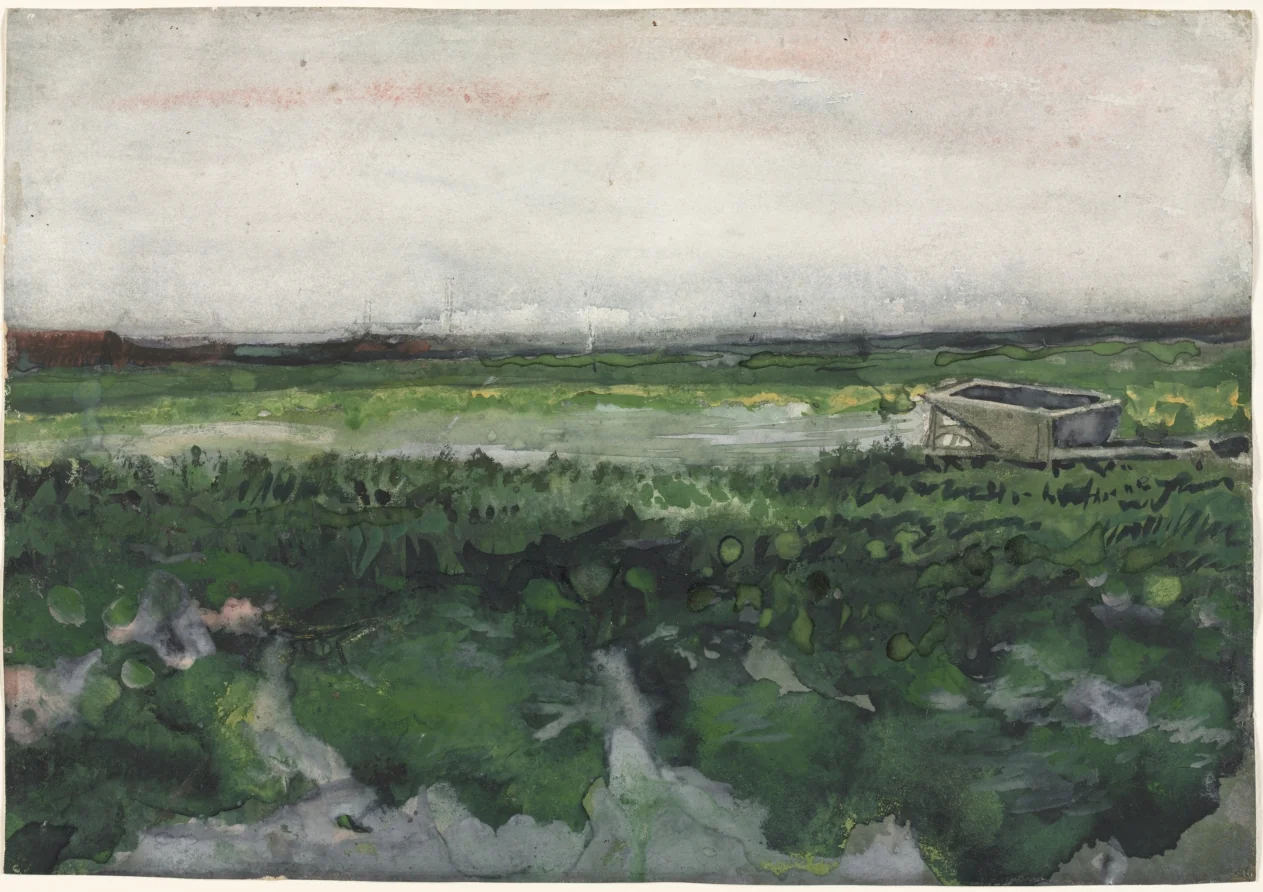
In September 1883 Van Gogh left the bustling Dutch city of The Hague in search of open countryside in which to paint. He moved to Drenthe, a village in northeastern Netherlands that was virtually untouched by the Industrial Revolution. He described the barren terrain as supremely beautiful and serene: "What tranquility, what expanse, what calmness in this nature." With a limited palette of steely greens and cool blues, Van Gogh masterfully portrayed one of the region’s expanses of heath—"a vast plane vanishing into infinity"—illuminated by the lilac hues of the evening sky.
Provenance
Dr. Frans Kantorowicz, Berlin; (Galerie d'Art Lutz, Berlin) (?-?); Erich Schall, Berlin (?-?); (Galerie d'Art Artz et de Bois, La Haye) (?-?); Justin K. Thannhauser, New York (?-?); Leonard C. Hanna, Cleveland, OH, bequeathed to the Cleveland Museum of Art, Cleveland, OH (?-1958); Cleveland Museum of Art, Cleveland, OH (1958-)
Accession Number
1958.30
Medium
watercolor and opaque watercolor with black chalk on cream paper
Dimensions
Sheet: 24.9 x 35.7 cm (9 13/16 x 14 1/16 in.); Framed: 39.8 x 52.4 x 2.6 cm (15 11/16 x 20 5/8 x 1 in.)
Classification
Drawing
Credit Line
Bequest of Leonard C. Hanna Jr.
Tags
Drawing Impressionist & Modern (1851–1900) Watercolor Paper Dutch Color: Green Color: White Color: Black
Background & Context
Background Story
This early watercolor from Van Gogh's Nuenen period (1883-85) shows the artist before his transformation into the colorist we know from the Arles and Saint-Rémy paintings. The palette is subdued — browns, grays, and muted greens — reflecting the somber Dutch landscape tradition and Van Gogh's own declaration that he wanted to paint peasants who smelled of the soil. The wheelbarrow in the field, the low horizons, the heavy skies — all belong to the world of Millet and the Hague School, which Van Gogh was studying intensively at this time.
Cultural Impact
Van Gogh's Dutch period is often dismissed as a prelude to the brilliant colorism that followed, but it contains the seeds of everything he would become. The empathy for rural labor, the willingness to find beauty in unspectacular subjects, the aggressive brushwork (here in watercolor rather than oil) — all are present. Landscape with Wheelbarrow shows an artist learning his craft with a seriousness and intensity that would characterize his entire career.
Why It Matters
This watercolor is Van Gogh before Van Gogh — before the sun of Provence transformed his palette. But the fundamental concerns are identical: the dignity of labor, the beauty of ordinary landscape, and the conviction that art should confront reality directly.