Description
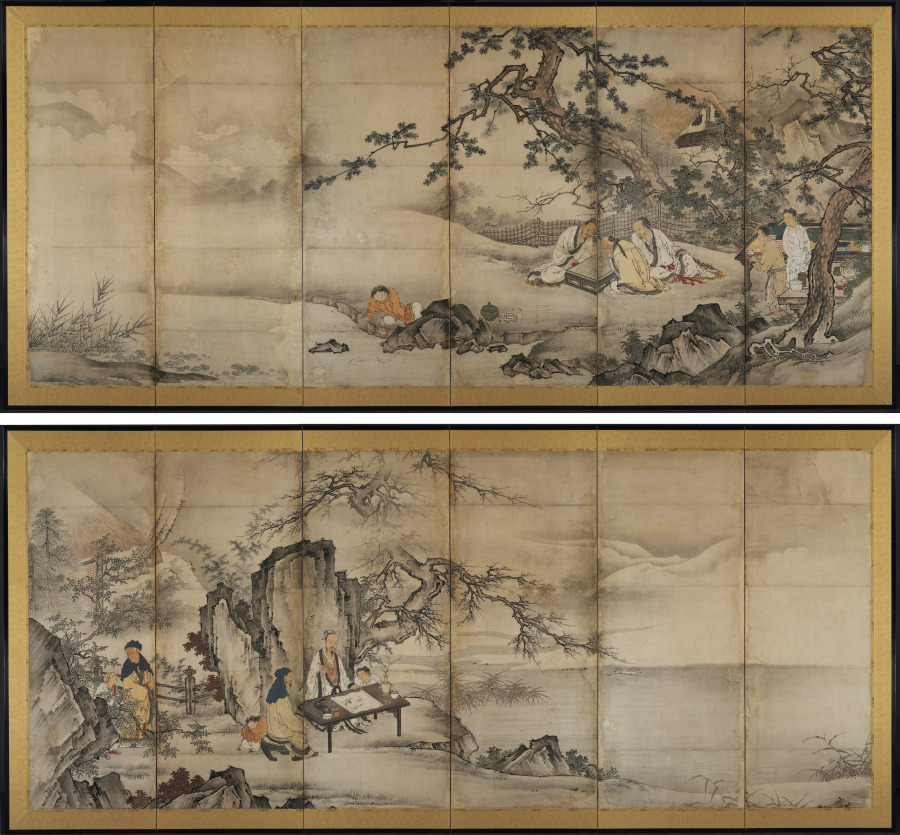
The landscape depicted in this pair of screens follows a seasonal progression from right to left, starting with the blossoming plum of early spring and ending with late autumn peonies. A variety of smaller birds are positioned throughout the scene, and a trio of swimming ducks is bracketed by early summer irises and early autumn bellflowers at the center. While some raptors (birds of prey) terrorize a pheasant and an egret (a waterfowl) to the right, a peacock and peahen converse to the left. Hawks are associated with military prowess, while the peafowl suggest cultural prestige.
Provenance
William G. Mather [1857–1951], Cleveland, OH, given to the Cleveland Museum of Art (?–1948); The Cleveland Museum of Art, Cleveland, OH (1948-)
Accession Number
1948.128.1
Medium
One of a pair of six-panel folding screens; ink, color, and gold on paper
Dimensions
Image: 155.9 x 339.4 cm (61 3/8 x 133 5/8 in.); Overall: 168.5 x 352.2 cm (66 5/16 x 138 11/16 in.); Closed: 172.5 x 61 x 11.3 cm (67 15/16 x 24 x 4 7/16 in.); with frame: 171.7 x 355.4 cm (67 5/8 x 139 15/16 in.)
Classification
Painting
Credit Line
Gift of William G. Mather
Tags
Painting Renaissance (1400–1599) Ink Panel Painting Gold Leaf Paper Japanese Color: Brown Color: Gray
Background & Context
Background Story
Kano Shōei (1519-1592) was a Japanese painter of the Kano school who served as the official painter to the Muromachi shogunate and the founder of the Kano school's Kyoto branch. Birds and Flowers from the late 1500s is a six-panel folding screen depicting the classic Sino-Japanese subject of birds and flowers with the combination of Chinese brush technique and Japanese decorative sensibility that defines the Kano school style. The gold background—a feature of the most formal folding screens—creates a luminous surface that transforms the natural subject into a decorative object of great beauty, while the birds and flowers are rendered with the precise brushwork that distinguishes Kano school painting from the more spontaneous traditions of Japanese art.
Cultural Impact
Shōei's Birds and Flowers screens are important in the history of the Kano school because they demonstrate the style that defined the school's Kyoto branch: Chinese brush technique combined with Japanese decorative sensibility, executed on gold-leaf grounds that transform natural subjects into objects of luxurious beauty. The birds-and-flowers subject is one of the oldest in East Asian painting, and Shōei's treatment combines the brush tradition of Chinese bird-and-flower painting with the decorative elegance of Japanese screen painting.
Why It Matters
Birds and Flowers is Shōei's Kano school style at its most characteristic: Chinese brush technique combined with Japanese decorative sensibility, executed on a gold-leaf ground that transforms a natural subject into an object of luxurious beauty. The six-panel screen format creates a decorative ensemble that is simultaneously a painting and an architectural element of the Japanese interior.