Description
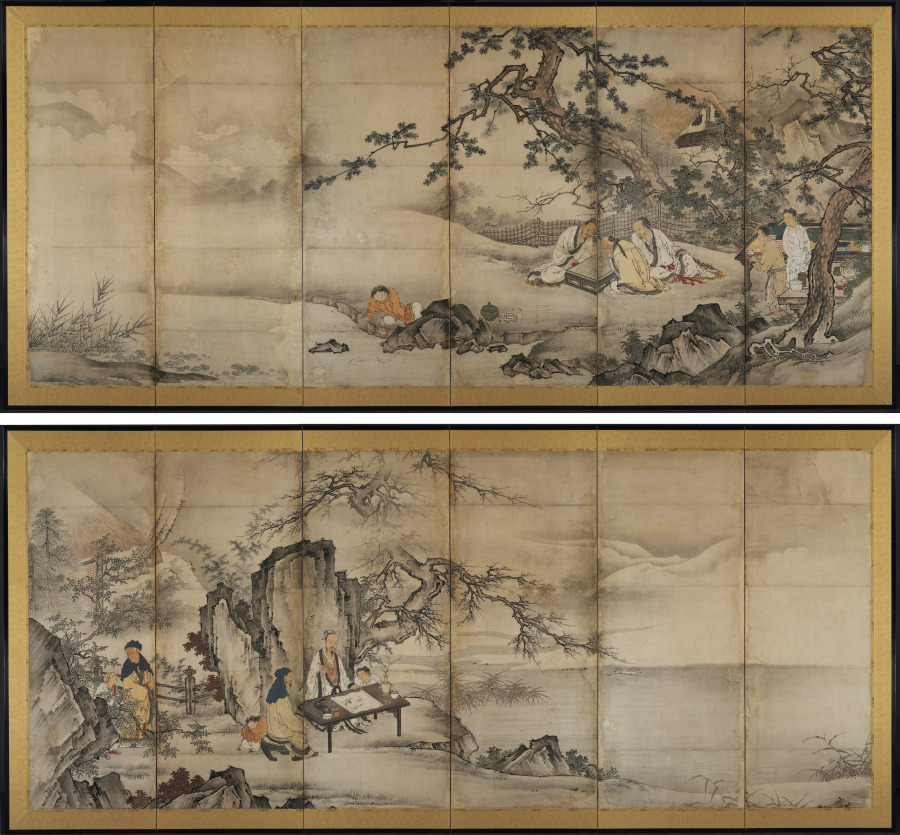
This is one of a pair of screens that shows a group of elite Chinese gentlemen and their servants in the countryside. One man looks on as two of his companions play a board game. Nearby is a table set with a selection of books and a qin, a type of stringed instrument, still wrapped in its cloth case, waiting to be played. The mood is one of enjoyment balanced with formality. Historically, playing the qin or qi (a game similar to chess called go in Japan), and practicing or admiring calligraphy were considered three skills essential for cultured men in China.
Provenance
(Kochukyo Co., Inc., Tokyo, Japan, sold to the Cleveland Museum of Art) (?–1979); The Cleveland Museum of Art, Cleveland, OH (1979–)
Accession Number
1979.46.1
Medium
One of a pair of six-panel folding screens; ink and slight color on paper
Dimensions
Painting: 153 x 358.6 cm (60 1/4 x 141 3/16 in.); Mounted: 174 x 378.5 cm (68 1/2 x 149 in.)
Classification
Painting
Credit Line
John L. Severance Fund
Tags
Painting Renaissance (1400–1599) Ink Panel Painting Paper Japanese Color: Brown Color: Gray
Background & Context
Background Story
The Four Accomplishments from the late 1500s to early 1600s depicts the four traditional accomplishments of the Chinese gentleman-scholar: qin (music), qi (go/chess), shu (calligraphy), and hua (painting). Shōei's treatment renders the four accomplishments on a six-panel folding screen in ink and slight color—the most restrained format in the Kano school repertoire, appropriate for a subject that celebrates the intellectual rather than the decorative arts. The ink and slight color format allows Shōei to emphasize the brushwork that is itself one of the four accomplishments—creating a self-reflexive relationship between the subject (painting as one of the four accomplishments) and the medium (brushwork as the essence of painting).
Cultural Impact
The Four Accomplishments subject is one of the oldest in East Asian painting, and Shōei's treatment demonstrates the Kano school's ability to combine Chinese subjects with Japanese decorative formats. The ink and slight color format is the most restrained in the Kano repertoire, appropriate for a subject that celebrates intellectual accomplishment rather than decorative display. The self-reflexive relationship between the subject (painting as accomplishment) and the medium (brushwork as essence) makes this one of the most conceptually sophisticated works in the Kano school tradition.
Why It Matters
The Four Accomplishments is Shōei's most conceptually sophisticated work: the four traditional arts of the Chinese gentleman rendered in the most restrained format of the Kano school repertoire—ink and slight color on paper. The screen creates a self-reflexive relationship between subject and medium: painting as one of the four accomplishments, and brushwork as the essence of painting.