Description
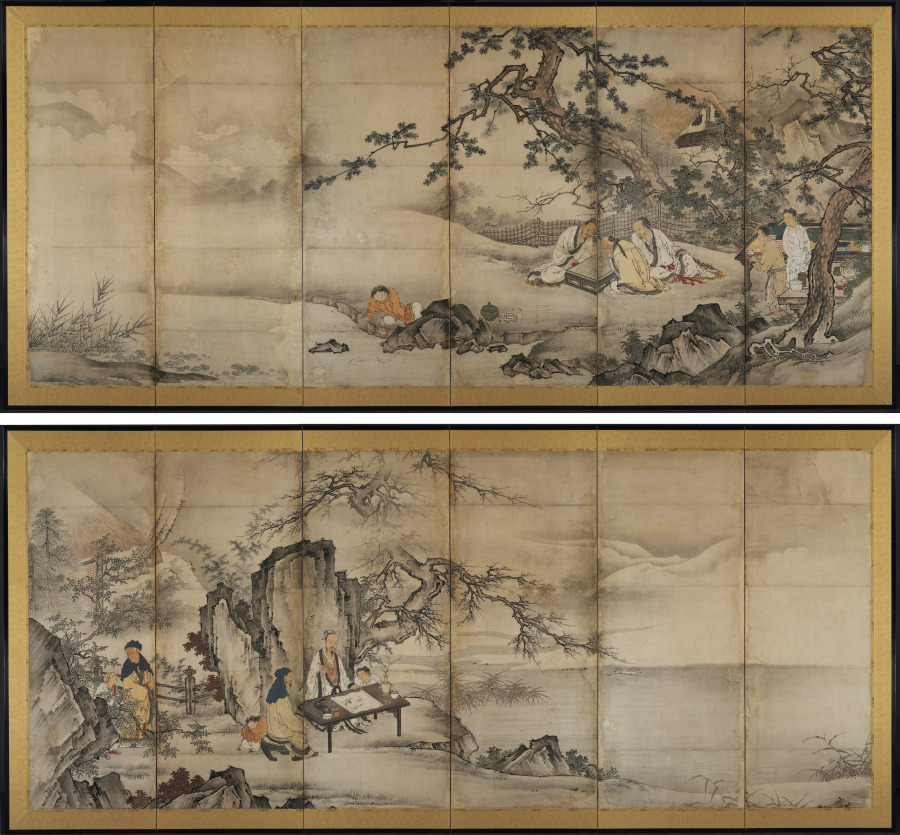
This is one of a pair of screens showing a group of elite Chinese gentlemen and their servants in the countryside. One man is considering his painting-in-progress. Historically, practicing or admiring painting was considered a skill essential for cultured men in China.
Provenance
(Kochukyo Co., Inc., Tokyo, Japan, sold to the Cleveland Museum of Art) (?–1979); The Cleveland Museum of Art, Cleveland, OH (1979–)
Accession Number
1979.46.2
Medium
One of a pair of six-panel folding screens; ink and slight color on paper
Dimensions
Painting: 153 x 358.6 cm (60 1/4 x 141 3/16 in.); Mounted: 174 x 378.5 cm (68 1/2 x 149 in.)
Classification
Painting
Credit Line
John L. Severance Fund
Tags
Painting Renaissance (1400–1599) Ink Panel Painting Paper Japanese Color: Brown Color: Gray
Background & Context
Background Story
This second screen of The Four Accomplishments pair from the late 1500s to early 1600s depicts the remaining accomplishments of the Chinese gentleman-scholar tradition. As the companion to the first screen, it forms a pair that would have been displayed together in a Japanese reception room, creating a full ensemble of scholarly accomplishment across twelve panels. The ink and slight color format maintains the restrained elegance of the Kano school's most formal tradition, and the brushwork demonstrates the calligraphic skill that was itself one of the four accomplishments being depicted.
Cultural Impact
The paired screens of The Four Accomplishments are among the most important works in the Kano school tradition because they demonstrate how Chinese subjects were adapted to Japanese decorative formats. The pair of six-panel screens creates an ensemble of twelve panels that could fill an entire wall of a Japanese reception room, transforming the Chinese scholarly ideal into a Japanese decorative ensemble that celebrates intellectual accomplishment through the very medium (brushwork) being depicted.
Why It Matters
The Four Accomplishments (companion screen) completes the pair that transforms the Chinese scholarly ideal into a Japanese decorative ensemble. The twelve panels of two six-panel screens fill an entire wall of a Japanese reception room, celebrating intellectual accomplishment through the very medium—brushwork—that the subject celebrates. The ink and slight color format maintains the restrained elegance appropriate to scholarly subjects.