Description
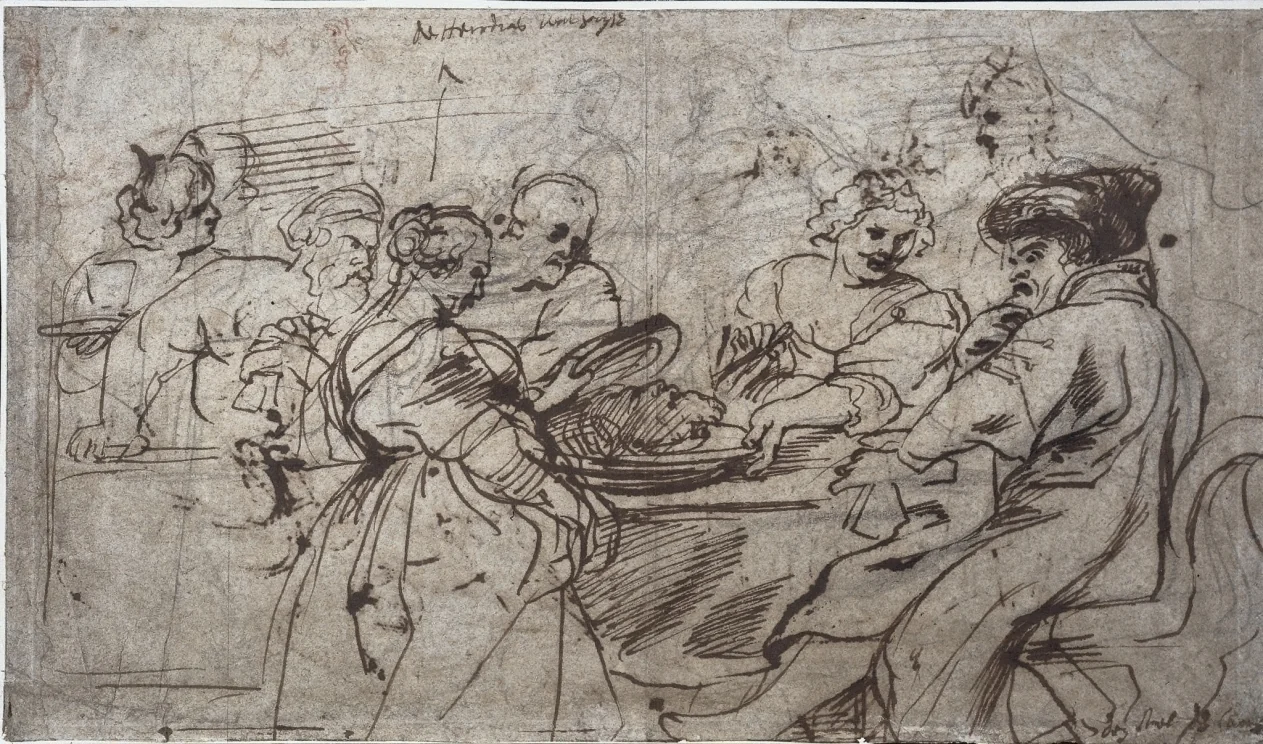
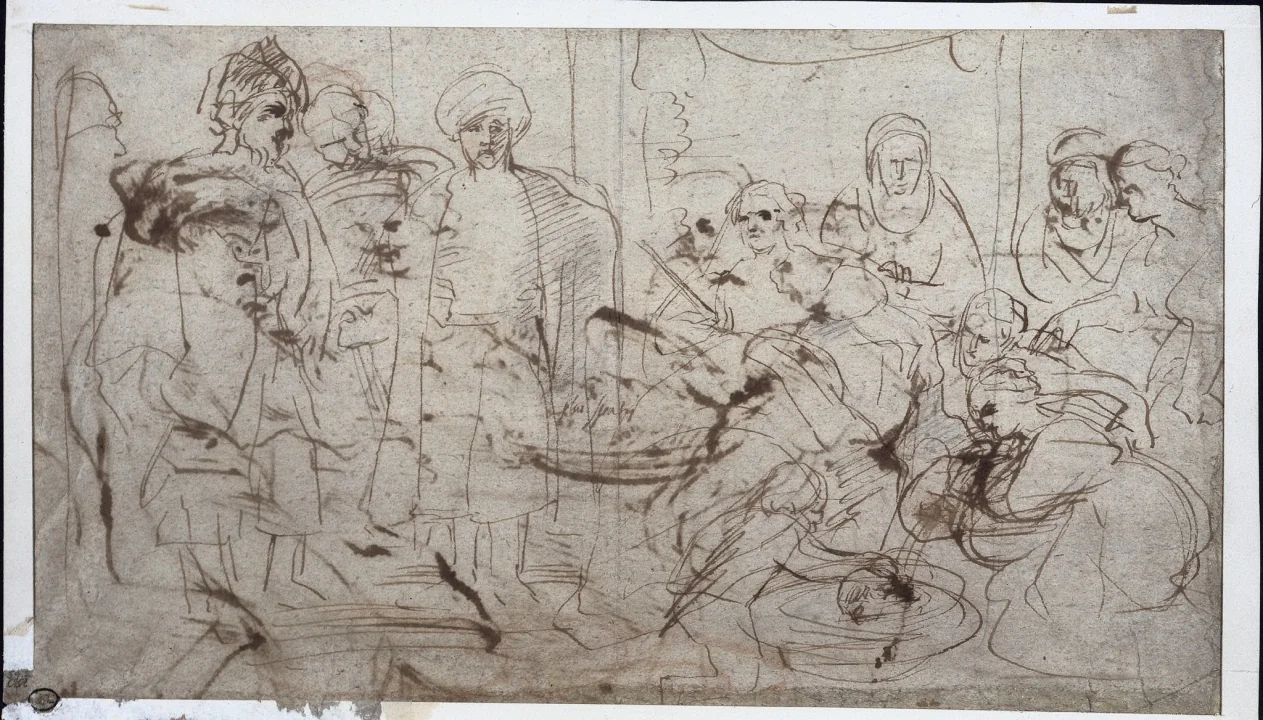
Peter Paul Rubens had a large studio in Antwerp and used drawing to prepare for large paintings as well as to direct the many pupils who assisted him. Striking in its immediacy, the drawing on the recto of this sheet of paper is a preparatory study for the Feast of Herod painting now at the Scottish National Gallery in Edinburgh. Herod, wearing a large cap and wrapped in a mantle, shrinks back in horror as Salome uncovers a charger that holds the head of Saint John the Baptist. Smiling, Herodias grabs the platter with her left hand and, in a chilling detail, gestures toward the charger with a fork. Rubens wrote what is usually interpreted as “Herodias somewhat higher” at the top of the sheet. The verso of the sheet depicts a sketch for another story featuring a change of fortune at the hands of a vengeful woman, Tomyris with the Head of Cyrus. Rubens made two paintings of the subject (now in Paris and Boston). A rare theme, the story tells of Queen Tomyris who, avenging the death of her son in battle, collects the head of his murderer Cyrus in a bag of human blood. Tomyris is shown seated under a canopy holding a scepter, while the servants before her handle Cyrus’s head. Rubens wrote “plus spatij” (more space) in the center of the sheet.
Provenance
Unidentified collector (Lugt 622, verso, lower right, in black ink, probably Austrian collection c. 1800); English private collection (According to Burchard and d'Hulst, Antwerp, 1956); [Herbert N. Bier]. Purchased by the Cleveland Museum of Art in 1954.
Accession Number
1954.2.b
Medium
pen and brown ink, with black and red chalk
Dimensions
Sheet: 27.2 x 47.2 cm (10 11/16 x 18 9/16 in.); Secondary Support: 27.6 x 47.3 cm (10 7/8 x 18 5/8 in.)
Classification
Drawing
Credit Line
Delia E. Holden and L. E. Holden Funds
Tags
Drawing Baroque (1600–1750) Ink Flemish Color: White Color: Gray
Background & Context
Background Story
Peter Paul Rubens (1577-1640) was a Flemish painter known for the dynamic, muscular manner that makes him the most accomplished painter of the Baroque tradition in Northern Europe. Tomyris with the Head of Cyrus from c. 1637-38 depicts the legendary episode in which the Massagetae queen Tomyris plunges the head of the Persian king Cyrus into a vessel of blood in the dynamic, muscular manner that distinguishes Rubens's best history paintings. The c. 1637-38 date places this in Rubens's late period, when he was producing some of his most dynamic history paintings in the energetic manner that defines the Baroque tradition.
Cultural Impact
Tomyris with the Head of Cyrus is important in Rubens's late oeuvre because it demonstrates the dynamic, energetic manner that he brought to history painting in his final years. The subject—the Massagetae queen taking revenge on the Persian king who killed her son—allowed Rubens to exercise his talent for depicting powerful emotions in the dynamic, muscular manner that defines his best history paintings, and the c. 1637-38 painting shows Rubens at his most energetic.
Why It Matters
Tomyris with the Head of Cyrus is Rubens at his most dynamic: the legendary queen taking revenge on the Persian king rendered in the energetic, muscular manner that defines his best history paintings. The c. 1637-38 painting shows Rubens in his final years, producing history paintings of extraordinary energy and dramatic power.